
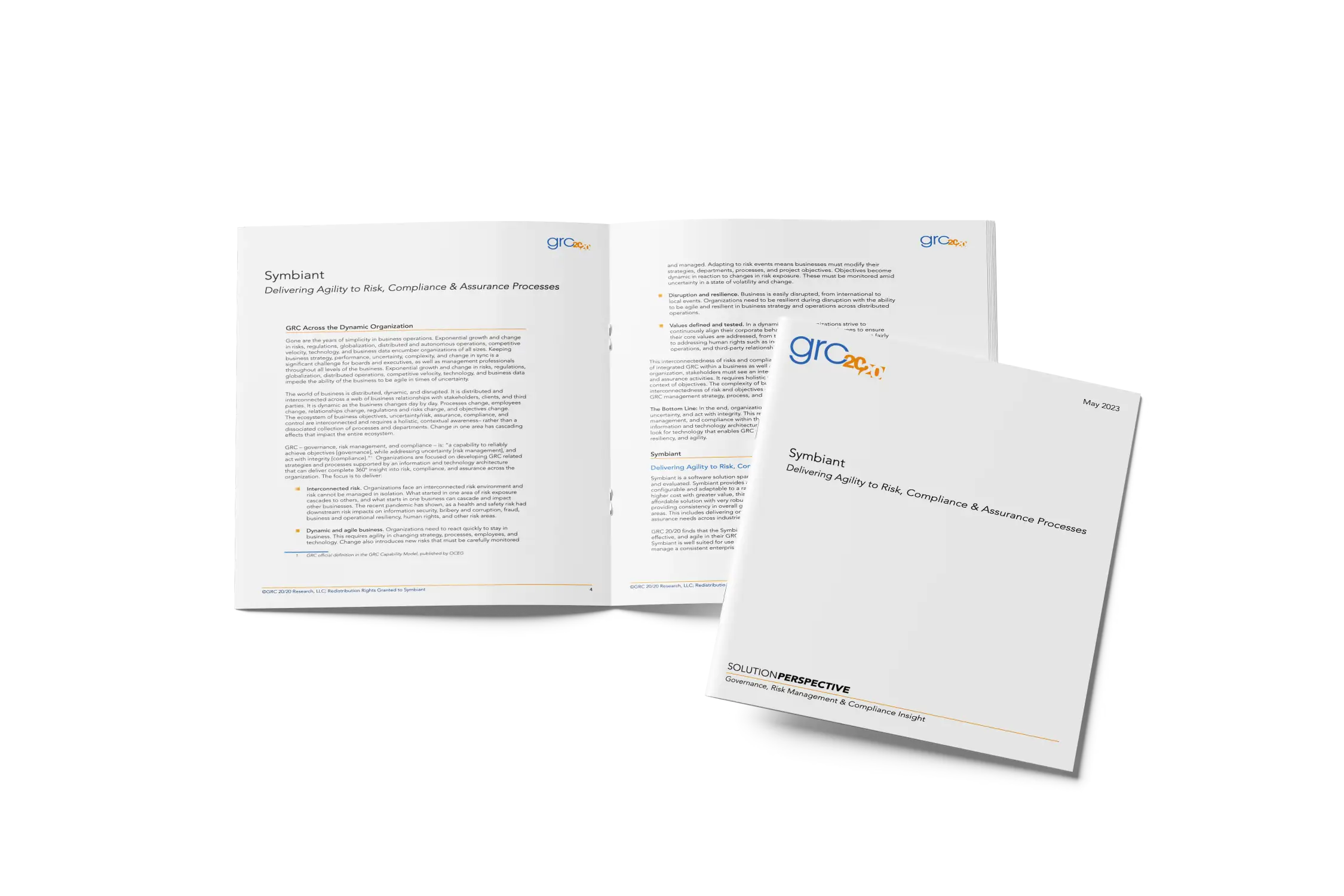
The complete guide to compliance risk management
Compliance
Take control of your compliance and risk processes
Move beyond spreadsheets and disconnected systems with a flexible platform that centralises your data, tracks actions, and gives you clear visibility across your organisation.
Compliance risk is an ever-present challenge for organisations operating in increasingly complex regulatory environments.
As regulations evolve across jurisdictions and industries, organisations must continuously adapt to new requirements while maintaining control over their internal processes. Failing to do so can result in financial penalties, operational disruption, legal exposure, and long-term reputational damage.
But the challenge is not just the volume of regulation, it’s the difficulty of managing it in a structured, consistent, and scalable way.
In this guide, we explore what compliance risk management is, why it matters, and how organisations can take a more structured and connected approach
What is compliance risk management?
Risk management is the process of identifying, assessing, and mitigating potential risks that could impact an organisation.
Compliance risk management focuses specifically on the risk of failing to meet regulatory or policy requirements.
In practice, this involves:
- Identifying the regulations and standards that apply to your organisation
- Assessing where gaps or weaknesses exist
- Implementing controls and processes to address those gaps
- Monitoring activities and tracking actions to ensure issues are resolved
Rather than being a one-off exercise, compliance risk management is an ongoing process that requires continuous oversight and coordination across teams.
Why is compliance risk management important?
Failing to manage compliance risk can have serious consequences.
These may include:
- Regulatory penalties and fines
- Operational disruption where certain activities cannot be performed
- Restricted access to markets or customers
- Loss of trust from regulators, clients, and stakeholders
However, compliance risk management is not only about avoiding negative outcomes.
When managed effectively, it helps organisations:
- Improve visibility across compliance and risk activities
- Strengthen internal controls and processes
- Support better decision-making
- Build a more resilient and accountable operating model
Compliance risk management best practices
1. Understand your regulatory obligations
Every organisation operates within a specific regulatory environment. This may include financial regulations, data protection laws, or industry standards.
A clear understanding of applicable requirements is essential for identifying compliance risks and prioritising efforts.
2. Take a proactive approach
Reactive compliance often leads to inefficiencies and increased risk.
A more effective approach is to identify potential gaps early and address them before they become issues. This requires ongoing monitoring, rather than relying solely on periodic reviews or audits.
3. Connect compliance and risk management
Compliance should not operate in isolation.
By linking compliance activities with broader risk management processes, organisations can gain a more complete view of their exposure and prioritise actions more effectively.
4. Improve visibility across the organisation
One of the biggest challenges in compliance risk management is limited visibility—especially when data is spread across spreadsheets, emails, and disconnected systems.
Centralising information and providing clear oversight enables organisations to identify issues more quickly and respond more effectively.
5. Track actions and accountability
Identifying risks and compliance gaps is only part of the process.
Organisations need a structured way to assign, track, and complete actions to ensure issues are resolved and do not reoccur.
6. Align processes across teams
Compliance risk often spans multiple departments.
Ensuring consistent processes and collaboration across teams helps reduce duplication, improve efficiency, and strengthen overall control.
7. Use technology to support consistency and oversight
Technology can play a key role in supporting compliance risk management by:
Centralising compliance and risk data
Supporting structured workflows
Tracking actions and responsibilities
Providing reporting and oversight
This enables organisations to move away from manual processes and towards a more consistent and controlled approach.
A more connected approach to compliance risk management
Managing compliance risk effectively requires more than isolated tools or one-off processes.
With Symbiant, organisations can take a more connected approach—bringing together compliance activities, risk management, and action tracking within a single, consistent framework.
This helps teams:
- Maintain clear visibility across compliance and risk activities
- Track and manage actions in one place
- Improve accountability across the organisation
- Support a more structured and sustainable approach to GRC
Compliance Risk Management vs Risk Management
Compliance risk management and risk management are closely related, but they differ in scope, focus, and how they are applied across the organisation.
Compliance risk management focuses specifically on the risk of failing to meet regulatory obligations, industry standards, or internal policies. It ensures that the organisation operates within defined rules and can demonstrate adherence when required.
This is essential, as compliance failures can result in financial penalties, legal action, and reputational damage. As such, compliance risk management is primarily concerned with maintaining control, accountability, and auditability.
Risk management, on the other hand, takes a broader, enterprise-wide view. It encompasses all types of risk that could impact the organisation’s ability to achieve its objectives, including strategic, operational, financial, and compliance risks.
Rather than focusing solely on adherence, risk management supports better decision-making by helping organisations understand uncertainty, prioritise actions, and balance risk with opportunity.
How they work together
Compliance risk management should not sit in isolation.
In practice, it is a critical component of a wider risk management framework. When connected effectively, organisations gain a more complete view of their exposure—linking regulatory obligations to broader business risks, controls, and actions.
This integrated approach enables:
- Better visibility across all risk and compliance activities
- More consistent processes and accountability
- Improved prioritisation of actions and resources
- Stronger alignment between regulatory requirements and business objectives
A connected approach with Symbiant
Symbiant’s highly agile, award-winning GRC and Audit Management Software supports this alignment by bringing compliance and risk management together within a single, structured framework.
By connecting obligations, risks, controls, and actions, organisations can move beyond siloed processes and gain a clearer, more actionable view of their overall risk landscape.
Take control of your compliance and risk processes
Move beyond spreadsheets and disconnected systems with a flexible platform that centralises your data, tracks actions, and gives you clear visibility across your organisation.