
Meet regulatory requirements with ISO 22301.
ISO 22301: The Complete Guide to Business Continuity Compliance
Achieving ISO 22301 compliance means your organisation has a tested and reliable Business Continuity Management System (BCMS) in place, ensuring resilience against cyberattacks, natural disasters, and supply chain failures while maintaining regulatory compliance, safeguarding stakeholders, and proving reliability to clients and auditors.
From only £100 per module/month for unlimited users*
Take control of your compliance and risk processes
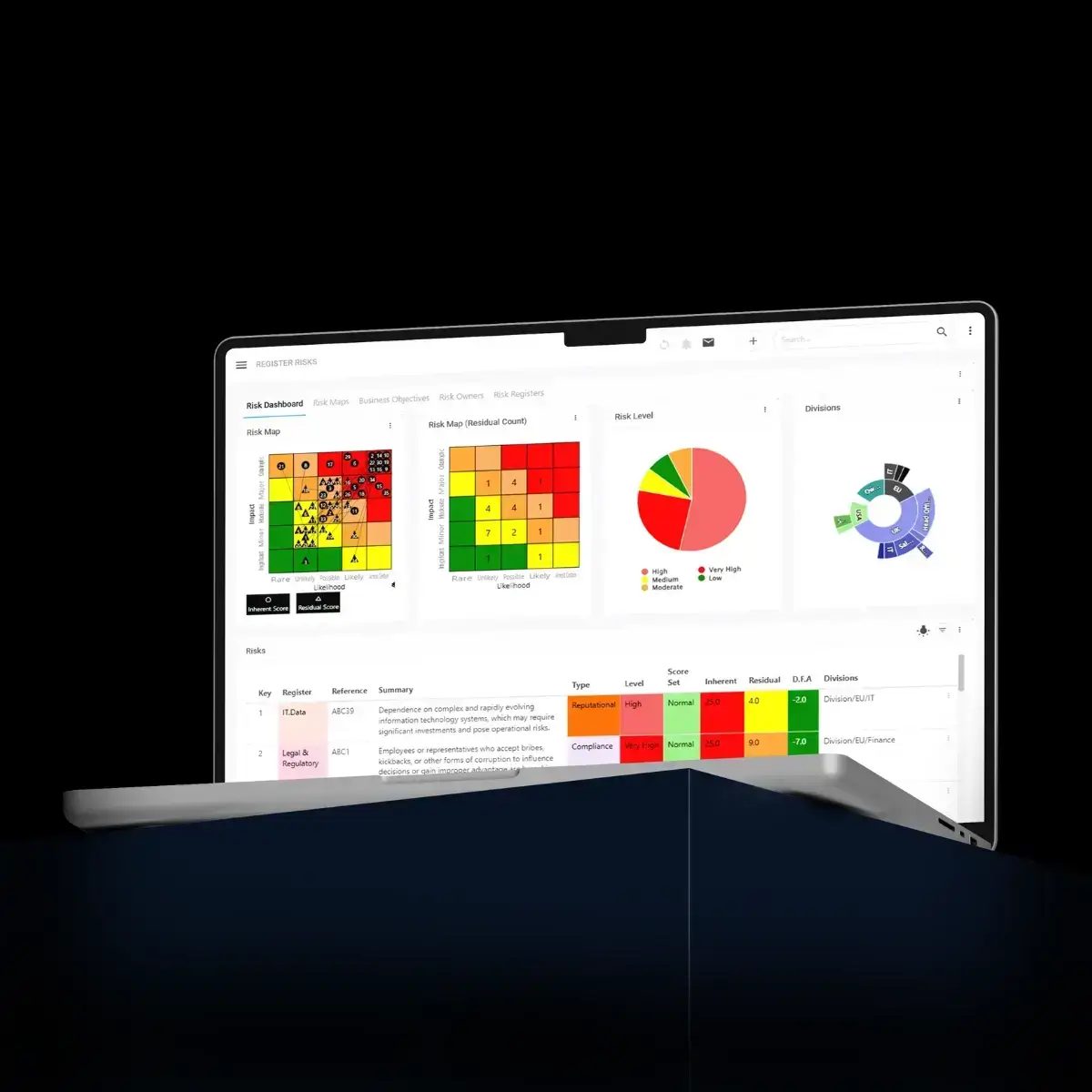
Move beyond spreadsheets and disconnected systems with a flexible platform that centralises your data, tracks actions, and gives you clear visibility across your organisation.
What is ISO 22301?
ISO 22301 is the international standard for Business Continuity Management Systems (BCMS). It provides a best-practice framework that helps organisations identify potential threats, prepare continuity plans, and ensure critical services continue during and after disruptions.
The standard applies to organisations of all sizes and industries, from finance and healthcare to government and manufacturing, and is recognised globally as the benchmark for Business Continuity Management Systems (BCMS)
Why ISO 22301 Compliance Is Essential for Business Continuity and Resilience
In today’s unpredictable world, organisations face constant threats ranging from cyberattacks, data breaches, and supply chain disruptions to pandemics and natural disasters. These risks make it essential to have a structured continuity framework in place.
ISO 22301 compliance demonstrates that your organisation is prepared for disruptions with documented and tested continuity plans, resilient and reliable in maintaining critical functions, and fully aligned with the expectations of regulators, auditors, and industry standards. Most importantly, it proves to customers, partners, and investors that your business can withstand crises, safeguard trust, and ensure long-term operational resilience.
Key Requirements of ISO 22301 for Business Continuity Management Systems (BCMS)
To comply with ISO 22301, organisations must establish, implement, and maintain a comprehensive Business Continuity Management System (BCMS). This begins with conducting a Business Impact Analysis (BIA) to identify critical processes, assets, and dependencies that must be prioritised in the event of disruption. Alongside this, a thorough risk assessment must be carried out to evaluate threats such as cyberattacks, natural disasters, equipment failures, and supply chain interruptions.
ISO 22301 also requires organisations to develop structured continuity plans that outline strategies for recovering and maintaining essential services, while assigning clear roles and responsibilities across leadership and operational teams. Regular testing and exercising of continuity plans is essential to ensure they remain effective, while ongoing monitoring and reviewing allows organisations to adapt their strategies as new risks emerge. Finally, maintaining audit trails and documentation is a critical requirement, providing evidence of compliance for regulators, auditors, and stakeholders.
Benefits of ISO 22301 Compliance
Implementing ISO 22301 delivers both regulatory and business advantages. At its core, the standard enhances operational resilience, helping organisations reduce downtime, recover faster, and protect revenue streams when disruptions occur. It also supports reputation management, demonstrating preparedness and reliability to customers, partners, and investors.
From a compliance perspective, ISO 22301 ensures alignment with regulatory requirements from bodies such as the ICO, FCA, and industry-specific authorities, reducing the risk of penalties. For many businesses, certification also provides a competitive advantage, as ISO 22301 is often a prerequisite for securing contracts, particularly in finance, healthcare, and government. Beyond compliance and credibility, organisations can achieve significant cost savings by avoiding the extended outages, financial losses, and operational inefficiencies caused by poorly managed disruptions.
ISO 22301 and Business Continuity Planning (BCP)
While ISO 22301 sets the standard for business continuity, the Business Continuity Plan (BCP) is the practical tool used to recover from disruption. A BCP provides step-by-step instructions for restoring operations, covering everything from IT systems and communications to supply chain management and stakeholder engagement. ISO 22301 ensures that this plan is created, tested, and continuously improved within a structured, organisation-wide framework. In short, ISO 22301 is the framework, while the BCP is the plan. Together, they form a complete approach to operational resilience: the standard defines how continuity should be managed, and the plan defines the actions to take when disruption occurs.
ISO 22301 vs Other Standards
It is important to understand how ISO 22301 compares to other management standards. ISO 22301 focuses specifically on ensuring continuity of operations, whereas ISO 27001 addresses information security management. Many organisations choose to implement both standards together, creating a stronger overall framework for governance, risk, and resilience. This integrated approach not only enhances compliance but also provides broader protection against both operational and cybersecurity threats.
In short, ISO 22301 is the framework, while the BCP is the plan. Together, they form a complete approach to operational resilience: the standard defines how continuity should be managed, and the plan defines the actions to take when disruption occurs.
How Software Supports ISO 22301 Compliance
Meeting ISO 22301 requirements can be difficult if continuity planning relies on manual processes or spreadsheets. Modern business continuity software simplifies compliance by centralising frameworks into one platform, making continuity strategies easier to manage and update. Software also helps by automating reminders, reviews, and action tracking, ensuring tasks are completed on time and plans remain active rather than static.
Advanced continuity solutions go further by linking continuity plans with risk registers, controls, and recovery actions, creating a fully integrated resilience framework. Organisations can maintain full audit trails that show exactly who made changes and when, making audits defensible and transparent. Automated reporting tools also allow compliance evidence to be generated for regulators and auditors in just a few clicks.
Ultimately, business continuity software doesn’t just support ISO 22301 compliance, it transforms continuity plans into dynamic, practical frameworks that strengthen resilience, improve recovery times, and ensure organisations are always prepared for disruption.
How Symbiant Supports ISO 22301 Implementation
Implementing ISO 22301 Business Continuity Management Systems (BCMS) can be complex with spreadsheets or manual processes. Symbiant makes it simple. Our Business Continuity Planning (BCP) Module allows you to establish, document, manage, and test your continuity framework with ease. Symbiant Incident Reporting ensures disruptions are logged in real time, while full audit trails show who made changes and when. At just £100 per module, per month*, compliance with ISO 22301 becomes cost-effective and defensible.
Always Ready, Always Resilient
Symbiant provides a central hub for business continuity and resilience planning. From critical resource assessment to incident response and recovery, the platform ensures your organisation is always prepared for disruption.
Build, test, and manage continuity plans across all departments.
Coordinate crisis response with clear ownership and accountability.
Strengthen resilience while meeting ISO 22301 and regulatory requirements.
Reduce disruption, protect reputation, and safeguard compliance.
Plan Continuity with Confidence
Create tailored business continuity plans for every critical function. Assign owners, map recovery steps, and ensure your team knows exactly what to do when disruption strikes.
Scenario Testing & Simulation – run event scenarios, test recovery strategies, and identify unknown risks.
Delegated Action Plans – assign tasks with clear deadlines and automated reminders.
Comprehensive Resource Management – capture every key data point, from dependencies to impact levels.
AI-Enhanced Business Continuity Management
Symbiant’s optional AI Assistant helps you plan smarter and respond faster. It supports your continuity framework by:
Creating probable event scenarios.
Identifying affected business areas and functions.
Suggesting root causes and potential mitigations.
Highlighting impacts on customer journeys.
Automating recovery steps for faster response.
AI-supported, human-controlled: you stay in charge, while AI saves up to 90% of the time spent on manual admin tasks.
Fully Customisable for Every Organisation
Every organisation faces unique risks. Symbiant’s BCP Module is fully configurable to your needs:
Custom impact levels and scoring for precision analysis.
Configurable departmental structures for accurate coverage.
Flexible workflows and layouts tailored to your processes.
Seamlessly Linked with Your GRC Ecosystem
Unlike standalone continuity tools, Symbiant connects your continuity planning directly to your wider risk and compliance framework.
Link to Risk Registers – identify resource failure points and align them with risks.
Integrate with Controls & Policies – test controls, validate mitigations, and improve resilience.
Action Tracking – ensure continuity plans are executed with accountability and oversight.
Key Benefits of Symbiant Business Continuity Planning Software
Achieve and maintain ISO 22301 compliance.
Protect critical business functions with tested continuity plans.
Gain full audit-ready documentation and defensibility.
Reduce disruption and speed up recovery.
Strengthen resilience across your organisation.
Affordable pricing at £100 per module/month with unlimited users*.
Build a Solution Around Your Standards, Not the Other Way Around
Symbiant’s agile, modular platform is designed to align with industry standards and adapt to your organisation’s unique requirements. Whether you’re working towards ISO accreditation, regulatory compliance, or a specialised framework, our flexible approach helps you create a solution that fits your needs today and evolves with you tomorrow. If an existing module doesn’t fully support your requirements, we can tailor a module or build a bespoke solution designed around your exact processes and standards.
Ready to create a platform tailored to your requirements?

Pricing Disclaimer
* Modules are charged at a standard monthly fee, not on a per-user basis. All users can access each module at any required level. Please note that costs exclude VAT, AI features, and additional modules you may wish to use. User seats are required.