ISO 27001 is widely recognised as the global standard for information security management. Yet for many organisations, achieving and maintaining certification can feel unnecessarily complex, driven by spreadsheets, disconnected tools, and manual processes that make audits stressful and time-consuming.
The reality is this: ISO 27001 doesn’t have to be bureaucratic. With the right structure and software in place, managing your Information Security Management System (ISMS) becomes clear, auditable, and far easier to sustain over time.
In this article, we explore what ISO 27001 really requires, where organisations commonly struggle, and how Symbiant supports ISO 27001 compliance end-to-end, backed by a real client case study.
ISO/IEC 27001: The Foundations of Information Security Governance
ISO/IEC 27001 is the leading international standard for information security management and the globally recognised benchmark for establishing an effective Information Security Management System (ISMS). Developed by the International Organization for Standardization (ISO) and the International Electrotechnical Commission (IEC), ISO/IEC 27001 provides a structured, risk-based framework for establishing, implementing, maintaining, and continually improving information security controls.
The standard is designed to help organisations of all sizes protect the confidentiality, integrity, and availability of information assets, whether data is held on-premises, in the cloud, or across complex, distributed networks. This makes ISO 27001 particularly relevant in today’s environment of increasing cyber threats, regulatory scrutiny, and third-party risk.
First published in 2005, ISO/IEC 27001 has evolved to reflect changing technologies and threat landscapes. The most recent revision, ISO/IEC 27001:2022, introduced a streamlined control structure and a stronger emphasis on aligning information security with organisational context, stakeholder expectations, and business objectives. Rather than enforcing a rigid checklist, the updated standard encourages organisations to tailor their ISMS based on real risk exposure.
This evolution reflects a broader shift in how information security is viewed:
from a technical or IT-led function to a core element of enterprise-wide governance, risk, and compliance (GRC).
ISO 27001 certification offers far more than a compliance badge. It provides independent validation that your organisation has implemented a structured, auditable approach to managing information security risk. Key benefits include:
- Improved information security risk posture through structured identification, treatment, and ongoing monitoring
- Increased trust and credibility with customers, regulators, and partners
- Stronger internal governance by embedding security into policies, processes, and organisational culture
- Greater resilience against data breaches, cyber incidents, and operational disruption
For organisations operating in sectors such as financial services, healthcare, education, government, and critical infrastructure, ISO/IEC 27001 is often a strategic requirement rather than an optional certification, supporting regulatory compliance, procurement requirements, and long-term operational resilience.
ISMS: The Heart of the ISO 27001 Framework
An Information Security Management System (ISMS) is the operational foundation of ISO/IEC 27001 compliance. It provides the structured framework through which organisations define, implement, operate, monitor, and continually improve their information security practices.
An ISMS encompasses policies, processes, roles, responsibilities, controls, and documented records that collectively enable the effective management of information security risks across the organisation.
At its core, an ISMS is designed to:
- Protect sensitive and business-critical information from unauthorised access, alteration, loss, or disclosure
- Ensure alignment with legal, regulatory, and contractual information security requirements
- Support continual improvement through a structured lifecycle of planning, implementation, monitoring, and review
- An effective ISMS is not static. It evolves in line with organisational objectives, changes in the threat landscape, regulatory expectations, and advances in technology — making adaptability a key requirement of ISO 27001.
How ISO 27001 Structures the ISMS
ISO/IEC 27001 is built around the Plan-Do-Check-Act (PDCA) cycle, providing a systematic approach to managing information security in a controlled and repeatable way. The standard is structured around 10 main clauses, supported by Annex A, which contains the reference set of information security controls.
Key ISMS components required by ISO 27001 include:
- Leadership and information security governance
- Senior management commitment, defined responsibilities, and clear accountability for information security across the organisation
- Information security risk management methodology
- A documented, repeatable process for identifying, analysing, evaluating, and treating information security risks
- Information security objectives and performance metrics
- Measurable objectives aligned with business strategy, supported by monitoring and reporting mechanisms
- Documented procedures, records, and evidence
- Controlled documentation demonstrating how controls are implemented, reviewed, and improved over time
Together, these elements ensure that information security is embedded into organisational governance, rather than treated as a standalone IT function.
Adapting ISO 27001 to Real-World Organisational Contexts
ISO/IEC 27001 is intentionally designed to be adaptable. While it provides a common structure for managing information security, how that structure is applied depends entirely on the organisation’s operating environment — including regulatory pressure, scale, geographic footprint, and risk appetite.
This flexibility is what makes ISO 27001 effective across vastly different sectors, but it also means that successful implementation requires thoughtful interpretation rather than a template-driven approach.
Regulated Sectors: Using ISO 27001 as a Compliance Anchor
In heavily regulated industries such as financial services, healthcare, education, and the public sector, ISO 27001 often acts as the central organising framework for information security and compliance activities.
These organisations rarely operate under a single regulation. Instead, they must align information security with multiple obligations — ranging from financial regulators and sector-specific standards to data protection laws and contractual requirements.
Rather than managing each framework in isolation, many organisations use ISO 27001 as the common baseline, mapping information security controls and risk processes to other standards and regulatory expectations. This approach:
- Reduces duplication of assessments and documentation
- Improves consistency across audits and regulatory reviews
- Creates clearer accountability for risk and control ownership
- Strengthens governance by linking security activities back to business objectives
When implemented this way, ISO 27001 supports a joined-up compliance model rather than adding another layer of administration.
What ISO 27001 Actually Requires (Beyond the Standard Text)
At its core, ISO 27001 is about protecting information in a structured, risk-based way. Certification bodies aren’t just looking for policies, they want evidence that information security is:
- Risk-driven and aligned to business objectives
- Actively managed through controls
- Reviewed, tested, and improved over time
- Fully auditable with clear ownership and traceability
To demonstrate this, organisations typically need to manage:
- ISMS risk identification and scoring
- Control selection and effectiveness testing
- A maintained Statement of Applicability (SoA)
- Internal and external audits
- Supporting documentation and records
- Actions, reviews, and continual improvement
Where many teams struggle is maintaining consistency and traceability across all of these areas — especially when data lives across spreadsheets, shared drives, and disconnected tools.
Common ISO 27001 Challenges (And Why Spreadsheets Fall Short)
Even well-run organisations encounter the same pain points when managing ISO 27001 manually:
- Risk registers that quickly become outdated
- Controls tracked separately from risks
- Manual SoA updates that are difficult to evidence
- Audit findings stored outside the ISMS
- Limited visibility for management
- Stressful certification and surveillance audits
Over time, this creates an ISMS that is hard to maintain, hard to evidence, and hard to scale.
How Symbiant Supports ISO 27001 Practically and Holistically
Symbiant’s highly agile, fully customisable and flexible Governance, Risk Management and Compliance (GRC) software to supports ISO 27001 as an integrated management system, not a compliance checklist. Its modular structure allows organisations to build an ISMS that fits their size, budget, risk profile, and maturity, while keeping everything connected.
1. ISMS Risk Management with Full Traceability
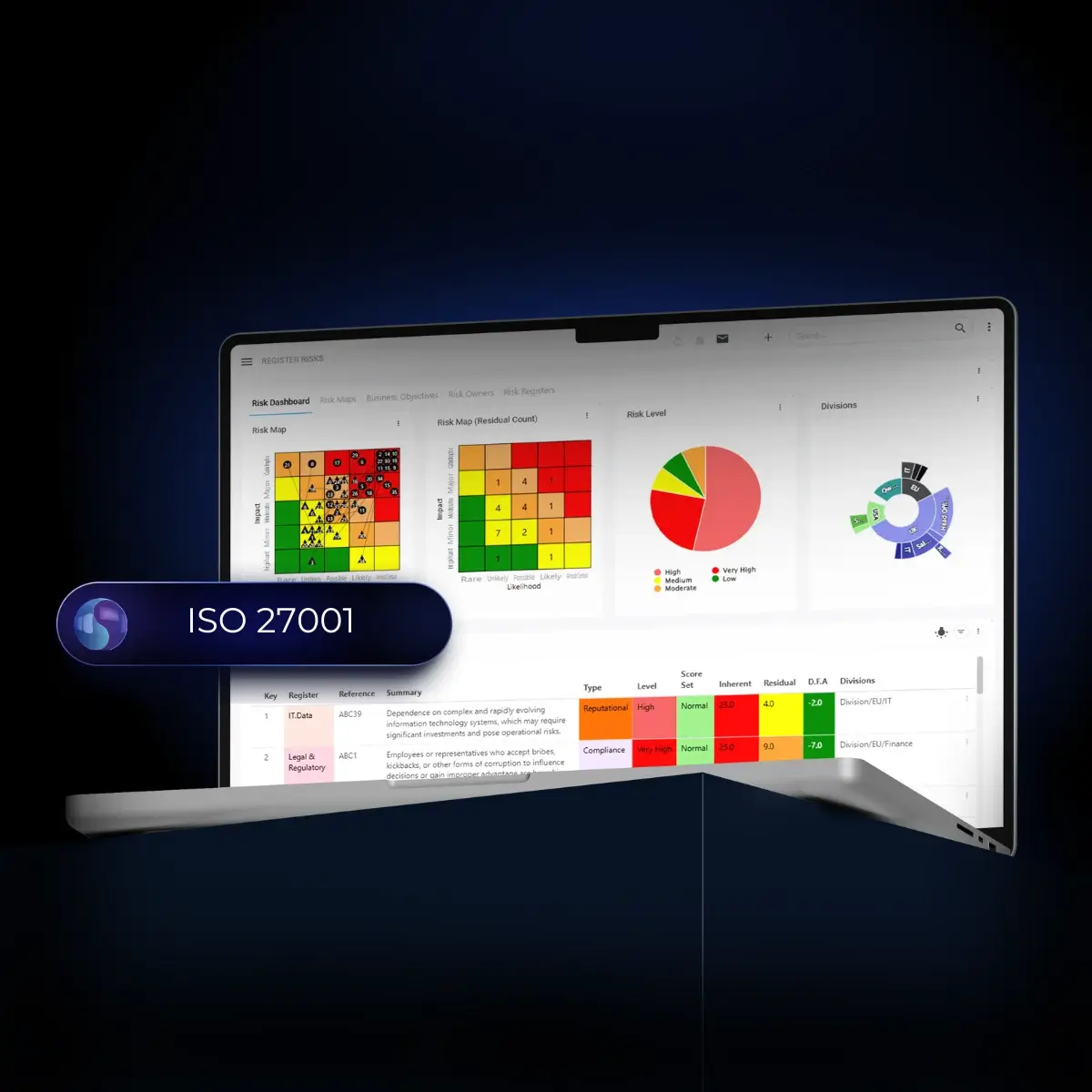
Symbiant enables organisations to manage ISMS risks centrally, with flexible scoring methods and clear ownership. Risks can be grouped, reviewed, reassessed, and linked directly to:
This creates a living ISMS risk register that remains accurate and auditable over time.
2. Controls & Policies with One-Click Statement of Applicability
The Controls and Policies Module is ISO 27001-ready, supporting:
- Active and key control designation
- Control testing and review cycles
- Dynamic residual risk scoring
- One-click generation of the Statement of Applicability
Because controls are directly linked to risks and reviews, auditors can easily see why a control exists, how it’s tested, and what actions have been taken.
3. Structured Internal & External ISO Audits
Symbiant supports ISO 27001 audits through integrated audit planning, execution, and follow-up:
- Plan audits centrally
- Store evidence and test results in audit working papers
- Track findings and remedial actions
- Maintain a full audit trail for certification bodies
Everything remains connected to the wider ISMS, eliminating duplicate effort and last-minute audit panic.
4. Centralised ISMS Documentation (Single Source of Truth)
ISO 27001 requires controlled documentation. Symbiant’s Document Management capability provides:
- A single source of truth for ISMS documents
- Version control and approval workflows
- Links between documents, risks, controls, and audits
- This ensures documentation is always current, accessible, and auditable.
Real-World ISO 27001 Success: Whistl Case Study
Whistl, a large UK-based organisation operating across multiple ISO standards, uses Symbiant to manage its ISMS and wider compliance framework.
As Ben Moulds, Head of Health & Safety, Assurance and Compliance at Whistl, explains:
“We use several modules of Symbiant for many requirements of our ISO standards, with the benefit being that they enable us to manage our multiple ISO certifications easily.”
For ISO 27001 specifically, Whistl uses Symbiant to:
- Manage ISMS risks and control effectiveness
- Plan, conduct, and follow up on internal and external audits
- Create, maintain, and share ISMS documentation
- Monitor progress against ISMS objectives
Before Symbiant, their ISMS relied heavily on paperwork, spreadsheets, and disconnected systems. Today, everything is integrated, reportable, and audit-ready — making certification body visits far more efficient and far less stressful.
Read the full Whistl Case Study
Why ISO 27001 Is Easier to Sustain with Symbiant
ISO 27001 certification isn’t a one-off project , it’s an ongoing management system. Symbiant helps organisations move from reactive compliance to embedded information security governance by providing:
- End-to-end traceability
- Clear ownership and accountability
- Automated notifications and reminders
- Flexible configuration to match your ISMS
- A scalable, cost-effective, highly agile platform that grows with your organisation
Most importantly, it allows teams to spend less time managing spreadsheets and more time managing risk.
Small and Medium-Sized Organisations: Building an ISMS That Grows with You
For small and mid-sized organisations, the challenge is rarely understanding what ISO 27001 requires, it’s finding a way to implement it without overwhelming limited resources.
In practice, many SMEs take a risk-led, incremental approach. Instead of attempting to address every requirement at once, they begin by securing their most sensitive and business-critical information, such as:
- Customer and personal data
- Core systems and cloud platforms
- Financial and operational records
As controls mature and internal capability grows, the ISMS expands in scope. This staged approach allows organisations to demonstrate meaningful progress early, while keeping costs, effort, and disruption under control. Over time, the ISMS becomes more comprehensive without ever losing focus on what matters most.
Large and Multinational Organisations: Consistency Without Losing Local Control
For large or globally distributed organisations, ISO 27001 introduces complexity of a different kind. Managing information security across regions, business units, and legal jurisdictions requires balancing global governance with local compliance realities.
Common challenges include:
- Different data protection and privacy obligations across regions
- Inconsistent operational maturity between subsidiaries or departments
- Conflicting requirements around data residency and system architecture
Effective organisations address this by establishing a core ISMS framework at the enterprise level, supported by local adaptations where required. Policies, risk methodologies, and reporting structures remain consistent, while local teams retain the flexibility needed to comply with regional laws and operational constraints.
This model enables central oversight and assurance without forcing a rigid, one-size-fits-all system onto diverse parts of the organisation.
Why Context Matters for ISO 27001 Success
Across all sectors and organisation sizes, the same principle applies: ISO 27001 works best when it reflects the organisation it is meant to protect. A well-designed ISMS supports business objectives, regulatory expectations, and operational reality, rather than existing purely to satisfy an audit.
This is where structure, flexibility, and traceability become critical, and where the right supporting system can make the difference between a sustainable ISMS and an administrative burden.
Achieve ISO 27001 with Confidence
Whether you’re preparing for your first ISO 27001 certification or managing multiple standards across your organisation, Symbiant provides the structure, visibility, and control needed to run a confident, auditable ISMS.