
Practical Business Continuity Planning Guide
Business Continuity Planning: A Practical Guide to Building Resilient Operations
A disruption becomes a crisis when essential services cannot continue or recover within an acceptable timeframe.
Business continuity planning helps your organisation identify its most important activities, understand what they depend on and establish practical arrangements for maintaining or restoring operations when disruption occurs.
This guide explains the complete business continuity planning process—from business impact analysis and recovery objectives to exercising, reviewing and improving your plans.

Turn Business Continuity Plans into a Connected Resilience Programme
Connect critical services, dependencies, risks, controls, incidents, recovery plans and improvement actions in one structured system. Symbiant helps your organisation move beyond static documents and maintain continuity arrangements that remain current, accountable and ready to use.
What Is Business Continuity Planning?
Business continuity planning is the structured process of preparing an organisation to continue delivering its most important products and services during disruption.
It identifies which activities must be recovered first, what resources they depend on and what people should do when normal processes become unavailable.
Disruption may result from:
Cyberattacks and technology outages
Loss of buildings, systems or utilities
Supplier and supply-chain failure
Severe weather and environmental events
Workforce shortages
Data or communications failure
Operational, security or safety incidents
A business continuity plan documents the agreed response and recovery arrangements. However, effective continuity planning is not simply about producing a document. It is an ongoing process of analysis, preparation, exercising, review and improvement.
Business continuity planning forms part of Business Continuity Management (BCM), the wider framework through which an organisation governs, maintains and continually improves its continuity arrangements.
Business Continuity Planning, BCM and Disaster Recovery
Business continuity planning, business continuity management and disaster recovery are closely related, but they are not interchangeable.
| Term | Meaning | Primary focus |
|---|---|---|
| Business continuity planning | The process of identifying recovery requirements and deciding how priority operations will continue | Preparation and recovery |
| Business continuity plan | The documented procedures, responsibilities and actions used during disruption | Coordinated execution |
| Business continuity management | The wider framework used to govern, maintain and improve continuity arrangements | Organisational oversight |
| Disaster recovery | The restoration of technology, infrastructure, systems and data | Technical recovery |
In simple terms, the business continuity plan provides the practical instructions, while business continuity management ensures that the organisation’s wider continuity arrangements remain governed, current and effective.
Disaster recovery supports business continuity, but it does not replace it. A technology system may be restored successfully while affected employees, suppliers, premises or customer services remain unable to operate.
How Business Continuity Relates to Emergency Response and Crisis Management
Several disciplines may be activated during the same disruption, but each performs a different role.
| Discipline | Primary purpose |
|---|---|
| Emergency response | Protect people, property and the environment during the immediate event |
| Crisis management | Provide strategic leadership, decision-making and stakeholder communication |
| Business continuity | Maintain or restore priority products, services and activities |
| Disaster recovery | Restore affected technology, systems and data |
| Incident management | Record, coordinate, investigate and resolve the event |
These activities should work together. Clear escalation routes and responsibilities help prevent gaps, duplicated effort and conflicting decisions during a disruption.
Why Is Business Continuity Planning Important?
Effective continuity planning helps an organisation make faster, better-informed decisions when normal operations are under pressure.
Minimising disruption
Business continuity planning identifies vulnerabilities, critical dependencies and recovery priorities before an incident occurs. This helps the organisation maintain essential operations and reduce avoidable downtime.
Safeguarding stakeholders
Employees, customers, suppliers, investors and other stakeholders need to know that the organisation can respond effectively. Clear responsibilities and communication procedures help protect people and maintain confidence during uncertainty.
Strengthening resilience
Resilience involves more than returning to the previous operating state. It requires an organisation to adapt, learn and continue delivering its most important services as circumstances change.
Supporting compliance and assurance
Organisations may be expected to demonstrate continuity arrangements through legal, regulatory, contractual or industry requirements. Documented, exercised and reviewed plans provide evidence that continuity risks are being actively managed.
Protecting organisational reputation
An organisation’s response to disruption can affect stakeholder confidence as much as the incident itself. Preparedness, transparent communication and coordinated recovery help demonstrate reliability and accountability.
Enabling continual improvement
Business continuity is not a one-time exercise. Findings from tests, incidents, audits and operational changes should be used to improve plans, controls and recovery arrangements.
Core Principles of Business Continuity
Three connected principles underpin effective continuity planning.
Resilience: strengthening operations before disruption
Resilience means improving the ability of people, processes, technology and suppliers to withstand disruption.
This may involve removing single points of failure, cross-training employees, strengthening supplier arrangements, maintaining backups, introducing alternative communications and embedding preparedness into everyday operations.
Recovery: restoring priority activities
Recovery involves establishing how priority services and operations will be resumed within agreed timeframes.
This includes setting recovery objectives, allocating resources, defining recovery sequences and establishing alternative ways of working.
Contingency: maintaining essential services
Contingency arrangements provide alternatives when normal operations are unavailable.
Examples include secondary suppliers, alternative premises, remote-working procedures, temporary manual processes and backup communications. These arrangements help maintain an acceptable level of service until normal operations can be restored.
How Symbiant Supports Implementation of ISO 22301
Implementing ISO 22301 Business Continuity Management Systems (BCMS) is far easier with Symbiant. Our Business Continuity Planning (BCP) Module allows organisations to build, document, and test their continuity framework in line with ISO 22301 requirements, while the integrated Incident Reporter provides an accessible platform to log events that could impact critical assets. Every update is fully traceable, creating a defensible audit trail that shows who made changes and when. By replacing manual spreadsheets with an automated, centralised solution, Symbiant makes compliance straightforward, cost-effective, and reliable — all for just £100 per module, per month*.
How to Create a Business Continuity Plan
A practical business continuity planning process should connect organisational priorities with clear operational procedures.
1. Define the scope and governance
Begin by deciding which products, services, teams, sites and legal entities the continuity programme will cover.
Define:
- The continuity policy and objectives
- The executive sponsor
- Roles and responsibilities
- Reporting and approval arrangements
- Applicable obligations
- The organisation’s tolerance for disruption
Senior leadership should provide direction, approve recovery priorities and ensure appropriate resources are available.
2. Conduct a Business Impact Analysis
A business impact analysis, or BIA, identifies priority activities and examines how the effects of disruption develop over time.
For each activity, consider:
- Which product or service does it support?
- What would happen if it became unavailable?
- How quickly would the impact become unacceptable?
- Which people, systems, information and facilities does it require?
- Which internal teams and external suppliers does it depend on?
- What minimum level of service must be maintained?
- Are there time-sensitive deadlines or periods of peak demand?
The BIA helps determine what must be recovered first.
It should not be replaced by a conventional risk assessment. Risk assessment considers potential causes, threats and uncertainty; the BIA concentrates on the consequences of losing an activity or resource.
3. Identify risks, vulnerabilities and dependencies
Once priority activities are understood, assess the circumstances that could interrupt them.
Potential vulnerabilities may include:
- Single points of operational failure
- Technology and communications outages
- Supplier concentration
- Loss of key personnel or specialist knowledge
- Inaccessible premises
- Cyber and information-security incidents
- Utility failure
- Regional or sector-wide disruption
Continuity planning should consider operational consequences rather than attempting to predict every possible incident. Different events can create the same consequence, such as the loss of a system, building, supplier or workforce.
4. Establish recovery objectives
Recovery objectives translate the findings of the BIA into measurable requirements.
| Objective | Question it answers |
|---|---|
| Maximum tolerable period of disruption | How long can the activity remain unavailable before the impact becomes unacceptable? |
| Recovery time objective | By when should the activity, resource or system be restored? |
| Recovery point objective | How much data loss can the organisation tolerate? |
| Minimum acceptable operating level | What level of service must be maintained during recovery? |
Recovery objectives should be realistic, agreed and supported by appropriate resources. An ambitious recovery time has little value if the organisation has not established a practical way of achieving it.
5. Select continuity and recovery strategies
Continuity strategies define how priority activities will be maintained or recovered.
Possible arrangements include:
- Alternative work locations
- Remote-working procedures
- Backup systems and communications
- Manual workarounds
- Cross-trained employees
- Alternative suppliers
- Additional inventory or capacity
- Data backup and restoration
- Reciprocal support arrangements
- Temporary reductions in service
Each strategy should be assessed against the recovery objectives established during the BIA.
The organisation should also confirm that the employees, technology, suppliers and funding required to activate the strategy will be available during a genuine disruption.
6. Document the plan
The plan should be concise enough to use under pressure while containing the information required to coordinate an effective response.
A business continuity plan should normally include:
- Purpose, scope and assumptions
- Activation criteria
- Authority to invoke the plan
- Roles and responsibilities
- Contact and escalation details
- Immediate response actions
- Priority activities and recovery objectives
- Alternative working arrangements
- Resource and supplier requirements
- Internal and external communications
- Decision and incident logs
- Recovery procedures
- Arrangements for returning to normal operations
- Document ownership and review dates
Sensitive information should be appropriately protected, but authorised employees must still be able to access the plan if normal systems or premises are unavailable.
7. Train employees and communicate responsibilities
A plan is only useful when the people named within it understand their responsibilities.
Training should be proportionate to each person’s role. General employees may need basic awareness training, while incident leaders, recovery teams and service owners require more detailed instruction and practice.
Relevant third parties should also understand their responsibilities. A supplier should not be treated as part of a recovery strategy unless its capacity and commitments have been confirmed.
8. Exercise, review and improve the plan
Business continuity plans should be exercised to establish whether the arrangements work in practice.
Exercises may include:
- Document walkthroughs
- Tabletop scenarios
- Communications exercises
- Technical recovery tests
- Remote-working tests
- Supplier exercises
- Full or partial simulations
Every exercise should have clear objectives. Findings should be documented, assigned to accountable owners and monitored through to completion.
Plans should also be reviewed after incidents and following significant changes to services, systems, suppliers, locations, personnel or organisational responsibilities.
Business Continuity Plan Checklist
Use this checklist to assess whether your plan is ready to operate.
| Area | Question |
|---|---|
| Scope | Are priority products, services, teams and locations clearly defined? |
| Ownership | Does every part of the plan have an accountable owner? |
| Business impact analysis | Have critical activities and the effects of disruption been assessed? |
| Dependencies | Are people, systems, information, premises and suppliers recorded? |
| Recovery objectives | Have realistic recovery time and service-level objectives been agreed? |
| Strategies | Can the proposed arrangements achieve those objectives? |
| Activation | Is it clear who can invoke the plan and under what circumstances? |
| Communication | Are escalation routes and stakeholder communications defined? |
| Accessibility | Can authorised teams access the plan during a system or site outage? |
| Exercising | Has the plan been tested against credible scenarios? |
| Improvement | Are findings, actions and changes recorded and monitored? |
| Review | Is there a defined review cycle and current plan owner? |
From Critical Services to Evidence of Resilience
Effective business continuity planning connects more than a collection of recovery documents. It creates a traceable journey from what the organisation must protect to the evidence that its arrangements are current, tested and improving.
Critical services → dependencies → risks → controls → incidents → continuity plans → testing → corrective actions → evidence
- Critical services: Identify the products, services and activities that must continue or recover first.
- Dependencies: Record the people, systems, information, premises and suppliers they require.
- Risks: Assess the events and vulnerabilities capable of disrupting them.
- Controls: Establish measures that reduce the likelihood or impact of disruption.
- Incidents: Capture events and identify which services, resources and obligations are affected.
- Continuity plans: Define responsibilities, recovery objectives, strategies and invocation procedures.
- Testing: Exercise the arrangements and challenge the assumptions on which they depend.
- Corrective actions: Assign weaknesses and findings to accountable owners.
- Evidence: Maintain records of decisions, tests, approvals, changes and completed improvements.
How Does ISO 22301 Relate to Business Continuity Planning?
ISO 22301 is the international requirements standard for business continuity management systems.
It places continuity planning within a wider management framework covering leadership, organisational context, planning, operational controls, performance evaluation and continual improvement.
The standard helps organisations move from isolated continuity documents towards a consistent and governed business continuity management system. ISO 22313 provides additional guidance on applying these requirements.
Not every organisation needs to pursue certification. However, the principles can still provide a useful structure for developing and evaluating continuity arrangements.
For a closer examination of the requirements, read our practical guide to ISO 22301 and business continuity management.
Common Business Continuity Planning Mistakes
Treating the plan as a one-time document
Operations, technology, suppliers and personnel change. A plan that is not maintained will quickly stop reflecting how the organisation works.
Confusing data backup with business continuity
Backups are important, but continuity also depends on people, facilities, communications, suppliers and operational decision-making.
Setting objectives without validating them
Recovery objectives must be supported by achievable strategies, resources and tested capabilities.
Focusing only on specific incidents
Plans written around individual hazards can become unnecessarily complicated. Planning for operational consequences often creates arrangements that work across several scenarios.
Missing critical dependencies
An activity may appear recoverable until the loss of a specialist employee, licence, dataset or third-party service prevents it from operating.
Testing without tracking improvements
A successful exercise is not necessarily one that reveals no problems. It is one that identifies weaknesses safely and leads to completed improvements.
When Documents and Spreadsheets Stop Being Enough
Smaller organisations may be able to coordinate continuity arrangements through controlled documents and spreadsheets.
As the number of services, locations, dependencies, plan owners and recovery actions grows, maintaining accurate information becomes more difficult. Teams may struggle to determine which version is current, whether reviews have been completed or how continuity plans connect with risks, controls, incidents and assurance activity.
A structured system can help organisations:
- Maintain centralised continuity records
- Map critical activities, resources and dependencies
- Assign owners and recovery actions
- Schedule reviews and reminders
- Record exercises and improvement actions
- Connect continuity information with risks, controls and incidents
- Maintain a traceable history of changes and decisions
Technology supports the continuity process, but it does not replace operational knowledge, leadership decisions or meaningful exercises.
How Symbiant Supports Business Continuity Planning
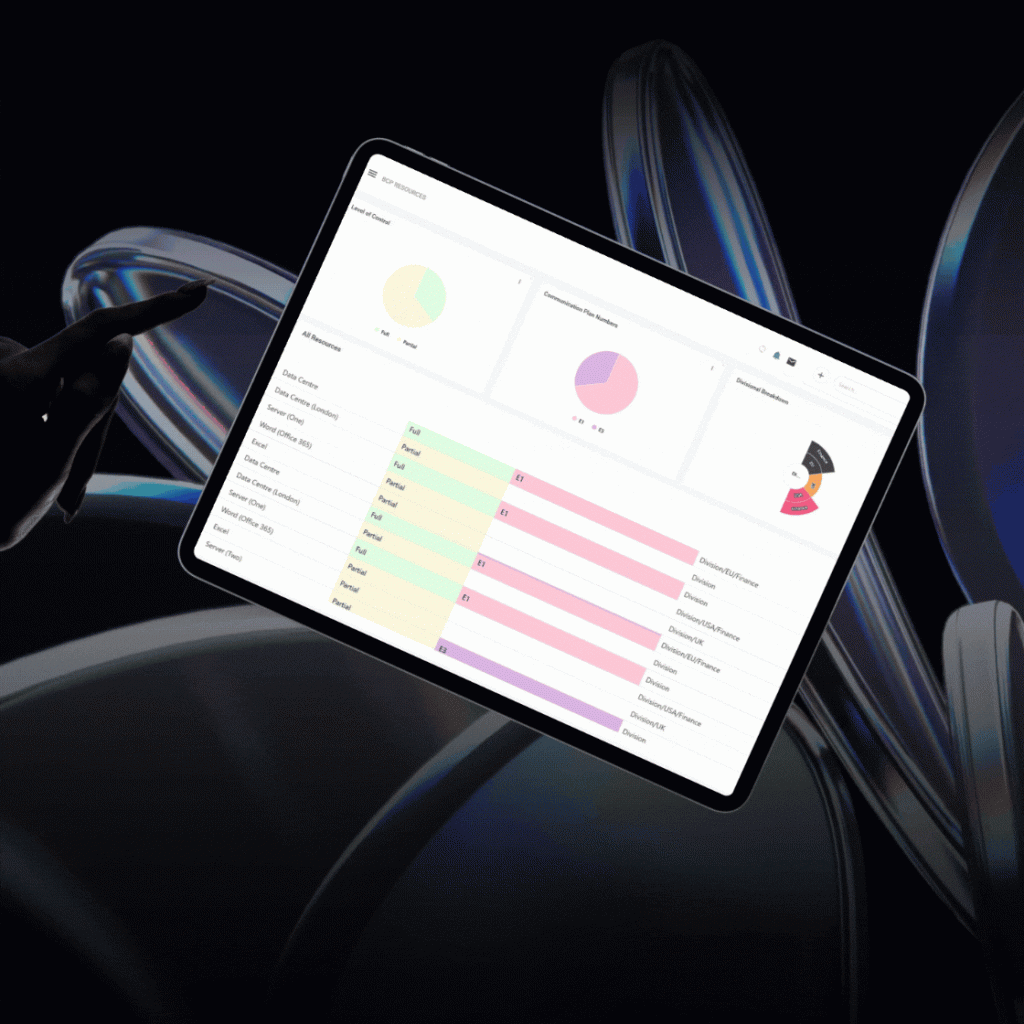
For organisations that have outgrown static plans and disconnected spreadsheets, Symbiant provides a centralised way to manage critical resources, impact assessments, continuity actions and recovery plans.
Symbiant’s Business Continuity and Resilience Planning module enables teams to:
- Record and assess business-critical resources
- Support structured business impact analysis
- Map operational dependencies and potential failure points
- Link resources with relevant risks and controls
- Build mitigation and recovery plans
- Assign actions, responsibilities and deadlines
- Automate alerts and review reminders
- Record continuity exercises and improvement activity
- Maintain a complete audit trail
Because the module connects with Symbiant’s wider risk, controls, incident and action-management capabilities, organisations can see how continuity arrangements relate to their wider governance and resilience environment.
Build Continuity Around Your Organisation
Symbiant’s agile, modular platform is designed to align with industry standards and adapt to your organisation’s unique requirements. Whether you’re working towards ISO accreditation, regulatory compliance, or a specialised framework, our flexible approach helps you create a solution that fits your needs today and evolves with you tomorrow. If an existing module doesn’t fully support your requirements, we can tailor a module or build a bespoke solution designed around your exact processes and standards.
Ready to create a platform tailored to your requirements?

Frequently Asked Questions
What is the main purpose of business continuity planning?
The purpose is to help an organisation continue or recover priority products, services and activities following disruption. It establishes recovery requirements, responsibilities and practical response arrangements before an incident occurs.
What should a business continuity plan contain?
What are the main stages of business continuity planning?
What is the difference between a BCP and a disaster recovery plan?
Who is responsible for business continuity planning?
How often should a business continuity plan be reviewed?
Does a business continuity plan need to follow ISO 22301?
Related Business Continuity Resources
Explore practical guidance on continuity standards, recovery planning and the difference between having a documented plan and demonstrating genuine operational readiness.

ISO 22301: A Practical Guide to Business Continuity Management

Is Your Business Continuity Plan Proof You Can Continue?
Beyond the Backup: Backup vs Disaster Recovery
Pricing Disclaimer
* Modules are charged at a standard monthly fee, not on a per-user basis. All users can access each module at any required level. Please note that costs exclude VAT, AI features, and additional modules you may wish to use. User seats are required.