What is ISO Compliance?
The International Organization for Standardization (ISO) is an independent, non-governmental body headquartered in Geneva, Switzerland. Established in 1946, it has grown to become one of the world’s most influential standard-setting organisations. Working closely with governments, policymakers, and industry experts, ISO has developed over 22,600 standards covering everything from child car seat safety to film speed ratings, as well as comprehensive frameworks for best practices in business management and manufacturing. Among its most widely recognised standards are ISO 9001 for Quality Management Systems (QMS), ISO/IEC 27001 for Information Security Management Systems (ISMS), and ISO 45001 for Occupational Health and Safety, alongside thousands of others spanning diverse sectors.
ISO Certification vs ISO Compliance
ISO offers certification for selected standards, such as ISO 27001 and ISO 9001, through independent third-party audits. While ISO itself does not perform certification audits, its Committee on Conformity Assessment (CASCO) provides the rules that accredited certification bodies must follow.
- Certification means a recognised third party has formally verified your organisation meets all requirements for a given ISO standard.
- Compliance means you follow the requirements of an ISO standard internally, without undergoing formal certification.
Certification is not mandatory, but it can:
- Demonstrate to clients and stakeholders that you operate to recognised global standards.
- Enhance market reputation and credibility.
- Provide a competitive advantage in securing contracts and partnerships.
Why ISO Compliance Matters
Even without formal certification, being ISO-compliant shows your organisation takes quality, security, and safety seriously. It signals that you:
- Follow international best practices in your field.
- Value transparency and trust in your relationships with customers, partners, and regulators.
- Protect your bottom line by reducing risks, improving efficiency, and preventing costly failures.
Key benefits of ISO compliance include:
- Streamlined Operations – ISO frameworks provide a ready-made structure for managing processes efficiently.
- Enhanced Reputation – Communicating compliance builds client confidence.
- Trustworthiness – Following ISO 27001, for example, shows you take data protection seriously.
- Loss Prevention – Standards like ISO 31000 provide tools for reducing risk and minimising losses.
- Higher Customer Satisfaction – Consistent processes lead to better products and services.
- Greater Efficiency – Eliminating waste and duplication boosts productivity.
- Revenue Growth – Efficient, high-quality operations improve profitability over time.
Popular ISO Standards
Here are some widely used ISO families:
ISO 9000 / 9001 – Quality Management: Frameworks for building quality management systems that meet customer and regulatory requirements while driving continuous improvement.
ISO 14000 – Environmental Management: Guidance for reducing environmental impact and meeting sustainability goals.
ISO 27000 / 27001 – Information Security: Frameworks for protecting data, managing cyber risks, and maintaining information security.
ISO 22000 – Food Safety: Ensures safety throughout the food production and distribution chain.
ISO 45001 – Occupational Health and Safety: Protects workers by managing health and safety risks.
ISO 26000 – Social Responsibility: Guidance for ethical, socially responsible business practices.
ISO 50001 – Energy Management: Improves energy efficiency and reduces consumption.
ISO 13485 – Medical Devices: Quality standards for designing, manufacturing, and distributing medical devices.
ISO 31000 – Risk Management: Principles and guidelines for managing organisational risk effectively.
ISO 22301 – Business Continuity Management: Ensures resilience and continuity during disruptions.
ISO 19600 / 37301 – Compliance Management: Framework for embedding compliance into governance and operations.
ISO 37001 – Anti-Bribery: Helps prevent and detect bribery and corruption.
ISO 41001 – Facility Management: Improves operational efficiency in facility management.
ISO Standards Most Relevant for GRC
Governance, Risk, and Compliance (GRC) frameworks bring together policies, processes, and controls to achieve organisational objectives, manage risks, and ensure compliance. Key ISO standards that align with GRC include:
ISO 19600 / 37301 – Compliance Management Systems – Guidelines for establishing, maintaining, and improving compliance programmes.
ISO 31000 – Risk Management – Foundational for integrating structured risk assessment and mitigation into decision-making.
ISO 22301 – Business Continuity – Ensures critical functions continue during disruptions.
ISO 27001 – Information Security – Protects sensitive data, a vital aspect of modern compliance and risk management.
ISO 9001 – Quality Management – Standardises processes to consistently meet objectives.
ISO 38500 – IT Governance – Provides a governance framework for technology investments and usage.
ISO 14001 – Environmental Management – Addresses environmental risk and sustainability governance.
ISO 37001 – Anti-Bribery – Supports ethical governance and regulatory compliance.
ISO 45001 – Health and Safety – Manages workplace safety as part of operational risk management.
ISO 26000 – Social Responsibility – Integrates ethical and societal responsibilities into governance frameworks.
ISO 31000 vs ISO 22301 — and the Role of ISO 27001’s Statement of Applicability
ISO 31000 and ISO 22301 are international standards closely related to risk management. However, they have different objectives and focuses within your organisation. In the most basic sense, ISO 31000 is a risk management standard that provides a framework to manage your risks across your organisation. Conversely, ISO 22301 is a specific standard for business continuity management.
ISO 31000
Purpose
ISO 31000 provides principles, guidelines, and a process for managing an organisation’s risks systematically and cost-effectively. It can apply to any organisation, regardless of size or industry. The goal of ISO 31000 is to help your organisation protect its assets, achieve objectives, and improve its decision-making by managing its risks.
Scope
ISO 31000 covers all risks, threats, and opportunities across your organisation’s activities, functions, and processes. It is not specific to a particular industry but provides a generic approach you can customise to meet your needs. You can customise for public, private, or community enterprises as necessary.
Key Components
Principles: ISO 31000 establishes eight principles to guide your organisation’s risk management approach.
Framework: It provides a framework for integrating risk management into your organisation’s overall management system and processes.
Process: ISO 31000 outlines a structured risk management process that you should implement, including risk assessment, treatment, monitoring, and review.
How Symbiant Award-Winning, Highly Trusted GRC, Risk Management and Audit Software Supports Implementation of ISO 31000
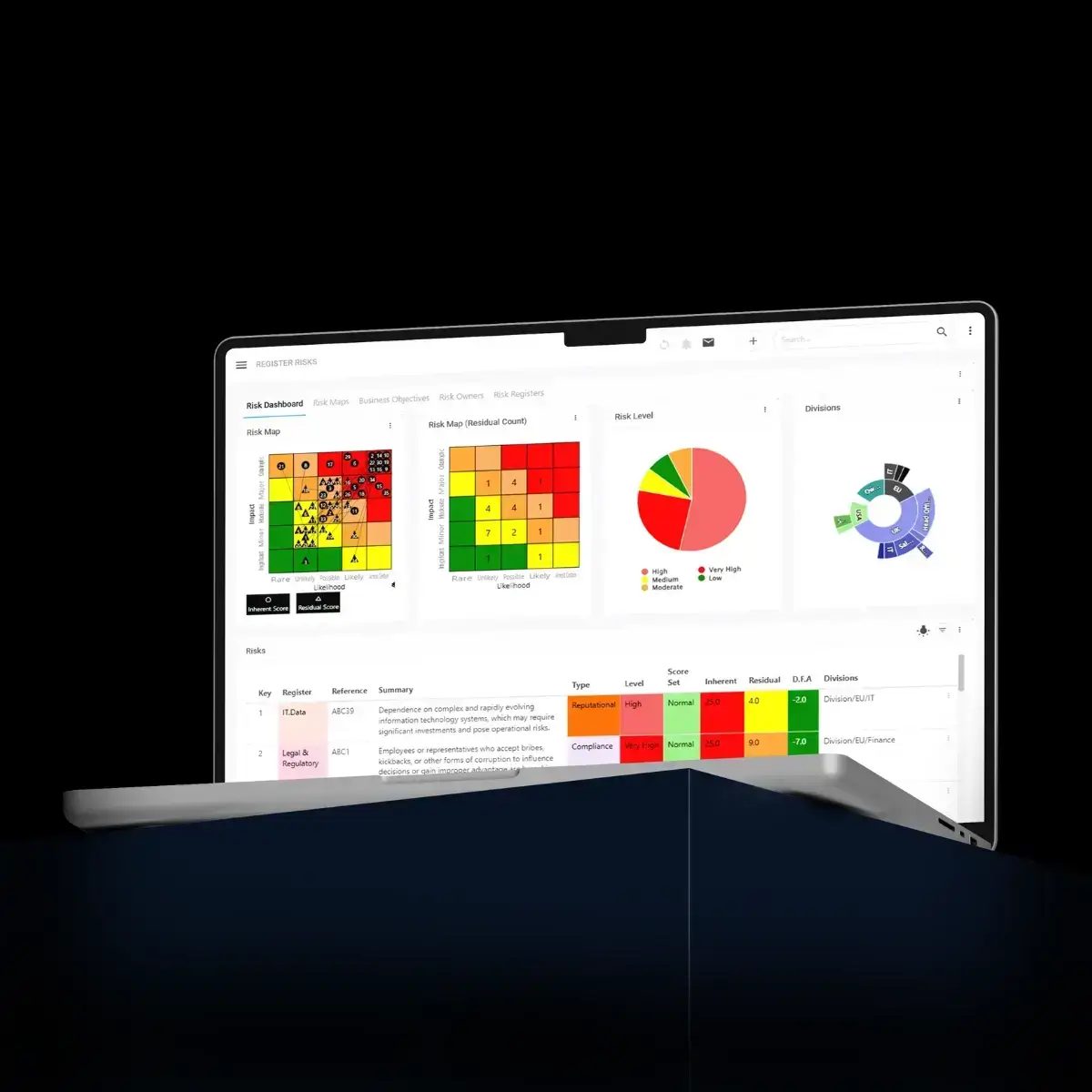
The cornerstone of ISO 31000 is achieving your business objectives. The Business Objectives Module allows you to manage your business objectives and identify the threats that would impact them. This then helps you build your risk registers. The Risk Registers Module enables risk owners to manage and review their risks and any mitigation or treatment plans and, if needed, perform risk assessments.
Symbiant provides a comprehensive framework for organisations to effectively identify, assess, and manage their risks, including strategic, operational, financial, compliance, IT/cybersecurity, and reputational risks. It helps promote a better risk culture by enabling continuous improvement through collaboration with an award-winning, easy-to-use and embed centralised GRC, Risk Management and Audit platform.
ISO 22301
Purpose
ISO 22301 provides a framework for organisations to reduce the likelihood of and ensure recovery from disruptive incidents. This framework covers planning, establishing, implementing, operating, reviewing, maintaining and continually improving your management system. The goal is to enhance your organisation’s resilience and ensure the continuity of operations and services, even in the face of unforeseen disruptions.
Scope
ISO 22301 supports your organisation in identifying risks, preparing for emergencies, improving recovery time, and improving overall organisational resilience. It can be integrated with other ISO management standards to provide a comprehensive approach to organisational resilience.
Key Components
Business Continuity Management: ISO 22301 defines business continuity management as part of overall risk management in your organisation, overlapping with areas such as information security and IT management.
Documented Evidence: The standard requires documented evidence of competence for defined roles, such as training records, education, and professional background.
Framework: ISO 22301 provides a framework for compliance with legal and regulatory requirements related to business continuity.
How Symbiant Supports Implementation of ISO 22301
Our Business Continuity Planning (BCP) Module lets you establish and efficiently document, manage, and test your business continuity framework. The Incident Reporter provides an easy-to-access platform for people to report incidents that might affect or disturb your monitored assets. Symbiant is entirely defensible, as you can assess the data from any point in history and track what users made changes and when.
If you want to implement ISO 22301 within your organisation, using our BCP module makes it much easier than a manual system and is well worth the £100* a month cost.
ISO 27001 and the Statement of Applicability (SoA)
What is ISO 27001?
ISO 27001 is an internationally recognised standard for information security management. It systematically manages sensitive company information, ensuring its confidentiality, integrity, and availability. Furthermore, the standard specifies requirements for establishing, implementing, maintaining, and continually improving an Information Security Management System (ISMS) within the context of the organisation’s overall business risks.
What is the Statement of Applicability (SoA)?
One key component of ISO 27001 is the Statement of Applicability (SoA). The SoA is a document that identifies the controls an organisation has selected and implemented to manage and mitigate information security risks. It is a crucial part of the ISO 27001 certification process, demonstrating how the organisation has addressed the standard’s requirements.
The SoA typically includes the following elements:
- Scope: Defines the boundaries of the ISMS and specifies the organisational units, business processes, and assets covered by the certification.
- List of Controls: Identifies the specific controls from Annex A of the ISO 27001 standard that apply to the organisation. These controls cover various aspects of information security, such as access control, cryptography, physical and environmental protection, and supplier relationships.
- Justification for Exclusions: If the organisation decides not to implement specific controls or parts of controls, the SoA should justify these exclusions.
Implementation Status: Indicates whether each control has been fully implemented, partially implemented, or not yet implemented, with associated details or notes. - Control Objectives and Controls: Describes how each control is implemented within the organisation’s context and outlines its objectives.
Supporting Documentation: References any documents or procedures supporting the controls’ implementation.
Symbiant’s Risk Controls and Policies Module with an Optional AI Assistant
Our Risk Controls and Policies Module facilitates individual users and teams working together to address and manage risks effectively. It streamlines compliance with ISO 27001 standards and simplifies the creation of the Statement of Applicability with a single click, aiding in meeting certification requirements efficiently.
ISO 31000 and ISO 22301 both involve risk management but have different objectives. ISO 31000 offers a general standard for mitigating risk in all aspects of your organisation, while ISO 22301 focuses on ensuring business continuity against potential disruption. ISO 27001, on the other hand, ensures your organisation’s information security management system meets international best practices — with the Statement of Applicability playing a central role in evidencing compliance.
Symbiant’s agile, modular, fully customisable software has been designed to align with industry standards. Our platform helps you achieve accreditation for any standard, and if one of our modules doesn’t meet a standard you need, we can adjust an existing module or create a new one to meet those standards.