
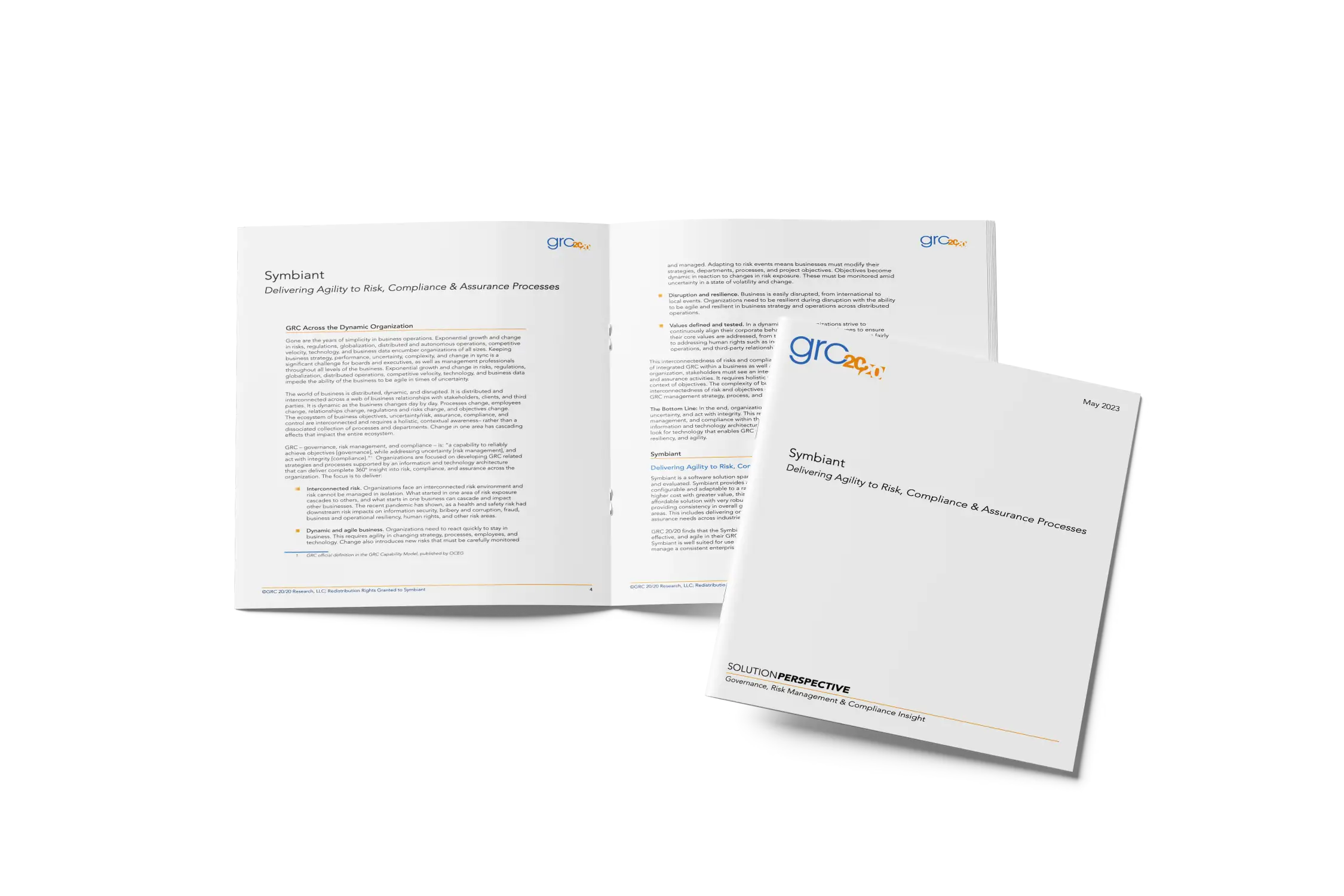
As organisations reflect on 2025, it is evident that governance, risk, compliance, and audit functions operated under sustained and increasing pressure. This was not driven by a single regulatory change or isolated event, but by the convergence of multiple forces: heightened cyber exposure, rising audit demands, growing third-party risk, reputational scrutiny, and increasing expectations for real-time oversight.
Research published throughout the year confirms what many risk and compliance leaders experienced first-hand: traditional, manual, and siloed approaches to GRC struggled to keep pace with the operating environment organisations now face. According a compliance analysis, the majority of organisations now recognise that spreadsheet-based compliance can no longer support modern audit cadence, regulatory change, or third-party oversight at scale.
This retrospective examines the key challenges that defined 2025 and outlines how organisations navigated them, drawing on observed client outcomes and broader industry evidence. It also highlights how Symbiant agile, highly trusted GRC, Risk Management and Audit software supported a more connected, sustainable approach to GRC.
Non-Compliance Became a Material Business Risk
In 2025, non-compliance was no longer viewed solely through a regulatory or legal lens. It increasingly manifested as a direct financial, operational, and reputational risk.
Industry data shows that:
28% of risk and compliance professionals reported privacy or cybersecurity breaches as the most common compliance issue in 2025
Data breaches involving regulatory non-compliance cost an average of $4.61 million, approximately 4% higher than the global average
Breaches where non-compliance was a contributing factor cost organisations an additional $174,000 on average
(Source: NAVEX Global and IBM Cost of a Data Breach Report 2025)
Beyond direct losses, 42% of organisations reported experiencing adverse media coverage, reputational damage, or employee litigation, placing non-financial risk on par with traditional compliance failures.
This shift reinforced an important reality: compliance failures rarely exist in isolation. They are often the result of disconnected risk information, weak control oversight, and delayed action tracking.
How organisations responded
Leading organisations placed greater emphasis on demonstrable accountability, ensuring risks, controls, incidents, and remedial actions could be traced clearly and defended with evidence.
How Symbiant GRC, Risk Management and Audit platform supported this shift
Symbiant award-winning GRC; Risk Management and Audit solution provides clients with a single, connected, auditable system for managing compliance obligations, action ownership, and evidence trails. This enabled clearer reporting to boards, regulators, and external stakeholders, while reducing reliance on fragmented documentation.
Audit Demand Increased Without Proportional Resourcing
Audit activity intensified across most sectors during 2025:
92% of organisations conducted at least two audits
58% conducted four or more audits
35% of enterprise organisations conducted six or more audits annually
(Source: A-LIGN 2025 Compliance Benchmark Report)
Despite this increase, 45% of organisations reported no increase in compliance staffing or resources, placing sustained pressure on audit and risk teams.
As a result, teams were required to deliver greater coverage, faster turnaround, and higher report quality, often under constrained conditions.
Key lesson from 2025
Audit effectiveness increasingly depended on continuous readiness, rather than periodic preparation.
How Symbiant addressed this challenge
Through modules such as Audit Universe, Audit Working Papers, organisations maintained a live view of audit scope, findings, and evidence. The Audit Action Tracker then ensured that audit outcomes were properly actioned, with clear ownership, defined deadlines, and automated notifications to prevent issues from being overlooked or delayed.
Together, these capabilities reduced duplication, strengthened accountability, and supported more consistent, sustainable management of audit workloads.
Reputational and Non-Financial Risk Gained Prominence
One of the most significant developments in 2025 was the growing visibility of non-financial risks, including reputational harm, ethics failures, and employee litigation.
According to NAVEX State of Risk & Compliance Global Report 2025:
- 42% of organisations experienced reputational damage, adverse media coverage, or employee litigation
- This figure now closely rivals traditional compliance concerns such as regulatory action and data breaches
(Source: NAVEX Global 2025)
These risks often materialised faster than regulatory enforcement and had immediate consequences for stakeholder trust and organisational credibility.
Organisational response
Risk leaders increasingly recognised the need to integrate reputational risk into formal risk frameworks, rather than treating it as an abstract or secondary concern.
Symbiant’s role
By linking incidents, complaints, controls, and actions directly to enterprise risks, Symbiant GRC, Risk Management and Audit platform, allowed organisations to identify emerging patterns early and provide senior management with timely, contextual insight. This supported more informed decision-making and earlier intervention.
Security Assurance and ISO 27001 Took Strategic Importance
Security and data protection remained central themes throughout 2025, with ISO 27001 gaining prominence as a preferred framework for demonstrating information security maturity.
Key findings include:
- 81% of organisations reported having, or planning to pursue, ISO 27001 certification in 2025, up from 67% in 2024
- ISO 27001 was ranked ahead of SOC 2 by many organisations as their most important assurance framework
(Source: A-LIGN 2025 Compliance Benchmark Report)
For many organisations, certification and ongoing compliance were no longer driven solely by regulatory need, but by customer expectations and trust requirements.
How organisations adapted
Security assurance became embedded into broader governance and risk management processes, rather than managed as a standalone technical exercise.
How Symbiant award winning GRC, Risk Management and Audit software supported ISO-aligned governance
Symbiant’s Controls and Policies module enabled clients to manage ISO-aligned controls, link them directly to risks, track reviews and actions, and generate structured evidence efficiently.
The Limits of Manual Compliance Became Clear
By the end of 2025, many organisations accepted that spreadsheet-driven compliance could no longer scale.
Research highlights that:
- 2025 was the first year in which a majority of organisations reported using purpose-built compliance technology
- 66% now use dedicated tools to manage compliance risk
- 72% of executives said increasing compliance complexity negatively impacted profitability
(Source: NAVEX Global and PwC Global Compliance Survey 2025)
Manual approaches struggled to provide:
- Consistent version control
- Reliable action ownership
- Cross-framework visibility
- Timely reporting to leadership
Observed shift
Organisations began prioritising single sources of truth and integrated GRC platforms that could evolve alongside regulatory and operational requirements.
Symbiant’s contribution
Symbiant’s modular,agile and flexible architecture allowed clients to move away from spreadsheets incrementally, embedding GRC into daily operations without disruptive transformation programmes, particularly valuable for organisations balancing compliance maturity with resource constraints.
Looking Ahead: What 2025 Set in Motion for 2026
Insights suggest organisations increasingly view compliance as a strategic enabler rather than a purely defensive function.¹ The direction of travel is clear:
- Continuous oversight over periodic reporting
- Integrated risk, audit, and compliance data
- Clear accountability and evidence-based assurance
- Technology that supports informed human decision-making
Symbiant was designed with these principles in mind, shaped by over two decades of client-led development across public sector bodies, regulated industries, and complex organisations.
Conclusion
2025 did not merely introduce new compliance challenges, it exposed the structural weaknesses in how many organisations managed governance, risk, and audit activities.
Those that navigated the year most effectively were not doing more compliance. They were doing more connected, more transparent, and more accountable GRC.
As organisations look toward 2026, the lessons from 2025 provide a clear mandate: invest in clarity, connectivity, and systems that can sustain governance under pressure.
This approach is reflected in the outcomes experienced by Symbiant clients. In an independent government-led user satisfaction survey of 450 users, Symbiant achieved satisfaction scores of 95% or higher, demonstrating consistent value across usability, reliability, and support.
To understand how a connected, flexible GRC platform can support your organisation’s requirements and exceed expectations, book a demo to explore Symbiant in more detail.
All-in-One GRC & Audit Management Powerhouse
Risk Management Software
Reduce exposure, invest in the right controls, respond faster to incidents, and navigate change with confidence. With optional AI, reveal blind spots and safeguard your objectives.
Audit Management Software
Simplify and centralise audits from start to finish. Assign actions, track progress, and generate reports effortlessly. Integrated workflows enhance accountability and transparency.
Compliance Management Software
Stay ahead of evolving regulations. Automate testing, track compliance actions, and ensure your organisation meets industry standards with confidence and clarity.