
A Complete Guide to Risk Management Registers
The Role of a Risk Register in Effective Risk Management
Risk Register Definition
What Is a Risk Register in Enterprise Risk Management?
A risk register is a structured tool used to identify, assess, document, and monitor risks that may affect an organisation’s objectives. It acts as a central record where potential threats are analysed, assigned ownership, and tracked through mitigation or resolution.
Risk registers are a fundamental component of modern risk management frameworks such as ISO 31000, ISO 27001, and the UK Government Orange Book. They help organisations maintain visibility over their risk landscape while ensuring that emerging issues are addressed proactively.
Traditionally, risk registers were maintained in spreadsheets. However, many organisations now use dedicated risk register software to automate scoring, monitoring, reporting, and governance processes across the enterprise.
Risk Register Definition
What Is the Purpose of a Risk Register?
The purpose of a risk register is to provide organisations with a structured, centralised approach to identifying, assessing, and managing risks that may impact strategic and operational objectives. By documenting risks within a consistent framework, organisations gain visibility of their overall risk exposure and ensure that potential threats are monitored and addressed proactively.
A well-maintained risk register enables organisations to:
- Identify potential threats and emerging risks at an early stage
- Evaluate the likelihood and potential impact of risks
- Assign clear ownership and accountability to risk owners
- Monitor changes in risk levels over time
- Track mitigation actions and treatment plans
- Support informed decision-making and governance oversight
Centralised Risk, Audit and Compliance Data in One System
When Should a Risk Register Be Used in Risk Management?
A risk register should be used whenever organisations need a structured way to identify, assess, and monitor risks that may affect strategic objectives, operational activities, or regulatory compliance. Rather than being a one-time document, the risk register should be embedded into key decision-making and governance processes.
RISK-INFORMED STRATEGY
Strategic Planning
PROJECT RISK MANAGEMENT
Project Initiation and Planning
ENVIRONMENTAL RISK MONITORING
Changes in the External Environment
CONTINUOUS RISK GOVERNANCE
Ongoing Risk Review and Governance
Centralised Risk, Audit and Compliance Data in One System
Key Components of a Risk Register
A risk register provides a structured framework for identifying, analysing, and managing organisational risks. While formats may vary between organisations, most risk registers contain several core components that help teams monitor risk exposure and coordinate mitigation activities.
Each entry begins with a clear description of the risk, outlining the nature of the threat, its potential causes, and the possible consequences for the organisation.
Risks are often grouped into categories such as strategic, operational, financial, compliance, or cybersecurity risks. Categorisation helps organisations analyse patterns and prioritise risk management efforts across different areas.
Assigning a responsible risk owner ensures accountability. This individual is responsible for monitoring the risk, coordinating mitigation activities, and reporting updates to leadership or governance bodies.
Likelihood measures the probability that a risk event may occur. Organisations typically evaluate likelihood using qualitative or quantitative scoring models.
Controls describe the policies, processes, or safeguards implemented to reduce risk likelihood or impact. Documenting existing controls also allows organisations to assess their effectiveness over time.
Where risks exceed acceptable thresholds, mitigation actions are recorded within the register. These actions outline the steps required to reduce or manage the risk.
The status of each risk is tracked over time (for example: active, mitigated, or closed). Regular reviews ensure that the risk register remains accurate and aligned with the organisation’s evolving risk landscape.
Centralised Risk, Audit and Compliance Data in One System
Benefits of Using a Risk Register
A risk register provides organisations with a structured and transparent approach to identifying, analysing, and managing risks. By centralising risk information within a single framework, organisations can improve governance oversight, strengthen decision-making, and ensure that risks are actively monitored and mitigated.
Enhanced Risk Visibility
A risk register provides a clear overview of all identified risks across the organisation. By consolidating risk information in one place, leadership teams gain better visibility of potential threats and emerging issues.
Proactive Risk Management
Maintaining a risk register enables organisations to identify and assess risks before they materialise. This proactive approach helps reduce the likelihood of incidents, operational disruptions, or compliance failures.
Improved Decision-Making
By documenting risks alongside their likelihood, impact, and mitigation strategies, a risk register provides leadership with the information needed to make informed strategic and operational decisions.
Effective Risk Prioritisation
Risk registers allow organisations to prioritise risks based on structured risk scoring methodologies. This ensures that resources are allocated efficiently, focusing attention on the most significant threats.
Stronger Accountability
Assigning risk ownership within the register ensures clear accountability for monitoring and managing risks. Risk owners are responsible for tracking mitigation activities and reporting progress to governance bodies.
Better Compliance and Audit Readiness
A well-maintained risk register demonstrates that an organisation is actively managing risk in line with governance frameworks and regulatory expectations. It also provides an auditable record of risk assessments, mitigation actions, and review activities.
Improved Communication Across Stakeholders
By providing a single source of truth for risk information, the risk register enables better communication between departments, leadership teams, and regulators.
Centralised Risk Registers with Real-Time Context
An effective risk management framework starts with a well-structured, actively maintained risk register. Without central visibility and consistent scoring, organisations risk fragmented oversight and outdated assumptions. Symbiant’s Risk Register provides the operational backbone needed to capture, assess, and maintain risk in a controlled, scalable way.
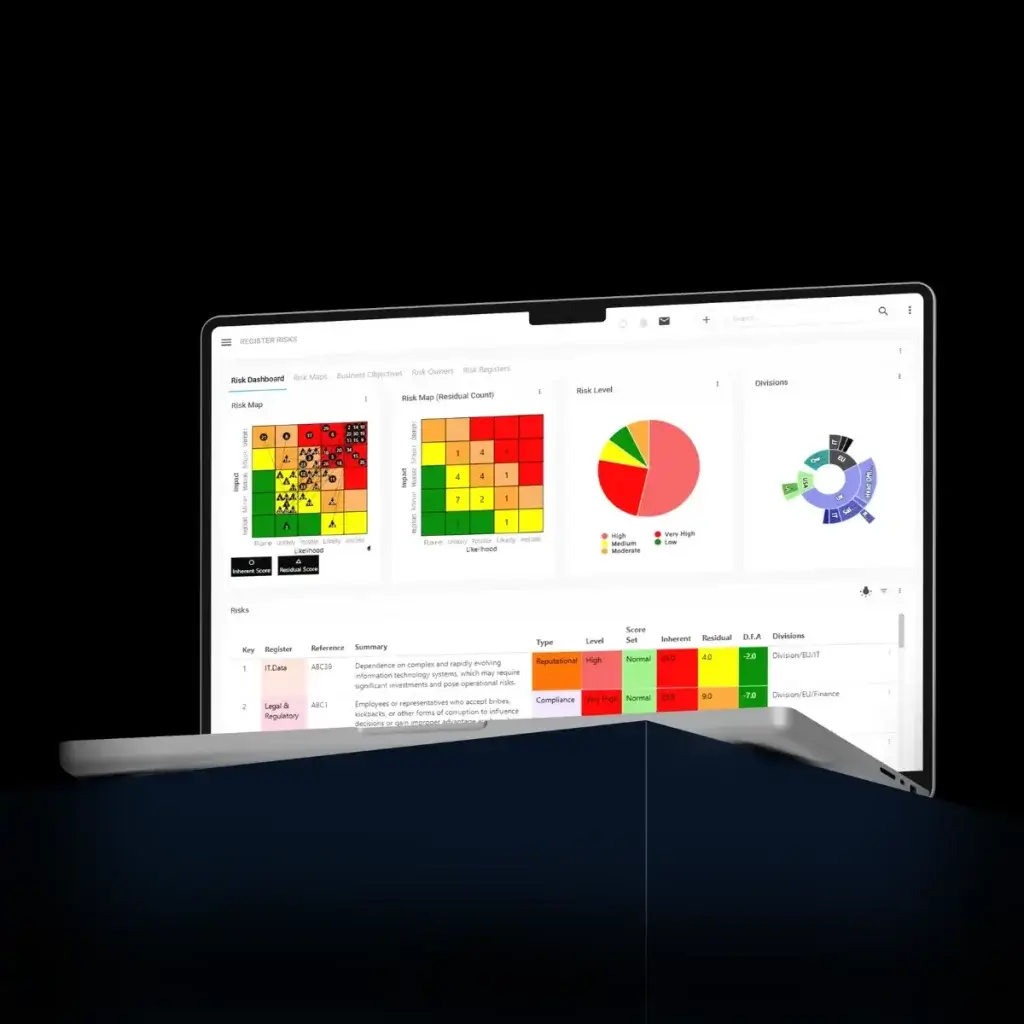
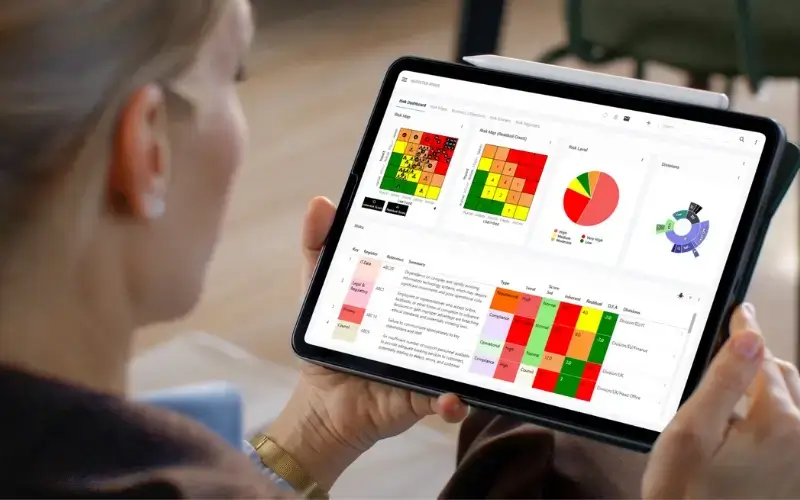
An example of how risks may be visualised and managed within a modern risk register system. Organisations can monitor risk levels, identify emerging threats, and track mitigation activities through dashboards, heatmaps, and structured registers.
| Key | Register | Reference | Summary | Type | Level | Score Set | Inherent | Residual | D.F.A | Divisions |
|---|---|---|---|---|---|---|---|---|---|---|
| 1 | Primary | 3 | Cyber security breaches may compromise customer data and disrupt operations, leading to financial loss and reputational damage. | Cyber Security Risk | Low | Normal | 20 | 8 | -12 | Operations |
| 2 | Strategic | 8 | Regulatory and compliance risks arising from changes in laws, regulations, and industry practices. | Compliance Risk | Medium | Normal | 16 | 6 | -10 | Compliance |
| 3 | Strategic | 6 | Credit risk arising from borrowers’ inability to repay loans or meet contractual obligations. | Financial Risk | Medium | Normal | 12 | 6 | -6 | Lending |
| 4 | Strategic | 1 | Failure to comply with evolving FCA requirements may result in penalties, reputational damage, and legal consequences. | Compliance Risk | High | Normal | 20 | 4 | -16 | Compliance |
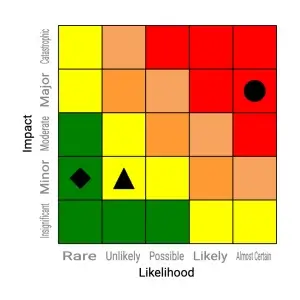
Risk heatmaps are a visual tool used within a risk register to help organisations understand the severity and priority of identified risks. By plotting risks according to their likelihood of occurring and potential impact, risk managers can quickly identify which risks require immediate attention.
In a typical heatmap, likelihood is displayed along the horizontal axis while impact is shown on the vertical axis. Each risk is positioned within the matrix based on its calculated score. Colour coding is then used to highlight risk severity:
Green represents low-risk areas that may require monitoring but minimal intervention.
Yellow indicates moderate risks that should be reviewed and managed through standard controls.
Orange highlights elevated risks that may require mitigation planning or closer oversight.
Red represents high-risk exposures that demand immediate action and senior management attention.
Risk heatmaps provide several important advantages within enterprise risk management:
Instant visual prioritisation of risks
Clear communication of risk exposure to leadership and boards
Support for structured risk scoring frameworks
Improved decision-making during risk review meetings
Modern risk management platforms often generate heatmaps automatically, updating them in real time as risk scores change or mitigation actions are implemented. This enables organisations to maintain an accurate, continuously updated view of their risk landscape.
| Impact / Likelihood | Rare | Unlikely | Possible | Likely | Almost Certain |
|---|---|---|---|---|---|
| Catastrophic | 🔴 | 🔴 | |||
| Major | 🟠 | 🔴 | 🔴 | ||
| Moderate | 🟡 | 🟠 | 🔴 | 🔴 | |
| Minor | 🟢 | 🟡 | 🟡 | 🟠 | 🟠 |
| Insignificant | 🟢 | 🟢 | 🟡 | 🟡 | 🟡 |
Legend
- 🟢 Low risk
- 🟡 Medium risk
- 🟠 Elevated risk
- 🔴 High risk
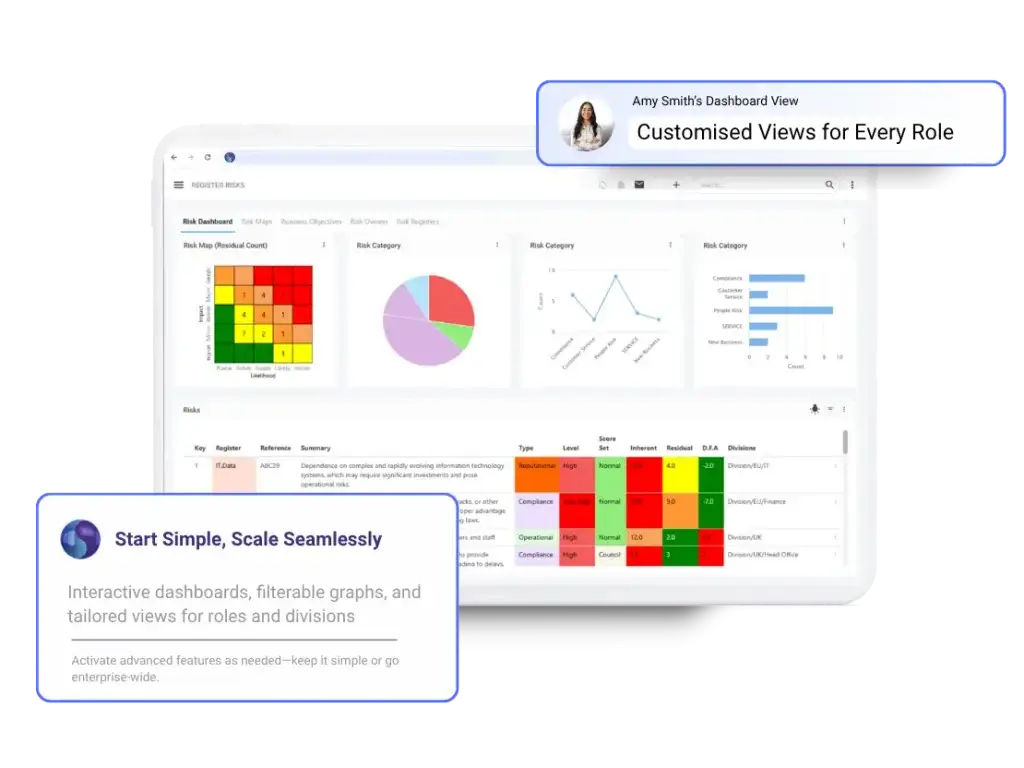
Modern risk management platforms allow organisations to monitor risks through dashboards that display:
Risk heatmaps and scoring matrices
Risk distribution by category or division
Inherent and residual risk levels
Risk ownership and mitigation actions
Real-time alerts when risk thresholds are exceeded
These dashboards provide leadership with a real-time view of organisational risk exposure, enabling faster and more informed decision-making.

Modern risk management platforms allow organisations to monitor risks through dashboards that display:
Risk heatmaps and scoring matrices
Risk distribution by category or division
Inherent and residual risk levels
Risk ownership and mitigation actions
Real-time alerts when risk thresholds are exceeded
These dashboards provide leadership with a real-time view of organisational risk exposure, enabling faster and more informed decision-making.

ENTERPRISE RISK MANAGEMENT CONTEXT
Risk Registers in Enterprise Risk Management
Risk registers form a core component of modern enterprise risk management (ERM) frameworks. They provide organisations with a structured system for identifying, documenting, assessing, and monitoring risks that may affect strategic and operational objectives.
Within an effective ERM programme, the risk register helps organisations align risk information with:
Operational activities
Regulatory obligations
Governance frameworks
Modern risk management approaches treat the risk register not simply as a static document, but as part of a connected risk management ecosystem. In advanced systems, risks can be linked to controls, incidents, assessments, and mitigation actions, providing a more complete and dynamic view of organisational risk exposure.
UNDERSTANDING THE DIFFERENCE
Risk Register vs Risk Assessment
Risk assessments and risk registers are closely related but serve different purposes within the risk management process.
A risk assessment is used to evaluate potential threats by analysing their likelihood and potential impact. It helps organisations understand which risks may exist and how severe they could be.
A risk register, by contrast, acts as the central record where those risks are documented, monitored, and managed over time. It captures key information such as risk ownership, scoring, mitigation actions, and review history.
While risk assessments may be conducted periodically, the risk register provides a continuous view of organisational risk exposure, allowing teams to track changes and monitor mitigation activities across the enterprise.
THE LIMITS OF SPREADSHEET RISK MANAGEMENT
Limitations of Spreadsheet Risk Registers
Many organisations initially manage risks using spreadsheets. While this approach may be sufficient at an early stage, it becomes increasingly difficult to maintain as risk environments grow more complex.
Common limitations of spreadsheet-based risk registers include:
Limited real-time visibility across teams and departments
Manual scoring and updates that increase the risk of errors
Difficulty tracking mitigation actions and review activities
Limited collaboration and version control challenges
No automated alerts when risks exceed defined tolerance levels
As organisations grow and risk environments become more dynamic, these limitations can significantly reduce the effectiveness of risk management processes.
MODERNISING RISK MANAGEMENT
Moving Beyond Spreadsheet Risk Registers
To address these challenges, many organisations transition from spreadsheet registers to dedicated Risk Register Software.
Modern risk management platforms enable organisations to:
Automate risk scoring and monitoring
Track risk thresholds and trigger alerts in real time
Link risks to controls, incidents, and assessments
Generate dashboards and reports for leadership teams
Maintain structured, audit-ready documentation
Platforms such as Symbiant Risk Register Software allow organisations to replace static registers with a connected risk management system that improves visibility, strengthens accountability, and supports effective governance oversight.
ALIGNMENT WITH GOVERNANCE FRAMEWORKS
Risk Registers and Governance Frameworks
Risk registers play a key role in supporting governance and compliance frameworks across many industries.
They are commonly used within frameworks such as:
ISO 31000 Risk Management
ISO 27001 Information Security
The UK Government Orange Book
COSO Enterprise Risk Management
Industry-specific regulatory compliance programmes
By providing structured documentation, scoring methodologies, and reporting capabilities, risk registers help organisations demonstrate that risks are being actively identified, monitored, and managed in line with recognised governance standards.
Integrating the Risk Register with the Symbiant GRC Platform
The Symbiant Risk Register Module is designed to operate as part of a connected risk management ecosystem, enabling organisations to link risks with other governance, risk, and compliance processes across the platform.
By integrating the risk register with other Symbiant modules, organisations gain a more complete and dynamic understanding of their risk landscape while improving visibility, accountability, and decision-making.
When used alongside the Symbiant Incident Reporter Module, incidents can be linked directly to risks within the register. This allows organisations to identify patterns, uncover root causes, and ensure that incidents contribute to improved risk identification and mitigation planning.
Through the Questionnaires, Surveys and Assessments Module, organisations can run structured assessments or collect Key Risk Indicator (KRI) data and attach the results directly to risks. This enables teams to support risk evaluations with measurable data and evidence.
When integrated with the Symbiant Controls and Policies Module, controls can be mapped directly to risks. Built-in control self-assessments allow organisations to test control effectiveness regularly. If a control fails, the associated residual risk score can update automatically, ensuring the risk register reflects the true risk position.
Risk reviews, mitigation actions, and remediation tasks can be logged within the register and assigned to responsible users with deadlines and automated notifications. This helps ensure that mitigation activities are tracked through to completion and that accountability is clearly defined across the organisation.
By connecting risks to incidents, controls, assessments, and mitigation actions, Symbiant transforms the risk register from a simple record into a fully connected enterprise risk management system.