
ISO 31000 Compliance & Risk Management Software
ISO 31000 Compliance Software for Risk Management Best Practices
ISO 31000 is the global benchmark for risk management excellence. It provides a clear framework for identifying, assessing, and managing risks in a way that supports organisational objectives, enhances decision-making, and builds long-term resilience. With Symbiant’s modular, cost-effective GRC software, aligning with ISO 31000 becomes faster, easier, and more collaborative, without the high price tag of traditional solutions.
From only £100 per module/month for unlimited users*
Take control of your compliance and risk processes
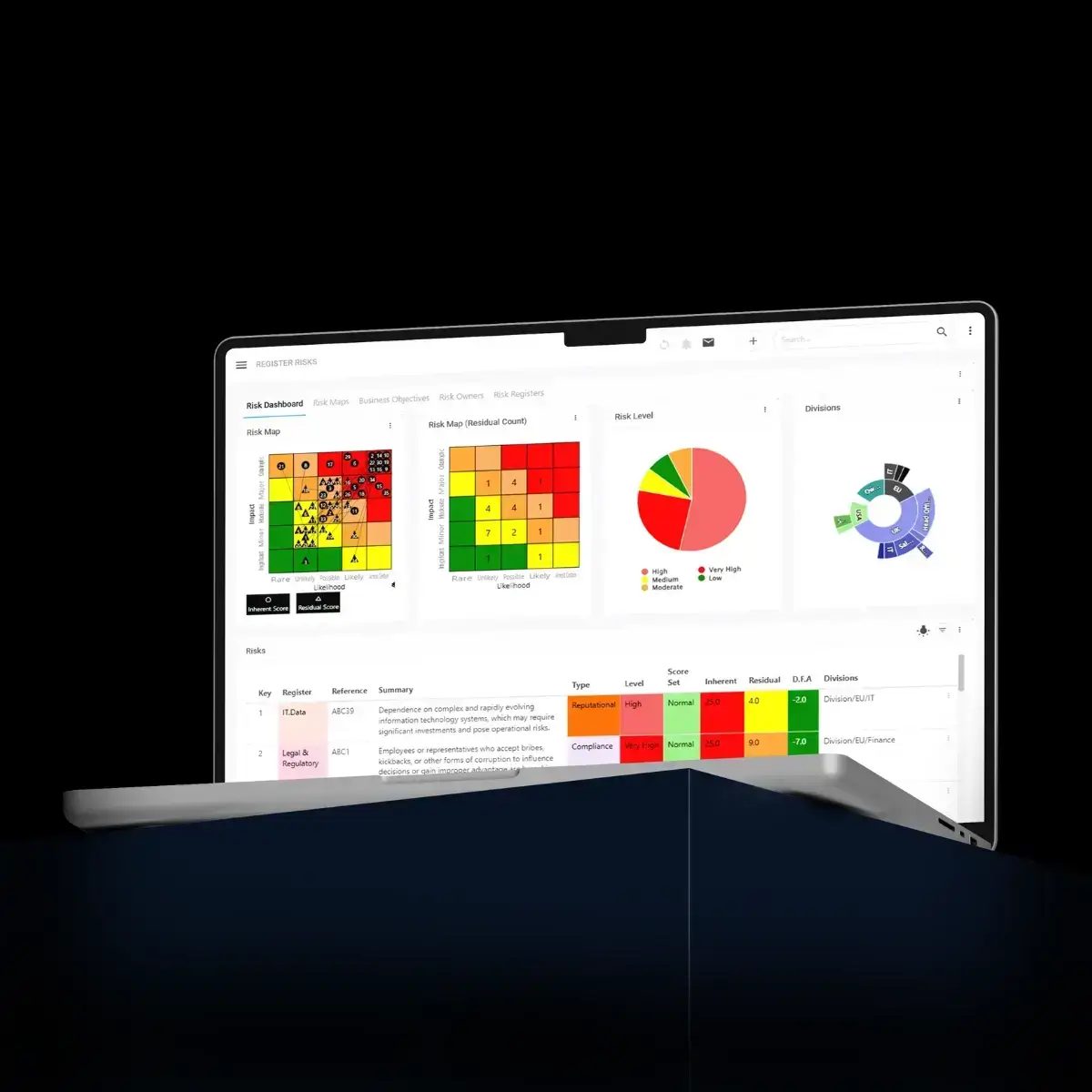
Move beyond spreadsheets and disconnected systems with a flexible platform that centralises your data, tracks actions, and gives you clear visibility across your organisation.
Looking for ISO 31000 risk management software that simplifies compliance and strengthens decision-making?
Symbiant provides a robust, centralised, collaborative ISO 31000 compliance software platform designed to help organisations align seamlessly with the ISO 31000 risk management framework. From risk identification and assessment to treatment, monitoring, and review, every tool within Symbiant supports the principles and processes outlined in ISO 31000. Whether you need to link risks directly to business objectives, track mitigation actions, or ensure transparent reporting, our modular, fully customisable, cost-effective software helps you implement ISO 31000 in a structured, efficient, and measurable way, improving organisational resilience and protecting value across your organisation.
What is ISO 31000?
In today’s fast-changing and unpredictable environment, effective risk management is essential for sustainable business success. Organisations that can proactively identify, assess, and address risks are far more likely to achieve their goals and strengthen long-term resilience. The ISO 31000 Risk Management Framework provides a globally recognised, flexible foundation to support this.
Although ISO 31000 outlines clear principles and best-practice guidelines, its real value emerges when it’s embedded into day-to-day operations, governance, and culture as part of a broader enterprise risk management strategy. This guide takes you from the fundamentals of ISO 31000 through to its practical application in real-world scenarios.
What is the ISO 31000 Risk Management Standard?
The ISO 31000 Risk Management Framework, developed by the International Organization for Standardization, offers principles and guidelines for managing risk systematically across any industry or organisation size. It defines risk as “the effect of uncertainty on objectives” and emphasises integration with governance, strategy, operations, and culture.
Key ISO 31000 objectives include:
- Establishing a shared risk language and process.
- Supporting governance and accountability.
- Improving operational efficiency and resilience.
- Enabling informed, confident decision-making.
ISO 31000:2018 is the latest edition of the standard, reviewed on a five-year cycle to ensure it remains relevant and effective. In addition to ISO 31000, other recognised risk management standards exist, such as ISO/IEC 31010, developed jointly by the International Organization for Standardization (ISO) and the International Electrotechnical Commission (IEC), which provides detailed guidance on risk assessment techniques.
What is Risk Management?
Risk management, in the context of Governance, Risk, and Compliance (GRC), is the discipline of understanding, evaluating, and acting on uncertainty in a way that directly supports organisational objectives. It’s not about filling out checklists or ticking off compliance tasks, it’s about enabling better decisions, building resilience, and unlocking opportunity.
In short, effective risk management transforms GRC from a bureaucratic compliance exercise into a strategic capability, one that helps leaders navigate complexity, achieve business objectives, protect value, and seize opportunities with confidence.
Lives in decisions, not documents
Risk is assessed and managed where strategy is set, investments are approved, and operational priorities are chosen.
Aligns with objectives
Following ISO 31000’s definition, risk is “the effect of uncertainty on objectives,” making it inseparable from performance and outcomes.
Goes beyond static heatmaps
Modern risk management uses scenario modelling, intelligent quantification, and dynamic dashboards to reveal interconnected impacts.
Enables action
Risk should be a driver of strategy, not a barrier.
What is the purpose of ISO 31000?
ISO 31000 exists to help organisations take a structured, consistent, and proactive approach to managing risk. It provides a globally recognised framework for identifying, assessing, and controlling threats that could impact business objectives, whether those risks stem from cybersecurity incidents, financial instability, compliance failures, operational disruptions, or strategic missteps.
By applying ISO 31000, organisations can:
- Integrate risk management into daily operations and decision-making processes.
- Address all types of risk from strategic to operational, using a unified framework.
- Strengthen governance and resilience by monitoring risk in a continuous, transparent way.
Ultimately, ISO 31000 helps leaders see risk in context, ensuring that every decision is informed by a clear understanding of potential threats and opportunities.
What is the scope of ISO 31000?
ISO 31000 provides guidelines for managing any type of risk an organisation might encounter. Its strength lies in its broad and adaptable framework, making it suitable for organisations of all sizes, sectors, and industries. The standard can be tailored to align with an organisation’s specific context, objectives, and risk appetite whether in the public sector, private enterprise, or non-profit space.
As an international benchmark for structured risk management, ISO 31000 sets the foundation for building consistent, integrated, and effective risk practices. However, unlike ISO 27001 or ISO 9001, it is not a certifiable standard. This means organisations cannot be officially certified or audited for compliance, instead, it serves as guidance for embedding best-practice risk management principles into existing processes and governance structures.
ISO 31000 Risk Management Principles
ISO 31000 promotes a structured and methodical approach to risk management, helping organisations:
- Identify risks that could impact strategic and operational objectives.
- Evaluate the likelihood of each risk event occurring.
- Determine the potential severity of its consequences.
The framework does not aim to eliminate all risks, a goal that is impossible in practice. Instead, it focuses on understanding and managing uncertainty, enabling organisations to reduce risk exposure and mitigate threats while seizing opportunities.
1. Inclusive
Engage key stakeholders in the process, ensuring their insights and perspectives shape risk decisions. Keep communication transparent, accessible, and free of jargon.
2. Dynamic
Recognise that risks evolve over time. Ongoing monitoring and re-assessment are essential to address new and emerging threats.
3. Best Available Information
Base decisions on the most accurate, up-to-date data, while accepting that not all information will be complete or certain.
4. Human and Cultural Factors
Account for the influence of people, behaviours, and organisational culture on both risks and their management.
5. Continual Improvement
Embed a culture of continuous learning, reviewing, and refining risk management processes over time.
6. Integrated
Weave risk management into every aspect of the organisation’s operations, governance, and decision-making.
7. Structured and Comprehensive
Apply a consistent, system-wide approach to ensure all significant risks are identified and addressed.
8. Customised
Tailor the risk management framework to the organisation’s unique context, objectives, and risk appetite.
By following these principles, ISO 31000 ensures that risk management is not a box-ticking exercise, but a strategic capability that supports resilience, growth, and long-term success.
Benefits of the ISO 31000 Standard
Implementing the ISO 31000 Risk Management Framework offers a range of strategic, operational, and financial advantages:
Proven Effectiveness
ISO 31000 is globally recognised and widely adopted, with a track record of delivering measurable results in diverse industries.
Standardised Risk Management
Provides a consistent template for identifying risk drivers, setting criteria, and determining treatments across the organisation.
Culture of Risk Awareness
Embeds risk identification and mitigation into daily business processes, encouraging proactive behaviour at every level.
Seamless Integration
Designed to complement other ISO standards, enabling organisations to incorporate ISO 31000 into existing management systems with minimal disruption.
Profitability Protection
Reduces the likelihood of costly incidents, safeguarding revenue and operational stability.
Proactive Decision-Making
Helps shift from a reactive stance to forward-looking, preventative risk strategies.
Investor Confidence
Demonstrates a serious commitment to risk management, potentially improving access to funding and investor trust.
A step-by-step guide to embedding the ISO 31000 framework into your organisation
Every organisation’s risk profile, culture, and resources are unique, which means there’s no single “one-size-fits-all” approach to ISO 31000. This is why Symbiant robust, agile, highly trusted GRC, Risk Management and Audit software is fully customisable. However, the standard itself outlines three essential preparation steps to set you up for success:
Align with Business Objectives
Your risk mitigation strategy must support, not obstruct, the achievement of organisational goals.
Assess Existing Governance
Larger organisations often have governance structures in place that can be adapted to incorporate ISO 31000 roles, responsibilities, and processes.
Define Commitment Levels
Determine the resources, budget, and leadership support needed for sustainable implementation.
The ISO 31000 Implementation Process
Once preparation is complete, ISO 31000 recommends a six-stage, cyclical process, designed to be repeated and refined over time. With Symbiant agile, fully customisable, AI-Enhanced GRC, Risk Management and Audit Software you can easily achieve:
- Communication and Consultation – Engage stakeholders early and often to build awareness, gather insights, and ensure shared understanding throughout the process, you can easily discuss anything in the Discussion section provided within the modules. With Symbiant’s Virtual Workshops, you empowers all users, regardless of expertise, to collaboratively manage risks, strengthen controls, and safeguard business objectives, anytime, anywhere.
- Scope, Context, and Criteria – Tailor ISO 31000 to your organisation’s risk environment by defining boundaries, understanding internal/external factors, and setting evaluation criteria.
- Risk Assessment:
- Risk Identification: Pinpoint potential events or conditions that could impact objectives.
- Risk Analysis: Assess the likelihood, impact, complexity, and potential velocity of each risk.
- Risk Evaluation: Compare analysis results against your criteria to prioritise action.
- Risk Treatment – Select, implement, and manage mitigation measures that balance cost, effectiveness, and organisational priorities.
- Monitoring and Review – Continuously evaluate performance, track changes, and adjust strategies to maintain relevance.
- Recording and Reporting – Document all findings, decisions, and actions for transparency, accountability, and compliance purposes.
ISO 31000 vs ISO 22301: Understanding the Difference
ISO 31000: A Universal Framework for Effective Risk Management
ISO 31000 is an international risk management standard that provides principles, guidelines, and a structured process for systematically and cost-effectively managing risks. Applicable to any organisation—regardless of size or industry—it aims to protect assets, achieve objectives, and improve decision-making. The standard covers all risks, threats, and opportunities across an organisation’s activities, functions, and processes, and can be customised for public, private, or community enterprises. Key components include eight guiding principles, a framework for integrating risk management into overall systems, and a process involving risk assessment, treatment, monitoring, and review.
ISO 22301: Strengthening Organisational Resilience Through Business Continuity Management
ISO 22301 is the international standard for business continuity management. Its purpose is to help organisations reduce the likelihood of disruptive incidents and ensure effective recovery when they occur. The standard covers planning, establishing, implementing, operating, reviewing, maintaining, and improving a business continuity management system. It supports identifying risks, preparing for emergencies, improving recovery time, and strengthening organisational resilience. ISO 22301 also requires documented evidence of competence for defined roles and provides a framework for meeting legal and regulatory requirements related to continuity.
Key Difference: While both standards address risk, ISO 31000 focuses broadly on risk management across all organisational objectives, whereas ISO 22301 is specifically concerned with maintaining operational continuity in the face of disruption.
How Symbiant Supports ISO 31000 Compliance
How Symbiant’s Risk Management Software Aligns with ISO 31000 Principles and Processes
Risk Workshops – Facilitate collaborative risk identification, assessment, and treatment, engaging stakeholders across the organisation in line with ISO 31000’s inclusive and dynamic principles.
Risk Registers – Centralise, track, and report on organisational risks, ensuring a structured and comprehensive approach to risk documentation and management.
Business Objectives – Link risks directly to business goals, reinforcing ISO 31000’s focus on managing the uncertainty that impacts strategic objectives.
Controls and Policies – Manage critical processes and mitigations to ensure risks are effectively addressed, supporting the framework’s emphasis on control implementation.
Incident Reporter – Capture, track, and analyse incidents, linking them to relevant risks and controls for continuous improvement.
Key Risk Indicators (KRIs) – Monitor environmental and operational data to detect early warning signs of emerging threats.
Symbiant embedded AI – Optional A Assistant helps streamline processes by identifying root causes, generating risk descriptions, and suggesting mitigation strategies, all aligned with ISO 31000 best practices.
How Symbiant Supports the Full ISO 31000 Risk Management Framework
Supporting the ISO 31000 Risk Management Process
In addition to aligning with ISO 31000’s guiding principles, Symbiant supports each stage of the standard’s structured process:
Communication & Consultation – Automated notifications, real-time dashboards, and collaborative modules ensure all stakeholders stay informed and engaged.
Scope, Context & Criteria – Flexible configuration allows you to define scope, set tailored criteria, and adapt risk management to your organisation’s objectives and environment.
Risk Assessment – Perform risk identification through workshops and incident reporting, analyse likelihood and impact, and evaluate risks against established criteria.
Risk Treatment – Assign, track, and monitor mitigation actions, with full linkage to relevant controls and policies.
Monitoring & Review – Use live KRIs, trend analysis, and alerts to keep the framework responsive to internal and external changes.
Recording & Reporting – Maintain a complete audit trail with time-stamped records, exportable reports, and historical data for transparency and accountability.
Customisable, Scalable ISO 31000 Risk Management Software with Defensible Compliance Scalable and Tailored to Your Needs
Symbiant’s modular and agile structure allows organisations to start small and expand over time. Whether you are a public-sector body, private enterprise, or a charity, the system can be customised to your specific risk appetite, maturity level, and operational needs, while still meeting ISO 31000 requirements.
Defensible Compliance
Every action in Symbiant is logged, time-stamped, and linked to a responsible user, making it easy to demonstrate due diligence and provide evidence for audits or reviews. This ensures your ISO 31000 framework remains transparent, defensible, and aligned with best practices.
By integrating these capabilities into a single, collaborative platform, Symbiant empowers organisations to align with ISO 31000 through our integrated ISO 31000 compliance software, supporting risk management best practices ISO 31000 to drive resilience, compliance, and strategic performance.
Build a Solution Around Your Standards, Not the Other Way Around
Symbiant’s agile, modular platform is designed to align with industry standards and adapt to your organisation’s unique requirements. Whether you’re working towards ISO accreditation, regulatory compliance, or a specialised framework, our flexible approach helps you create a solution that fits your needs today and evolves with you tomorrow. If an existing module doesn’t fully support your requirements, we can tailor a module or build a bespoke solution designed around your exact processes and standards.
Ready to create a platform tailored to your requirements?

Pricing Disclaimer
* Modules are charged at a standard monthly fee, not on a per-user basis. All users can access each module at any required level. Please note that costs exclude VAT, AI features, and additional modules you may wish to use. User seats are required.