
Compliance Management Guide
What Is Compliance Management Software?
Compliance management software helps organisations bring obligations, controls, risks, evidence and corrective actions into one connected system. Discover how it reduces manual work, improves visibility and accountability, and supports a more efficient, continuous approach to compliance.
From only £100 per module/month for unlimited users*
Take control of your compliance and risk processes
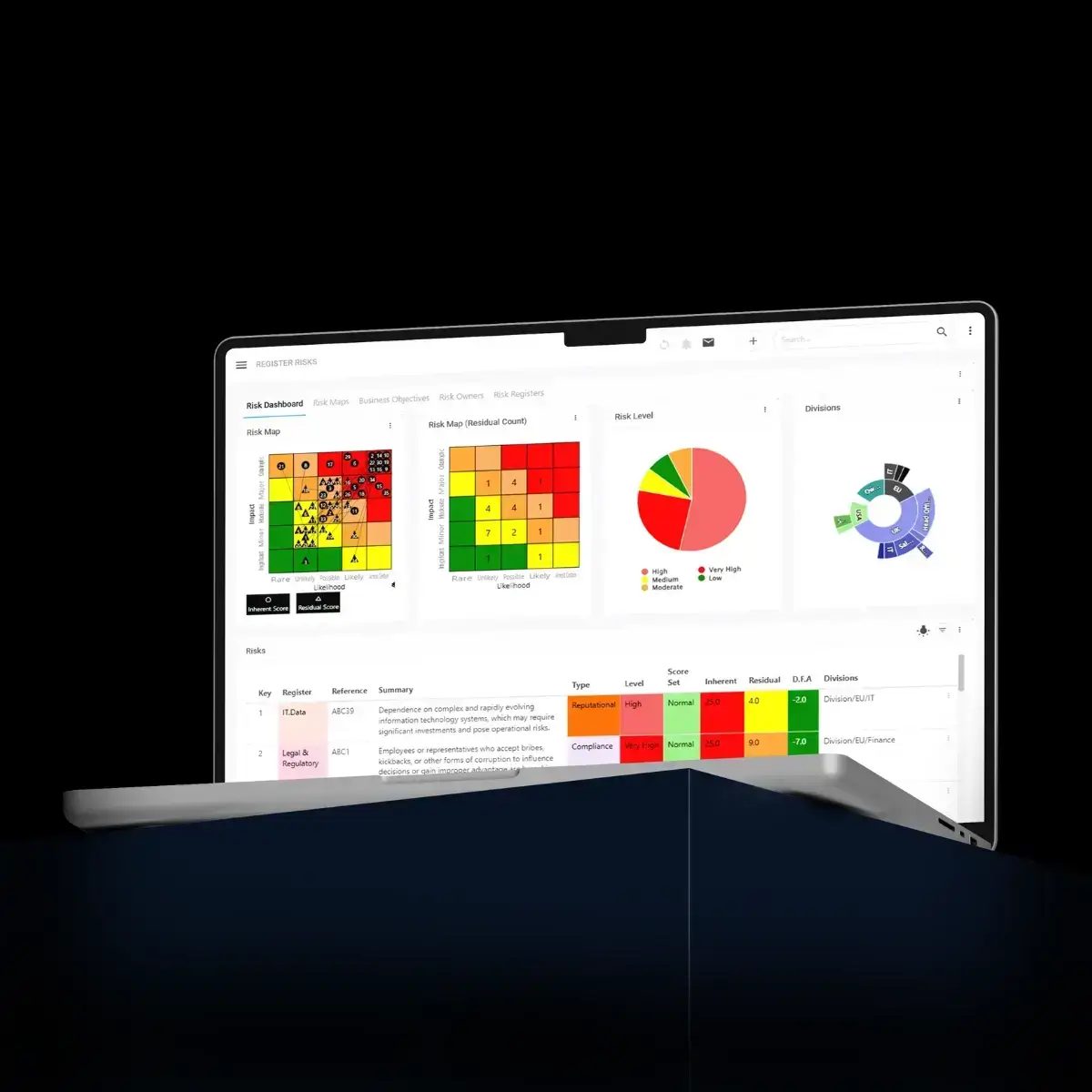
Move beyond spreadsheets and disconnected systems with a flexible platform that centralises your data, tracks actions, and gives you clear visibility across your organisation.
Compliance management software helps organisations understand their regulatory obligations, monitor whether those obligations are being met and maintain evidence of the actions, controls and decisions supporting compliance.
Rather than managing requirements through disconnected spreadsheets, documents and emails, compliance software brings obligations, controls, policies, assessments, evidence, incidents and corrective actions together in a structured system. This gives compliance teams greater visibility, strengthens accountability and makes it easier to demonstrate assurance to regulators, auditors, customers and senior management.
Modern compliance software should do more than record whether a requirement has been completed. It should connect compliance with the organisation’s wider risk, audit and governance activities, helping teams understand where weaknesses exist, what could be affected and what action should be prioritised.
What is compliance management?
Compliance management is the ongoing process of identifying the laws, regulations, standards, policies and contractual requirements that apply to an organisation and ensuring that appropriate measures are in place to meet them.
This typically involves:
- Identifying applicable obligations and regulatory changes
- Translating requirements into internal controls and procedures
- Assigning responsibility for compliance activities
- Collecting evidence and conducting assessments
- Monitoring controls and performance indicators
- Recording incidents, breaches and exceptions
- Managing corrective and remedial actions
- Reporting compliance performance to management and regulators
- Maintaining a complete and defensible audit trail
Compliance is not a one-time exercise. Requirements change, controls can become ineffective and new risks emerge as organisations introduce different processes, suppliers, systems and technologies. Compliance management software supports this continuous cycle.
What does compliance software do?
Compliance software provides a central environment for managing obligations, controls, evidence, assessments and improvement actions.
It replaces fragmented compliance processes with structured workflows, clear ownership and connected information. Teams can see which requirements apply, how they are being addressed, whether supporting controls are effective and where further action is needed.
When compliance information is connected with risk and audit data, organisations can also understand the wider context. For example, a failed control may affect several regulatory requirements, increase related risks, generate an audit finding and require a corrective action. Connected compliance software makes these relationships visible.
Key features of compliance management software
The capabilities offered by different platforms vary, but effective compliance software will usually include the following features.
Compliance obligations management
A central obligations register allows organisations to document and organise the regulations, standards, contractual commitments and internal requirements that apply to them.
Each obligation can be linked to responsible owners, policies, controls, risks, evidence and review dates, creating a clear view of how the organisation is addressing its responsibilities.
Compliance assessments and monitoring
Compliance assessments help teams evaluate whether requirements are being met and identify areas of partial or non-compliance.
Assessment questionnaires can be issued to different departments, business units, suppliers or control owners. Responses, evidence and follow-up actions can then be managed centrally.
Controls and policy management
Controls provide the practical measures through which many compliance requirements are implemented.
Compliance software should enable organisations to:
- Create and maintain a central control library
- Assign control owners
- Schedule control testing and reviews
- Record design and operating effectiveness
- Link one control to multiple requirements
- Manage policies and supporting documents
- Identify control gaps, duplication and weaknesses
Mapping controls across multiple frameworks can reduce duplicated work and show where a single control supports several obligations.
Automated workflows and notifications
Configurable workflows help standardise recurring compliance activities. Automated reminders, approvals, escalations and notifications reduce dependence on manual follow-ups and make it less likely that reviews or actions will be missed.
Evidence and document management
Organisations need reliable evidence to demonstrate that controls and compliance activities have been completed.
A compliance platform can store or link supporting records, maintain document histories and provide a clear audit trail showing who completed, reviewed or approved an activity and when.
Issue and action management
Where an assessment, control test or audit identifies a weakness, compliance software should allow the resulting issue to be assigned, tracked and escalated.
Actions can be given owners, priorities, deadlines and approval stages, helping management monitor progress through to completion.
Incident and breach management
Compliance is closely connected with incident management. A breach, complaint, service failure or data-protection event may affect several obligations and expose the organisation to regulatory, financial and reputational consequences.
Connecting incidents to risks, controls, requirements and actions helps teams assess their full impact and coordinate an appropriate response.
Risk management
Compliance obligations should not be considered in isolation from risk.
Integrated risk management capabilities allow organisations to identify compliance risks, assess inherent and residual exposure, evaluate control effectiveness and prioritise resources according to the potential impact of non-compliance.
Audit management
Internal audits provide independent assurance over compliance arrangements and control effectiveness.
Integrated audit functionality supports audit planning, working papers, findings, recommendations and action tracking while connecting audit results with the relevant risks, controls and compliance requirements.
Regulatory change management
Regulations and industry expectations continue to evolve. Compliance software can help organisations record emerging changes, assess their potential impact, assign responsibility and monitor the implementation of necessary updates.
Dashboards and compliance reporting
Real-time dashboards provide a clearer picture of compliance performance across the organisation.
Reports may cover:
- Compliance status by requirement or framework
- Overdue reviews and actions
- Control performance
- Assessment results
- Open incidents and breaches
- Emerging regulatory changes
- Trends across departments or business units
- Areas requiring management attention
This allows leadership to move beyond static, point-in-time reporting and make decisions using current information.
Audit trails and accountability
A complete history of changes, decisions, approvals and actions is essential for defensible compliance.
Compliance software creates a traceable record of who did what, when it occurred and what evidence supported the decision. This improves accountability and makes regulatory reviews and audits more efficient.
What are the benefits of compliance software?
A single source of truth
Bringing compliance information into one central system reduces conflicting records and makes it easier for teams to work from consistent, current information.
Greater visibility
Dashboards and connected records help management understand the organisation’s compliance position, including overdue activities, control weaknesses and emerging areas of concern.
Reduced manual administration
Automated reminders, recurring assessments, workflows and reporting reduce the time spent maintaining spreadsheets, chasing updates and manually compiling evidence.
Stronger accountability
Clearly assigned owners, deadlines and escalation routes establish responsibility for obligations, controls, reviews and remedial actions.
More consistent processes
Standardised workflows and assessment methods help different departments apply the organisation’s compliance approach consistently.
Better audit and regulatory readiness
Centralised records, evidence and audit trails make it easier to respond to information requests and demonstrate how compliance is being managed.
Improved decision-making
When compliance data is connected with risk, controls, incidents and audit findings, leaders gain the context needed to prioritise actions and allocate resources more effectively.
Earlier identification of gaps
Continuous monitoring and structured assessments help identify missing evidence, overdue reviews, weak controls and unaddressed requirements before they develop into more serious issues.
Reduced duplication
Mapping common controls across multiple regulations or standards can reduce repeated assessments and evidence requests.
Increased stakeholder confidence
A structured and transparent approach to compliance can strengthen confidence among regulators, customers, employees, investors and business partners.
| Spreadsheets | Compliance management software |
|---|---|
| Information is often stored across multiple files | Information is managed within a central system |
| Updates depend heavily on manual input | Workflows, reminders and reviews can be automated |
| Ownership can be unclear | Responsibilities and deadlines are assigned |
| Relationships between records are difficult to see | Requirements can be connected with controls, risks, incidents and actions |
| Version control is challenging | Changes are recorded within a clear history |
| Reporting requires manual consolidation | Dashboards and reports update as information changes |
| Evidence may be stored separately | Evidence can be linked directly to the relevant activity |
| Scaling creates further complexity | Processes can be extended across teams and business units |
Who uses compliance management software?
Compliance software can support organisations in regulated industries as well as organisations managing contractual, ethical or internal governance requirements.
Typical users include:
- Compliance teams
- Risk managers
- Internal auditors
- Information security teams
- Data protection officers
- Policy and control owners
- Legal and governance teams
- Quality and assurance functions
- Operational managers
- Senior leadership and boards
It can be used across financial services, government, local authorities, healthcare, housing, charities, education, manufacturing and other sectors.
How to choose compliance software
The right platform will depend on the organisation’s size, regulatory environment and existing governance processes. Important considerations include:
Flexibility
Can the software reflect your organisation’s terminology, structure, workflows and assessment methods without forcing teams into an inflexible template?
Integration across GRC
Can compliance requirements be connected with risks, controls, policies, incidents, audits, findings and actions?
Ease of use
Will employees outside the compliance team be able to complete assessments, provide evidence and update actions without extensive training?
Reporting capabilities
Can the platform provide both detailed operational reports and clear management-level dashboards?
Scalability
Can the system support additional frameworks, departments, entities and users as requirements grow?
Security
How is organisational information protected? Consider hosting, access controls, permissions, certifications, data processing and the security arrangements surrounding any AI functionality.
Auditability
Does the platform provide a reliable record of changes, approvals, assessments and supporting evidence?
Implementation and support
How quickly can the system be configured, and what level of assistance is available during implementation and ongoing use?
Total cost
Consider implementation costs, licence structure, user limits, additional modules, configuration fees and long-term support, rather than looking only at the initial subscription price.
How Symbiant supports compliance management
Symbiant provides a flexible, modular, connected platform for managing compliance alongside risk, controls, policies, incidents, audit and assurance.
Rather than treating compliance as a separate checklist, Symbiant creates relationships between the information that shapes the organisation’s governance environment. Requirements can be connected with the controls intended to address them, the risks associated with failure, the evidence demonstrating performance and any incidents, findings or actions requiring attention.
Symbiant can help organisations:
- Build structured compliance registers
- Record regulatory and internal obligations
- Conduct compliance assessments and questionnaires
- Assign owners, review dates and responsibilities
- Map requirements to controls, policies and risks
- Monitor control effectiveness
- Record evidence and supporting documentation
- Manage breaches, exceptions and incidents
- Track remedial actions through to completion
- Maintain detailed, time-stamped audit trails
- Produce real-time dashboards and management reports
- Connect compliance activity with audit and wider assurance
Its modular structure allows organisations to select the capabilities they require and extend the platform as their needs develop. Unlimited users also make it easier to involve control owners and operational teams without restricting participation to a small group of licence holders.
Symbiant AI can further support users by analysing connected governance information, identifying relevant relationships and highlighting possible gaps or missing connections. This helps teams examine not only the information already recorded, but also what may need further attention. AI-assisted outputs remain subject to human review and governance.
Build a more connected approach to compliance
Effective compliance management requires more than storing requirements or completing periodic checklists. Organisations need to understand how obligations relate to their risks, controls, policies, incidents and assurance activities.
Symbiant brings this information together within a connected Single Source of Truth, giving teams the visibility and context to manage compliance more efficiently, identify weaknesses earlier and make better-informed decisions.
Discover how Symbiant GRC can help your organisation build a more connected, accountable and resilient approach to compliance. Request a demonstration today.

Pricing Disclaimer
* Modules are charged at a standard monthly fee, not on a per-user basis. All users can access each module at any required level. Please note that costs exclude VAT, AI features, and additional modules you may wish to use. User seats are required.