
Enterprise Risk Management & Data Protection
GDPR Compliance: A Complete Guide to Risk Management, Data Protection, and Regulatory Readiness
Under Article 33 of the UK GDPR and EU GDPR, organisations must assess and, where required, notify personal data breaches within 72 hours. This requires structured documentation, clear escalation and accountable action tracking. Symbiant’s GDPR Breach Management Software provides a configurable, audit-ready framework to log, assess and manage data breaches within an integrated governance and risk environment.
From only £100 per module/month for unlimited users*
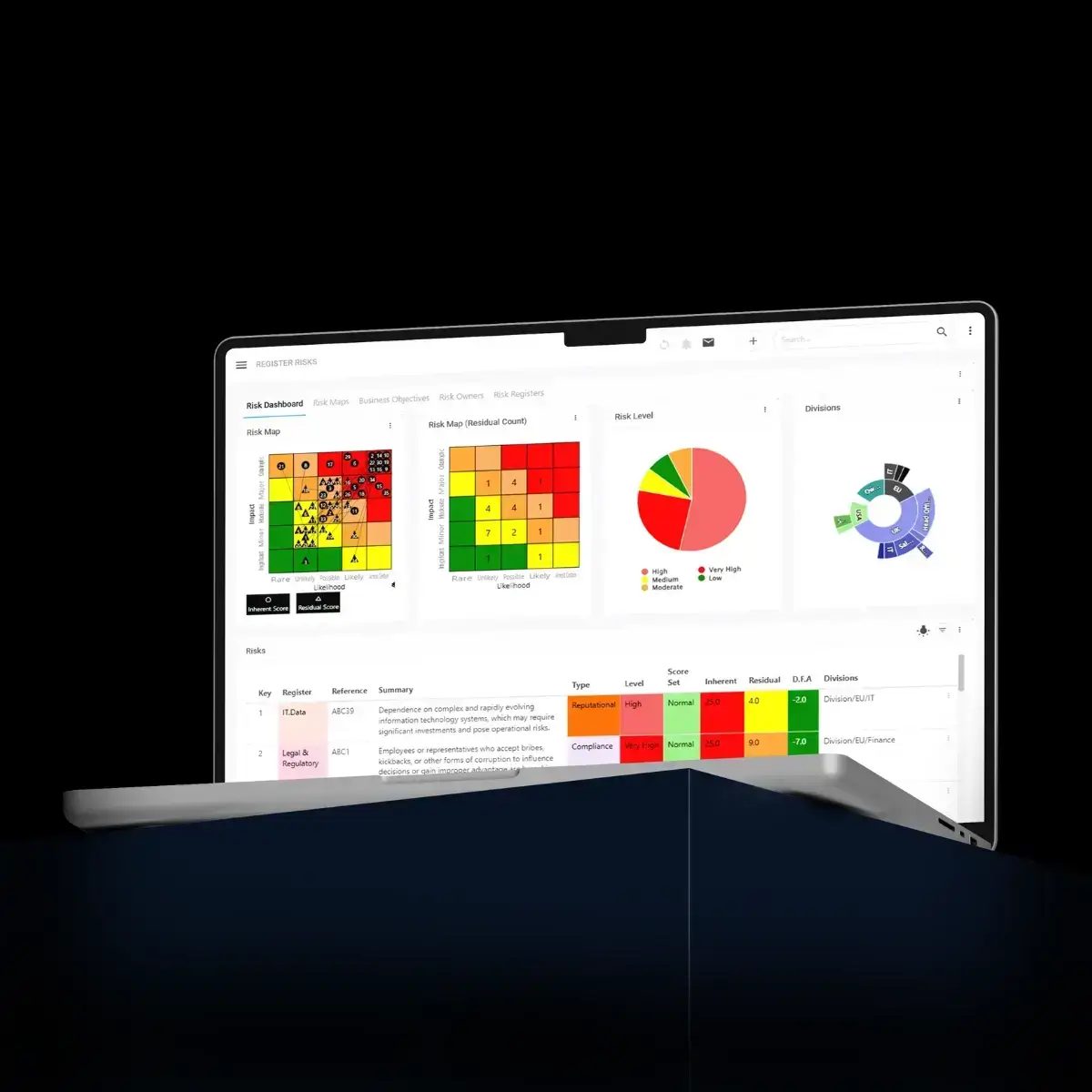
Take control of your compliance and risk processes
Move beyond spreadsheets and disconnected systems with a flexible platform that centralises your data, tracks actions, and gives you clear visibility across your organisation.
What is GDPR and Why It Matters for Risk Management
The General Data Protection Regulation (GDPR) is the EU’s gold standard for data protection and privacy. Enforced since May 2018, it modernised outdated laws and introduced strict requirements for how organisations collect, store, and use personal data. GDPR applies not only to companies based in the EU, but also to any organisation worldwide that processes EU citizens’ data.
For risk managers, GDPR compliance is non-negotiable. Failure to comply can result in fines of up to €20 million or 4% of global annual revenue, alongside reputational damage, customer loss, and operational disruption. In today’s data-driven world, GDPR is not just an IT concern, it’s a core component of risk management.
Key GDPR Compliance Requirements Organisations Must Meet
To align with GDPR, organisations must implement policies and controls that ensure data privacy, transparency, and accountability. Some of the most important requirements include:
- Parental consent for minors – companies must obtain verifiable consent before processing the data of individuals under 16.
- Data Protection Officer (DPO) – mandatory for public authorities and companies carrying out large-scale data processing.
- 72-hour breach reporting – data controllers must report breaches to supervisory authorities within three days.
- Rights of data subjects – individuals have enhanced rights, including access, correction, and erasure (“the right to be forgotten”).
These requirements apply across all industries and geographies, making GDPR a global compliance benchmark.
The Business Risks of GDPR Non-Compliance
Non-compliance with GDPR poses significant financial and reputational risks. Beyond fines, companies may face sanctions, litigation, and customer trust erosion. For risk professionals, GDPR highlights the need to embed data privacy into enterprise-wide risk management programs.
The 72-hour breach notification rule is particularly critical. In the event of a cyberattack, organisations must act quickly to contain the damage, communicate transparently, and protect their reputation. This transforms GDPR from a narrow IT security issue into a board-level risk management priority.
Risk Management Steps to Prepare for GDPR Compliance
A structured approach ensures organisations can align with GDPR requirements while strengthening their overall risk posture. Recommended steps include:
- Know the Rules – study GDPR requirements and stay updated on amendments.
- Scan Your Internal Environment – audit existing data protection processes and identify gaps.
- Identify Regulated Data – separate GDPR-relevant personal data from other categories.
- Assess and Prioritise Critical Data – run a business impact analysis on data assets.
- Update Security Measures – ensure controls meet GDPR standards across IT and operations.
- Monitor Data Protection Performance – establish ongoing monitoring and reporting to maintain compliance.
By embedding these practices into enterprise risk management frameworks, organisations can build resilience, meet regulatory requirements, and enhance stakeholder confidence.
How Risk Management Software Supports GDPR Compliance
Relying on spreadsheets or fragmented systems makes GDPR compliance difficult and risky. Modern risk management and compliance software simplifies GDPR alignment by:
- Centralising data protection frameworks in one platform.
- Automating audits, reviews, and reminders to ensure no compliance steps are missed.
- Linking GDPR requirements to risks, controls, and policies for complete oversight.
- Maintaining full audit trails to demonstrate accountability to regulators.
- Generating reports for auditors in minutes instead of weeks.
Software doesn’t just reduce the burden of compliance, it ensures GDPR requirements become an integrated part of enterprise risk management, rather than a siloed IT function.
Symbiant is Fully GDPR Compliant
At Symbiant, we understand that data protection is at the heart of GDPR compliance. Our Governance, Risk, and Compliance (GRC) and Audit Management Software has been designed with privacy and security built in.
By being fully GDPR compliant, Symbiant guarantees that your data is handled with the highest level of security and transparency.
Whether you are aligning with ISO 22301, ISO 27001, or GDPR, Symbiant provides the tools to centralise your compliance processes, automate reporting, and maintain defensible evidence of compliance for regulators, auditors, and stakeholders.
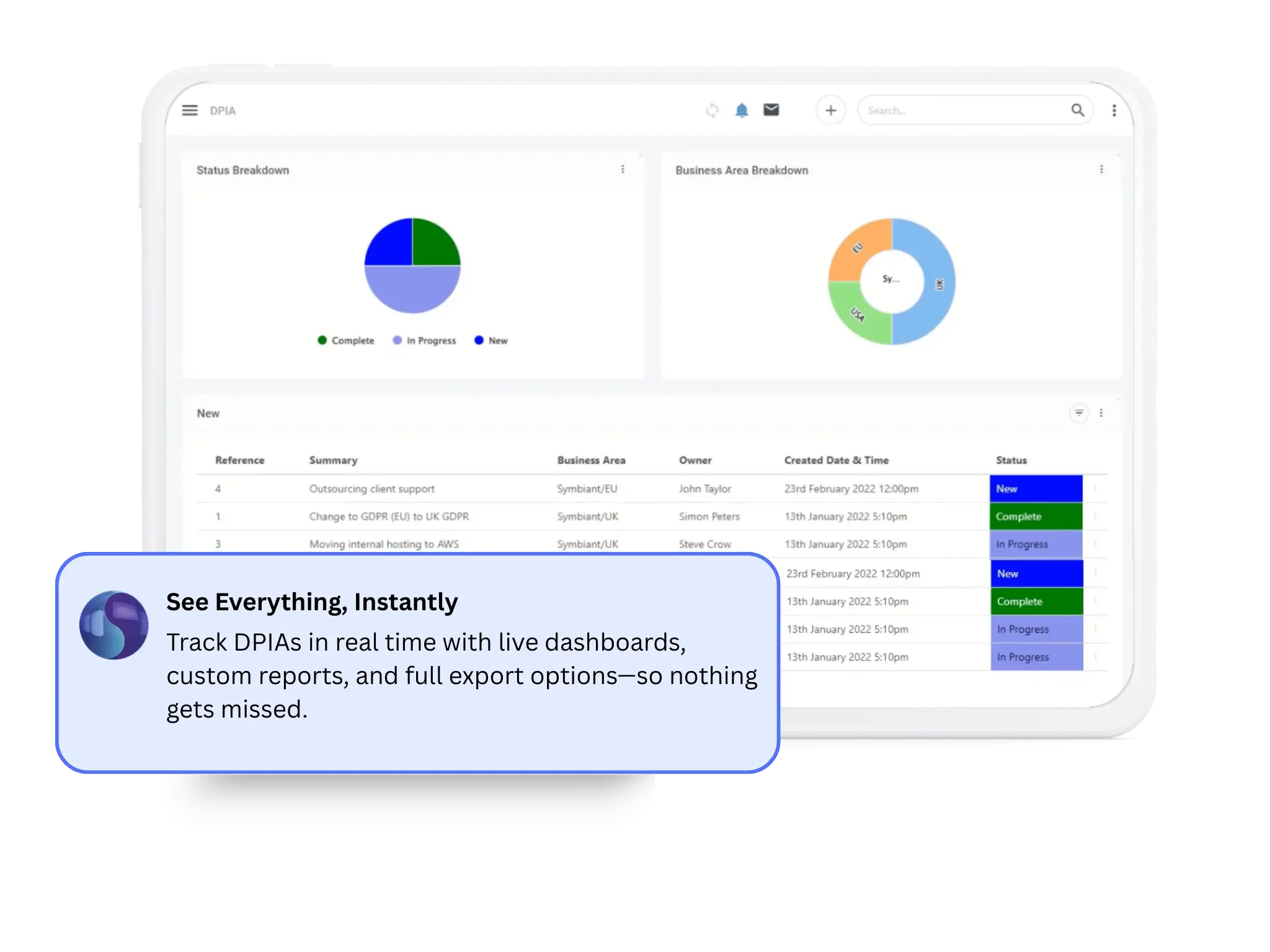
Ensure GDPR and Data Protection Compliance with Symbiant’s Data Protection Impact Assessment Software (DPIA)
Symbiant’s Compliance Monitoring Software lets you track, escalate, and resolve compliance actions with ease. Assign responsibilities, automate reminders, and ensure full visibility across every stage. Custom workflows, escalation paths, and optional AI assistance help you stay on top of your obligations.
UK GDPR vs EU GDPR: What Organisations Need to Know
Since Brexit, the UK and the EU have followed the same core data protection principles, but their regulatory paths are no longer identical. The introduction of the Data (Use and Access) Act 2025 marks the first real point of divergence for the UK GDPR, creating practical differences organisations now need to manage, especially those operating across both regions. Here’s a clear breakdown of how the two frameworks compare and what has changed.
UK GDPR vs EU GDPR: Understanding the Difference in 2025–2026
Since Brexit, the UK and the European Union have continued to share the same foundational data protection principles, but their regulatory paths are no longer identical. For organisations operating in the UK, Europe, or across both regions, understanding the distinction is essential for compliance, governance and long-term risk management.
How the Two Frameworks Originated
The EU GDPR, introduced in 2018, remains the core data protection regulation across all EU and EEA member states. When the UK left the EU, the regulation was carried over into domestic law and renamed the UK GDPR, supported by the Data Protection Act 2018.
For several years, both frameworks were essentially the same.
That changed with the introduction of the Data (Use and Access) Act 2025 (DUAA), the UK’s first move to adapt GDPR to its own regulatory environment.
Where UK GDPR and EU GDPR Are Still the Same
Even after the DUAA, the UK still follows the same seven GDPR principles, the same definitions of personal data, and the same core data subject rights. Both frameworks require organisations to:
protect personal data through technical and organisational measures
demonstrate accountability
be transparent about how data is used
maintain lawful bases for processing
respond to access, deletion and correction requests
In essence, the spirit of the GDPR survives unchanged on both sides.
Where They Now Differ
Although the foundations remain aligned, the operational rules are beginning to diverge.
1. Lawful Basis: Recognised Legitimate Interests
The DUAA introduces a list of “recognised legitimate interests” — scenarios where UK organisations may not need a full balancing test.
The EU GDPR does not offer this shortcut.
2. Automated Decision-Making (ADM)
The EU maintains stricter controls on automated decision-making, often requiring consent or contractual necessity.
Under the DUAA, UK organisations may rely on legitimate interests for some ADM activities, provided safeguards exist.
3. DSAR Search Requirements
The EU expects broad, comprehensive searches unless a request is manifestly excessive.
The UK now requires “reasonable and proportionate” searches — a more flexible and scalable approach.
4. International Data Transfers
The EU uses the “essential equivalence” standard when assessing third countries.
The UK’s DUAA introduces a new, less restrictive threshold: “not significantly worse.”
5. Cookies and PECR Enforcement
PECR fines in the UK now match GDPR-level penalties.
The EU continues to enforce cookie rules under its own mechanisms (ePrivacy + GDPR).
What This Means for Organisations
For organisations with customers, staff, or data subjects in both the UK and EU, this divergence means dual responsibilities:
compliance with the EU GDPR for data relating to individuals in the EU/EEA
compliance with the UK GDPR, as amended by the DUAA, for UK individuals
The biggest practical impact is operational: organisations must maintain processes and documentation that reflect the correct regulatory regime for each jurisdiction.
This includes:
updated DSAR workflows
reviewed lawful bases
refreshed privacy notices
reassessed ADM activities
reviewed data transfer mechanisms
strengthened complaints handling processes
updated risk, control and governance documentation
How Symbiant Helps Organisations Manage Both
With a single, centralised platform that connects risks, controls, DPIAs, incidents, complaints and audits, Symbiant helps organisations meet the expectations of both regulatory frameworks.
Whether you need to document DUAA-specific processes, track lawful bases, demonstrate accountability, or manage evidence for internal and external audits, Symbiant gives you:
a flexible, modular system
customisable workflows
dynamic questionnaires
tamper-proof audit trails
linked risks and controls
centralised governance documentation
This makes Symbiant an ideal Single Source of Truth for organisations navigating the increasingly complex post-Brexit data protection landscape.
Build a Solution Around Your Standards, Not the Other Way Around
Symbiant’s agile, modular platform is designed to align with industry standards and adapt to your organisation’s unique requirements. Whether you’re working towards ISO accreditation, regulatory compliance, or a specialised framework, our flexible approach helps you create a solution that fits your needs today and evolves with you tomorrow. If an existing module doesn’t fully support your requirements, we can tailor a module or build a bespoke solution designed around your exact processes and standards.
Ready to create a platform tailored to your requirements?

Pricing Disclaimer
* Modules are charged at a standard monthly fee, not on a per-user basis. All users can access each module at any required level. Please note that costs exclude VAT, AI features, and additional modules you may wish to use. User seats are required.