
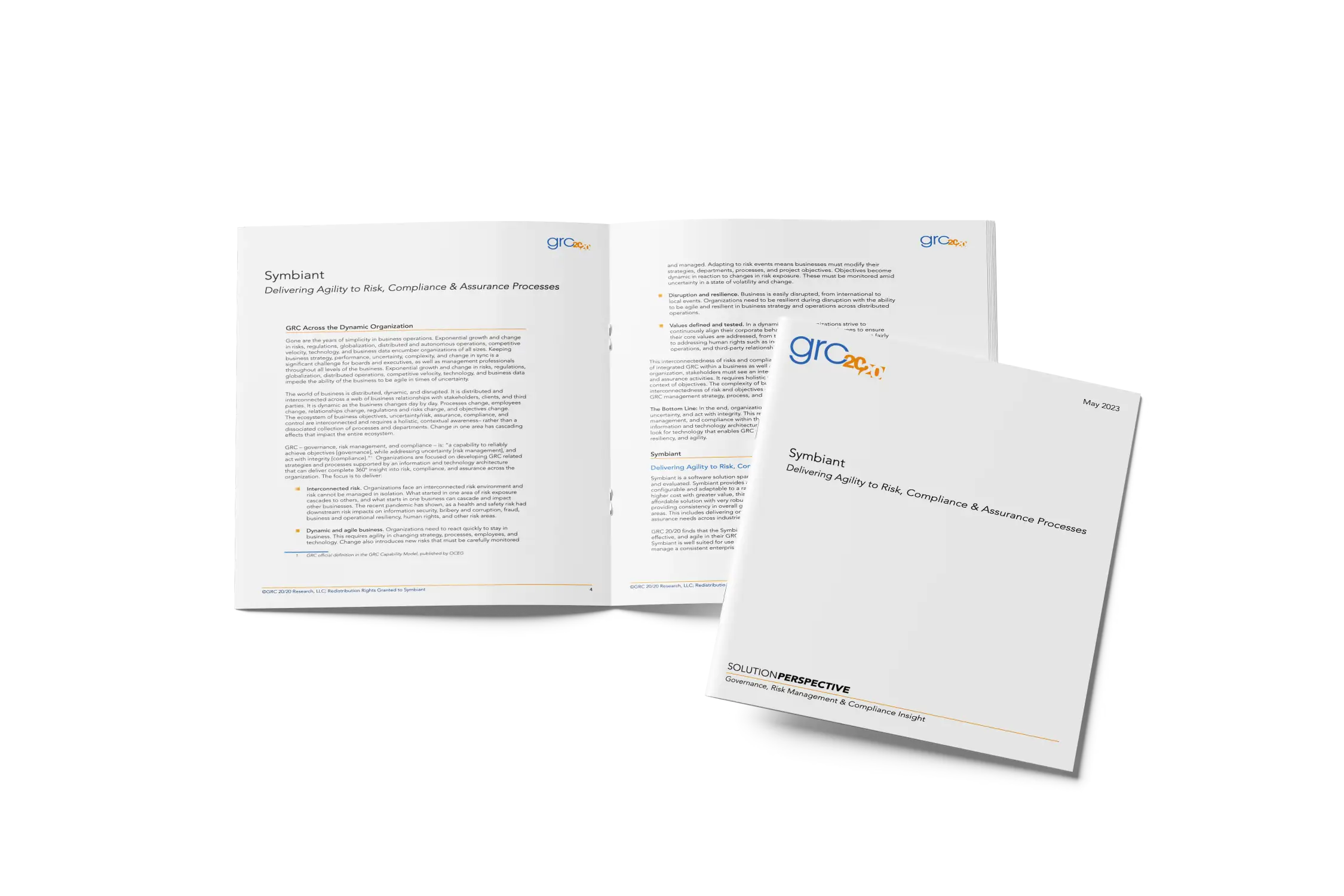
What is compliance reporting?
Compliance
Take control of your compliance and risk processes
Move beyond spreadsheets and disconnected systems with a flexible platform that centralises your data, tracks actions, and gives you clear visibility across your organisation.
Compliance reporting is the structured process of documenting and demonstrating an organisation’s adherence to regulatory requirements, internal policies, and industry standards. It provides a clear, evidence-based view of your compliance posture, whether for internal oversight or external audit.
In today’s regulatory landscape, organisations rarely deal with a single framework. Instead, they must manage multiple overlapping requirements across risk, audit, compliance, and governance functions. As a result, compliance reporting is no longer just a periodic task, it is an ongoing process that underpins visibility, accountability, and control.
Well-structured compliance reporting does more than satisfy auditors. It enables leadership teams to understand their risk exposure, track performance against regulatory obligations, and make informed decisions with confidence.
What this guide covers
In this guide, we’ll explore:
- What a compliance report is and the different types
- What a typical compliance report includes
- The key steps in the compliance reporting process
- Common challenges organisations face and how to overcome them
What is a Compliance Report?
A compliance report is a structured document that demonstrates how well an organisation adheres to applicable regulatory requirements, industry standards, and internal policies. It provides clear, evidence-based insight into an organisation’s compliance status and is typically used to support audits, regulatory reviews, and internal oversight.
Compliance reports play a critical role in validating that controls are in place, processes are being followed, and any gaps are identified and addressed. They are not just static documents—they are a reflection of how effectively compliance is managed across the organisation.
Types of Compliance Reports
The type of compliance report an organisation produces depends on its regulatory environment, industry, and GRC maturity. Common types include:
Regulatory Compliance Reports
Demonstrate adherence to external laws and regulations such as GDPR or HIPAA, often required by regulators or governing bodies.
Financial Compliance Reports
Show alignment with financial regulations and standards, such as the Sarbanes-Oxley Act (SOX), ensuring transparency and accuracy in financial reporting.
Operational Compliance Reports
Focus on internal processes and controls, ensuring that day-to-day operations follow established policies and reduce the risk of errors or non-compliance.
IT & Security Compliance Reports
Assess an organisation’s cybersecurity and information security posture, typically aligned with standards such as ISO 27001.
Environmental & ESG Compliance Reports
Environmental and ESG (Environmental, Social, and Governance) compliance reports demonstrate how an organisation meets sustainability, ethical, and regulatory expectations set by governing bodies or internal policies.
These reports typically cover areas such as:
- Environmental impact (e.g. emissions, resource usage)
- Social responsibility (e.g. workforce practices, community impact)
- Governance (e.g. policies, oversight, accountability)
With increasing regulatory focus on sustainability, ESG reporting has become a critical component of modern compliance programmes.
For example, under the EU’s Corporate Sustainability Reporting Directive (CSRD), organisations are required to disclose detailed information on environmental and social risks, as well as the impact of their operations. These reports must often be independently assured by external auditors, increasing the need for accurate, well-structured data.
Beyond Reporting: A More Connected Approach to Compliance
Compliance reporting is only one part of a broader compliance ecosystem. In practice, organisations must manage multiple frameworks, align reporting with risk and audit processes, and maintain continuous visibility across their operations.
Symbiant supports this by:
- Managing multiple frameworks in one system, reducing duplication and improving consistency
- Enabling continuous compliance, with real-time data and always up-to-date reporting
- Linking compliance with risk, audit, and remediation workflows
- Providing a single source of truth across the organisation
- Reducing manual effort and compliance fatigue through streamlined processes
This allows organisations to move beyond static reporting and adopt a more integrated, proactive approach to compliance management.
Example of Compliance Reporting
To understand how compliance reporting works in practice, consider a financial institution such as a bank operating under strict regulatory frameworks like the Dodd-Frank Act and the Sarbanes-Oxley Act (SOX). These regulations require the organisation to maintain accurate financial reporting, implement strong internal controls, and actively manage risk.
A well-structured compliance report in this context brings together multiple areas of the organisation into a single, coherent view of compliance. Rather than existing as separate documents, these elements should be connected to provide a complete and auditable picture.
Typically, such a report would include:
- Financial Statement Accuracy
Evidence demonstrating that financial records are accurate, complete, and reflect the organisation’s true financial position. - Internal Controls
Documentation of the controls in place to prevent fraud, errors, and misconduct, along with details of how these controls are tested and maintained. - Risk Management
An overview of key risks (such as credit, market, and operational risks) and the measures implemented to monitor and mitigate them. - Regulatory Changes
Updates on relevant regulatory developments and how the organisation has adapted its policies, processes, and controls in response. - Training and Awareness
Records of employee training programmes to ensure staff understand compliance obligations and follow best practices.
In many organisations, these elements are managed across different systems and teams, making it difficult to produce a single, reliable report. A more effective approach is to centralise this information, linking risks, controls, evidence, and actions, so compliance reporting becomes a continuous, real-time process rather than a manual, point-in-time exercise.
Who Requires and Uses Compliance Reporting?
Compliance reporting is relevant to most organisations, particularly those operating in regulated industries or handling sensitive data. While some reporting requirements are mandatory, others are adopted voluntarily to demonstrate strong governance and build stakeholder trust.
For example, organisations that store or process customer data often pursue frameworks such as SOC 2 to demonstrate their commitment to security and privacy. In contrast, industries like healthcare must comply with strict regulations such as HIPAA, which mandate specific controls, policies, and reporting obligations.
In practice, compliance reporting is rarely created for a single audience. It serves multiple stakeholders across the organisation and beyond.
Internal Stakeholders
Within the organisation, compliance reports are used to maintain oversight, manage risk, and support decision-making:
- Compliance officers and risk managers use reports to monitor adherence to regulations and identify gaps
- Internal auditors rely on reports to assess control effectiveness and ensure audit readiness
- Senior management and board members use reporting insights to understand risk exposure and guide strategic decisions
External Stakeholders
Outside the organisation, compliance reports provide assurance, transparency, and accountability:
- Regulators and government bodies use reports to verify adherence to legal and regulatory requirements
- External auditors and audit firms assess the accuracy of reporting and the strength of internal controls
- Investors and stakeholders review compliance posture to evaluate governance, risk, and long-term stability
Because compliance reporting serves multiple audiences, organisations often struggle to tailor reports using fragmented data from different systems. A more effective approach is to centralise compliance information, enabling consistent, accurate reporting for both internal and external stakeholders.
Benefits and Purpose of Compliance Reporting
An effective compliance reporting process is the foundation of a strong compliance management programme. It ensures that organisations not only meet regulatory requirements but also maintain visibility, accountability, and control across their operations.
Without structured reporting, organisations risk falling into reactive compliance, leading to inefficiencies, missed risks, regulatory penalties, and reputational damage.
Why Compliance Reporting Matters
Effective compliance reporting goes beyond documentation. It plays a critical role in how organisations manage risk, demonstrate accountability, and support decision-making.
Demonstrates Regulatory Adherence
Compliance reporting provides clear, auditable evidence that your organisation meets relevant laws, standards, and internal policies. This is essential for maintaining trust with regulators, customers, and investors.
Improves Audit Readiness
A well-structured reporting process ensures that evidence, controls, and documentation are readily available—making audits smoother, faster, and less disruptive.
Identifies Gaps and Drives Improvement
Regular reporting highlights areas of partial or non-compliance, enabling organisations to take corrective action before issues escalate.
Supports Better Decision-Making
Compliance reports translate complex data into actionable insights, helping leadership prioritise risks, allocate resources effectively, and justify compliance investments.
Strengthens Risk Management
Ongoing reporting enables organisations to identify and monitor risks across areas such as data privacy, cybersecurity, and operations—supporting a more proactive approach to risk mitigation.
Ensures Accountability Across the Organisation
By clearly documenting compliance activities, responsibilities, and outcomes, reporting creates transparency and holds teams accountable for maintaining compliance standards.
What does a compliance report consist of?
The structure of a compliance report will vary depending on the regulatory framework, industry, and scope of assessment. However, most effective compliance reports follow a consistent structure to provide a clear, evidence-based view of an organisation’s compliance status.
A well-designed report should include the following core components:
Executive Summary
A high-level overview of key findings, compliance status, and recommended actions. This section is designed for senior stakeholders who need quick, decision-ready insights without reviewing the full report.
Scope and Objectives
Defines what has been assessed, including systems, processes, business units, and time periods. It should also clarify which regulations, standards, or internal policies the report is aligned with.
Methodology and Process Review
Explains how the assessment was conducted, including:
- Risk assessment approaches
- Control design and testing
- Evidence collection methods
- This ensures transparency and credibility in how conclusions were reached.
Compliance Status and Key Findings
Provides a detailed view of:
- Areas of full, partial, or non-compliance
- Results of control testing
- Identified gaps and weaknesses
- This is the core analytical section of the report.
Risk Assessment
Outlines the potential impact of non-compliance, including legal, financial, operational, and reputational risks. It helps prioritise remediation efforts based on severity and likelihood.
Action Plan and Next Steps
Defines the actions required to address identified gaps, including:
- Recommended remediation steps
- Responsible owners
- Timelines for completion
This section ensures the report drives real outcomes—not just documentation.
Supporting Evidence and Documentation
Includes all relevant supporting materials such as:
- Policies and procedures
- Audit logs and test results
- Charts, data, and references
This provides the audit trail needed to validate findings.
Benefits and Purpose of Compliance Reporting
An effective compliance reporting process is the foundation of a strong compliance management programme. It ensures that organisations not only meet regulatory requirements but also maintain visibility, accountability, and control across their operations.
Without structured reporting, organisations risk falling into reactive compliance, leading to inefficiencies, missed risks, regulatory penalties, and reputational damage.
Why Compliance Reporting Matters
Effective compliance reporting goes beyond documentation. It plays a critical role in how organisations manage risk, demonstrate accountability, and support decision-making.
Demonstrates Regulatory Adherence
Compliance reporting provides clear, auditable evidence that your organisation meets relevant laws, standards, and internal policies. This is essential for maintaining trust with regulators, customers, and investors.
Improves Audit Readiness
A well-structured reporting process ensures that evidence, controls, and documentation are readily available—making audits smoother, faster, and less disruptive.
Identifies Gaps and Drives Improvement
Regular reporting highlights areas of partial or non-compliance, enabling organisations to take corrective action before issues escalate.
Supports Better Decision-Making
Compliance reports translate complex data into actionable insights, helping leadership prioritise risks, allocate resources effectively, and justify compliance investments.
Strengthens Risk Management
Ongoing reporting enables organisations to identify and monitor risks across areas such as data privacy, cybersecurity, and operations—supporting a more proactive approach to risk mitigation.
Ensures Accountability Across the Organisation
By clearly documenting compliance activities, responsibilities, and outcomes, reporting creates transparency and holds teams accountable for maintaining compliance standards.
How Symbiant GRR & Audit Software Improves Compliance Reporting
For many organisations, compliance reporting is slowed down by fragmented systems, manual processes, and inconsistent data. Teams spend significant time gathering evidence, reconciling spreadsheets, and preparing reports—often only achieving a point-in-time view of compliance.
Symbiant addresses these challenges by providing a connected GRC platform that brings all compliance data together into a single, structured system.
A Single Source of Truth for Compliance
Symbiant centralises all compliance-related data, including risks, controls, incidents, audits, and actions—into one unified platform.
This eliminates the need to pull information from multiple systems and ensures that compliance reports are always based on consistent, up-to-date data.
End-to-End Visibility Across GRC Processes
Unlike traditional tools that treat compliance as a standalone activity, Symbiant connects compliance reporting directly to operational workflows:
- Risks are linked to controls and assessments
- Controls are tied to evidence and testing
- Issues and incidents are tracked through to resolution
- Audit findings feed directly into reporting
This connected approach ensures that reports reflect the real state of compliance across the organisation.
Streamlined Evidence Collection and Audit Readiness
Manual evidence collection is one of the biggest bottlenecks in compliance reporting.
Symbiant simplifies this by:
- Centralising documentation and audit trails
- Tracking updates and changes automatically
- Making evidence instantly accessible for reporting and audits
- This reduces preparation time and improves confidence in reporting accuracy.
Real-Time Compliance Monitoring
Traditional compliance reporting is often retrospective, requiring significant effort to compile.
With Symbiant, compliance data is continuously updated, enabling:
- Real-time visibility of compliance status
- Faster identification of gaps and risks
- Ongoing audit readiness without last-minute preparation
Workflow Automation and Accountability
Symbiant helps organisations move beyond static reporting by embedding compliance into daily operations:
- Tasks and controls are assigned to responsible owners
- Automated reminders and notifications keep processes on track
- Progress is tracked across remediation actions
This ensures that compliance reporting reflects active management, not just documentation.
Flexible Reporting for Different Stakeholders
Compliance reporting needs vary across the organisation. Symbiant supports:
- Detailed reports for auditors and regulators
- Insight-driven summaries for senior management
- Operational views for compliance and risk teams
All reports are generated from the same underlying data, ensuring consistency and accuracy across audiences.
From Manual Reporting to Continuous Compliance
Rather than treating compliance reporting as a periodic exercise, Symbiant enables a continuous, integrated approach.
By connecting data, workflows, and reporting in one platform, organisations can reduce manual effort, improve visibility, and maintain a stronger, more resilient compliance posture.
Take control of your compliance and risk processes
Move beyond spreadsheets and disconnected systems with a flexible platform that centralises your data, tracks actions, and gives you clear visibility across your organisation.