

Regulatory expectations are changing rapidly. Organisations are being asked not only to identify and assess risk, but also to demonstrate how risks are monitored, controlled, escalated and managed over time.
This places increasing pressure on risk, compliance and audit teams. Regulators, boards and other stakeholders expect timely information, clear accountability and reliable evidence that risk management processes are working effectively.
Yet many organisations still manage risks through disconnected spreadsheets, documents, emails and departmental systems. This makes it difficult to maintain a complete view of exposure, identify emerging issues or explain why particular risk decisions were made.
As regulatory pressure intensifies in 2026, organisations need a more connected and continuous approach to risk management.
This article examines the forces reshaping the risk landscape and outlines seven practical ways organisations can strengthen their risk management processes.
Why is regulatory pressure increasing in 2026?
The modern risk environment is increasingly interconnected. Cybersecurity, data protection, operational resilience, third-party dependencies, artificial intelligence and regulatory compliance can no longer be managed as entirely separate concerns.
A control failure in one area can quickly create consequences elsewhere. A supplier disruption might affect operational resilience. A cyber incident might trigger data-protection obligations. An inadequately governed AI system could introduce regulatory, reputational and operational risks simultaneously.
Regulatory expectations are evolving in response to these connections. Four developments are particularly important in 2026.
1. Greater accountability at leadership level
Boards and senior leaders are increasingly expected to understand their organisation’s principal risks and demonstrate appropriate oversight.
It is no longer sufficient for risk information to remain within individual departments. Decision-makers need clear evidence showing:
- Who owns each risk
- How the risk has been assessed
- Which controls are in place
- Whether those controls are effective
- What actions have been agreed
- Whether the organisation is operating within its risk appetite
This requires reliable reporting and a traceable history of assessments, decisions and actions.
2. Shorter incident-reporting timescales
Several regulatory regimes require organisations to assess and report qualifying incidents within strict timescales.
Under the UK GDPR, for example, a reportable personal data breach must generally be reported to the Information Commissioner’s Office without undue delay and, where feasible, within 72 hours. Organisations must therefore be able to capture incidents, assess their potential consequences and escalate them quickly.( source: ICO guidance )
Requirements such as the EU’s NIS2 Directive and Digital Operational Resilience Act also introduce structured notification processes for organisations within their scope. NIS2 includes an early-warning stage within 24 hours, while DORA establishes reporting requirements for major ICT-related incidents.( source: NIS2 Directive, DORA reporting requirements. )
These deadlines make fragmented email- and spreadsheet-based processes increasingly difficult to defend.
3. Stronger operational-resilience expectations
Regulators increasingly expect organisations to demonstrate that critical services can continue during disruption.
Documenting a business continuity plan is only part of that process. Organisations must also understand their critical activities, dependencies, risks and controls, and be able to show that plans have been reviewed, tested and improved.
In the UK, the Cyber Security and Resilience Bill is intended to strengthen the country’s existing cyber and resilience framework, expand regulatory coverage and increase protections for essential and digital services. ( source: UK Government summary)
4. The emergence of AI governance
Artificial intelligence is creating opportunities for organisations, but it also introduces new risks involving transparency, privacy, accuracy, security, bias and accountability.
Organisations need to understand where AI is being used, what information it processes, who is responsible for it and how its outputs are reviewed. AI-related risks should form part of the wider risk and control environment rather than being maintained in an isolated register.
Why traditional risk management is becoming inadequate
Traditional risk management processes are often built around periodic reviews and reporting cycles. These can provide useful snapshots, but they may not reflect changes occurring between assessments.
Three limitations are particularly common.
Static assessments create blind spots
A risk assessment represents a particular moment in time. If there is no structured process for reviewing changes, risk information can quickly become outdated.
New incidents, control failures, overdue actions and changing key risk indicators may all affect an organisation’s exposure before the next formal review takes place.
Disconnected systems obscure relationships
Risks rarely exist independently. They may be connected to controls, incidents, regulations, objectives, suppliers, audits and remedial actions.
When this information is stored across separate spreadsheets or systems, teams cannot easily see those relationships. Management may receive several conflicting versions of the same risk rather than one reliable organisational view.
Manual administration limits scalability
Chasing risk owners, consolidating spreadsheets and manually preparing reports consume valuable time. As the organisation grows and regulatory obligations increase, these processes become increasingly difficult to manage consistently.
Technology cannot replace professional judgement, but it can provide the structure, visibility and evidence needed to apply that judgement more effectively.
Seven risk management best practices for 2026
1. Move towards continuous risk monitoring
Annual or quarterly assessments alone may not provide sufficient visibility in a rapidly changing environment.
Organisations should establish processes that allow risks to be reviewed when relevant information changes, not simply when the next assessment date arrives.
This could include monitoring:
- Key risk indicators
- Control performance
- Incidents and near misses
- Overdue actions
- Audit findings
- Regulatory changes
- Changes to critical suppliers or processes
Symbiant’s award-winning, highly trusted GRC software helps organisations connect these elements within one secure, connected single source of truth. Key risk indicators, controls, incidents and actions can be linked to the risks they affect, helping teams identify changes that may require reassessment or escalation.
Automated notifications and reminders can also help ensure that reviews and actions are not overlooked.
2. Establish a single source of truth
Different teams may use different terminology, scoring methods and reporting formats. Without a common structure, comparing risks across the organisation becomes difficult.
A centralised risk register provides a consistent foundation for recording:
- Risk descriptions
- Causes and consequences
- Inherent and residual scores
- Risk owners
- Controls and assurance
- Treatment decisions
- Actions and deadlines
- Supporting documentation
Symbiant provides a central environment in which organisations can manage multiple risk registers while maintaining organisation-wide visibility.
Configurable fields, scoring methodologies and workflows allow the platform to reflect the organisation’s existing framework instead of forcing every team into a rigid, predefined model.
3. Connect risk management to business objectives
Risk management is most valuable when it supports decision-making.
Every significant risk should be considered in relation to the objectives, services, projects or processes it could affect. This helps leaders understand not only how likely a risk is, but why it matters to the organisation.
For example, a supplier outage is more than an isolated third-party risk. It may threaten a critical service, affect customer commitments, activate a business continuity plan and create financial or reputational consequences.
Symbiant allows risks to be connected with business objectives and other relevant GRC records. This creates clearer context for decision-makers and helps teams prioritise resources according to potential organisational impact.
4. Strengthen control management
Recording a control does not prove that it is operating effectively.
Organisations should distinguish between:
- The intended design of a control
- Whether the control has been implemented
- How frequently it operates
- Who owns it
- How its effectiveness is assessed
- What happens when it fails
Controls should also be linked to the risks and regulatory requirements they address. This allows teams to understand whether important risks are adequately controlled and whether the same control supports several obligations.
With Symbiant’s Controls and Policies capabilities, organisations can maintain a central control library, assign ownership and connect controls with risks, policies and other GRC activities.
Control assessments and testing results can provide evidence of effectiveness. Where weaknesses are identified, remedial actions can be assigned and monitored through to completion.
5. Integrate incidents with the risk process
Incidents provide valuable evidence about whether risks and controls are being understood correctly.
When an incident occurs, organisations should consider:
- Was the corresponding risk already identified?
- Did an existing control fail?
- Has the likelihood or impact changed?
- Does a new risk need to be recorded?
- Are further actions or controls required?
- Could the incident affect other departments or processes?
If incidents are managed separately, these lessons may never reach the risk register.
Symbiant’s Incident Reporter allows incidents and near misses to be captured and connected with related risks, controls and actions. This helps organisations move beyond simply recording what happened and use incidents to improve the wider control environment.
It also creates a more complete audit trail of the organisation’s response.
6. Test resilience through scenarios and assessments
A plan may appear effective on paper but behave very differently during a real disruption.
Scenario exercises, control testing, questionnaires and assessments can help organisations examine how risks might develop and whether their response arrangements are practical.
Exercises might consider:
- Loss of a critical technology service
- Disruption affecting an important supplier
- A significant personal data breach
- Ransomware or another cyber incident
- Loss of access to premises
- Failure of a key business process
- Unavailability of critical personnel
The results should be documented, reviewed and translated into actions.
Symbiant’s Business Continuity, Questionnaires and Assessments, Controls and Action Tracker modules can support this process. Findings can be recorded centrally, assigned to accountable owners and tracked until the required improvements have been completed.
7. Connect risk, compliance and audit
Risk, compliance and internal audit perform different functions, but they depend on much of the same information.
Compliance teams need to understand which controls address regulatory obligations. Risk teams need assurance that those controls are effective. Auditors need evidence showing how risks were assessed, how controls were tested and whether previous findings were resolved.
When each function maintains separate records, work is duplicated and assurance gaps can emerge.
A connected GRC platform enables information to flow between these activities. Within Symbiant:
- Risks can be linked to controls and requirements.
- Incidents can identify control weaknesses.
- Control failures can trigger remedial actions.
- Audit findings can be connected to affected risks.
- Actions can be assigned and tracked to completion.
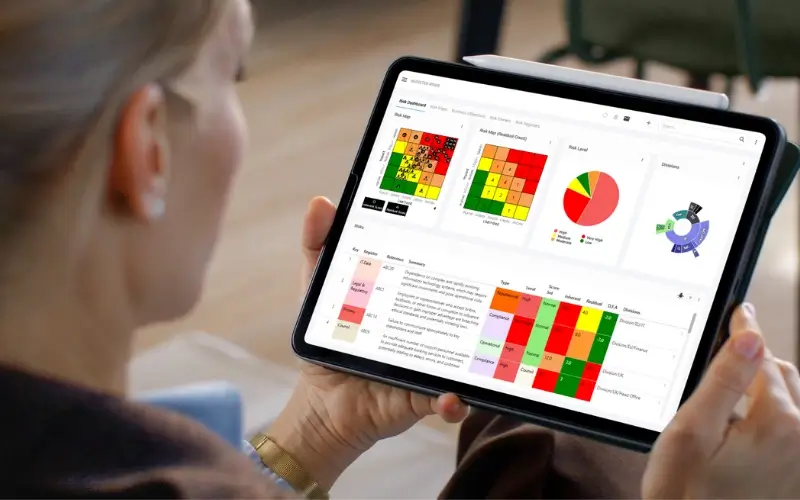
- Dashboards can provide management with an integrated view.
This supports clearer accountability and helps organisations demonstrate how their risk, compliance and assurance activities work together.
Building a more defensible risk management process
Regulatory pressure in 2026 is not simply creating more reporting. It is changing what organisations must be able to demonstrate.
Regulators and boards increasingly expect evidence that risks are understood, controls are operating, incidents are escalated and corrective actions are completed.
That evidence is difficult to produce when information is fragmented across spreadsheets, inboxes and departmental systems.
Symbiant brings risk, controls, compliance, incidents, business continuity, assessments, actions and audit together within one configurable GRC platform. Organisations can select the modules they need and expand their system as their requirements evolve.
By creating clearer relationships between risk information, ownership, evidence and action, Symbiant helps organisations replace isolated snapshots with a more connected and accountable approach to GRC.
Discover a more connected approach to risk management
See how Symbiant can help your organisation centralise risk information, strengthen control oversight and demonstrate a clear, auditable approach to managing uncertainty.