
Control Monitoring
Continuous Control Monitoring: A Practical Guide for Stronger GRC
Take control of your compliance and risk processes
Move beyond spreadsheets and disconnected systems with a flexible platform that centralises your data, tracks actions, and gives you clear visibility across your organisation.
Traditional control reviews provide an important snapshot of an organisation’s control environment. However, when assessments are performed only periodically, control failures, overdue reviews and emerging compliance gaps can remain unnoticed between reporting cycles.
Continuous control monitoring (CCM) provides a more proactive approach. By regularly assessing control performance, tracking key indicators and assigning clear accountability, organisations can identify weaknesses earlier and respond before they develop into significant risks, incidents or compliance failures.
This guide explains:
- What continuous control monitoring is
- How CCM differs from continuous auditing
- The principal benefits of monitoring controls continuously
- How to establish an effective CCM process
- How Symbiant GRC connects controls with risks, incidents, audits and remedial actions
What is continuous control monitoring?
Continuous control monitoring is the ongoing assessment of whether an organisation’s controls remain present, appropriate and effective.
These controls may relate to:
- Risk management
- Regulatory compliance
- Information security
- Finance
- Operations
- Corporate governance
- Health and safety
- Third-party management
- Business continuity
Rather than waiting for an annual audit or scheduled review to reveal a problem, CCM uses regular assessments, control indicators, alerts and reporting workflows to provide more timely visibility.
“Continuous” does not necessarily mean that every control must be tested automatically or in real time. The appropriate monitoring frequency depends on the control, the associated risk and the availability of reliable data. A critical cybersecurity control may require near-real-time monitoring, while a governance policy might be reviewed quarterly or following a regulatory change.
The purpose is to replace isolated, point-in-time assessments with a structured process that keeps control information current, visible and actionable.
Why are periodic control reviews no longer enough?
Organisations operate in environments where risks, regulations, technologies and responsibilities can change quickly. A control that was effective during the previous audit may no longer adequately address the organisation’s current exposure.
Common limitations of traditional control monitoring include:
- Control failures being identified too late
- Reviews depending heavily on spreadsheets and email reminders
- Unclear ownership of controls and remedial actions
- Inconsistent testing and evidence collection
- Limited visibility across departments or business units
- Control information becoming outdated between assessments
- Risks, controls, incidents and audits being managed separately
- Difficulty demonstrating an effective control environment to senior management or auditors
Continuous monitoring helps organisations identify these changes earlier and maintain a more accurate view of control performance.
Continuous control monitoring and continuous auditing
Continuous control monitoring and continuous auditing are related, but they serve different purposes.
| Process | Primary users | Main purpose |
|---|---|---|
| Continuous control monitoring | Risk, compliance, control owners, operational teams and management | Monitor whether controls remain effective, identify weaknesses and initiate corrective action. |
| Continuous auditing | Internal audit and assurance teams | Provide ongoing, independent assurance over controls, processes and areas of risk. |
Control monitoring is normally a management responsibility and forms part of the first and second lines of defence. Internal audit, as the third line, independently evaluates whether the control framework and monitoring activities are working as intended.
Connecting these processes gives auditors access to current control information while preserving the independence of the audit function.
What are the benefits of continuous control monitoring?
Earlier identification of control weaknesses
Regular monitoring helps organisations detect deteriorating or failed controls before they contribute to a major incident, financial loss or regulatory breach.
Clearer ownership and accountability
Every control can be assigned to an accountable owner, with defined review dates, responsibilities and escalation routes. This reduces the likelihood of important activities being overlooked.
More efficient compliance management
When controls are linked to applicable requirements, policies and evidence, compliance teams can see where obligations are being met and where further action is necessary.
Better risk visibility
Linking controls directly to risks helps decision-makers understand whether important exposures are being adequately managed. When a control becomes ineffective, the associated residual risk can be reviewed rather than relying on an outdated assessment.
Improved audit readiness
Maintaining current control records, assessments, evidence and action histories makes it easier to demonstrate how controls have been monitored over time.
Faster remediation
When a weakness is identified, responsible individuals can be notified and corrective actions can be assigned, tracked and escalated through to completion.
More informed decision-making
Dashboards and reports provide management with a clearer view of control effectiveness, outstanding actions, emerging trends and areas requiring investment.
Key elements of an effective control-monitoring system
A central control library
A central repository provides a consistent record of controls across the organisation. Each control should include information such as:
- Control purpose
- Control owner
- Related risks and objectives
- Control type
- Review frequency
- Testing method
- Current effectiveness
- Supporting evidence
- Associated policies and requirements
- Outstanding actions
This creates a single source of truth and reduces dependence on separate spreadsheets, documents and email trails.
Connected risk and control information
Controls should not be assessed in isolation. Connecting them with the risks they are designed to manage makes it possible to understand the effect of a control failure on residual exposure.
This relationship also helps organisations identify:
- Risks without adequate controls
- Controls duplicated across multiple risks
- Controls that no longer address the underlying exposure
- High-risk areas requiring more frequent monitoring
- Failed controls that require a new risk assessment
Defined control assessments
Each control should have an appropriate assessment method. Depending on its nature, this might include:
- Pass-or-fail testing
- Control self-assessments
- Evidence reviews
- Management attestations
- Questionnaires
- Performance measures
- Sample testing
- Audit testing
- Automated data feeds
- Observation of the control in operation
The method should provide enough evidence to support a reliable conclusion about the control’s design and operating effectiveness.
Key risk indicators
Key risk indicators provide early warning that exposure may be increasing or a control may no longer be operating effectively.
Useful KRIs should be:
- Relevant to a specific risk or control
- Measurable
- Based on reliable information
- Sensitive enough to provide an early warning
- Assigned to an owner
- Supported by thresholds and escalation rules
For example, an organisation might monitor overdue access reviews, unresolved high-priority incidents, supplier assessments approaching expiry or the percentage of mandatory training completed.
Alerts and escalation workflows
Monitoring only adds value when identified issues lead to action. Notifications and escalation workflows can alert relevant owners when:
- A control assessment is overdue
- A KRI crosses an agreed threshold
- A control is assessed as ineffective
- Supporting evidence has expired
- A remedial action misses its deadline
- An incident indicates that a control may have failed
- A risk exceeds the organisation’s appetite or tolerance
Reporting and audit trails
Control-monitoring reports should allow different stakeholders to see the information relevant to their responsibilities.
Senior management may need an overview of control effectiveness and significant weaknesses, while control owners need detailed information about upcoming reviews and outstanding actions.
A complete audit trail should record assessments, decisions, evidence, approvals and changes over time.
Common applications of continuous control monitoring
Risk and control management
Organisations can monitor whether controls remain effective against their associated risks and reassess residual exposure when performance changes.
Compliance monitoring
Controls can be linked to regulatory requirements, internal policies and compliance obligations. This makes it easier to identify gaps and demonstrate how individual requirements are being addressed.
Policy management
Policy owners can monitor review dates, approvals, staff acknowledgement and related controls to ensure important documents remain current.
Incident management
Incidents may reveal that a control has failed or that an existing risk assessment is incomplete. Connecting incident and control information helps organisations identify root causes and implement appropriate improvements.
Internal audit
Internal auditors can use current risk and control information when planning audits, selecting areas for testing and following up agreed recommendations.
Third-party risk management
Supplier controls, assessments, due-diligence findings and remedial actions can be monitored throughout the relationship—not only during initial onboarding.
Business continuity
Continuity plans, recovery controls and testing activities can be reviewed regularly, with weaknesses and improvement actions tracked to completion.
How to implement continuous control monitoring
1. Identify your most important risks and controls
Begin with the risks that could have the greatest effect on strategic objectives, regulatory obligations, customers or critical operations.
Review existing risk registers, audit findings, incidents, compliance assessments and policies to identify the controls already in place.
Not every control requires the same level of monitoring. Prioritise controls associated with:
- High or critical risks
- Important regulatory requirements
- Previous incidents or audit findings
- Critical systems and processes
- Significant financial or operational exposure
- Areas undergoing substantial change
2. Define control objectives
For every important control, document what it is intended to achieve.
A strong control objective should explain the outcome expected from the control rather than merely describing an activity. It should also connect with the relevant business objective, risk or compliance requirement.
For example, instead of defining a control as “access review completed quarterly,” the objective might be “ensure that access to sensitive information remains restricted to authorised individuals.”
3. Assign accountable owners
Each control should have a named owner responsible for maintaining it, completing assessments, providing evidence and addressing weaknesses.
Responsibilities should also be established for:
- Reviewing assessment results
- Approving control changes
- Managing exceptions
- Completing remedial actions
- Escalating significant failures
4. Decide how and when controls will be assessed
Establish a testing method and frequency based on the importance and nature of each control.
Monitoring may take place:
- Continuously or in near real time
- Daily or weekly
- Monthly
- Quarterly
- Annually
- Following a significant change
- After an incident or control failure
Frequency should reflect risk. A critical control protecting sensitive customer information will normally require closer monitoring than a low-risk administrative control.
5. Establish indicators and thresholds
Define the measurements that will indicate whether the control is functioning as expected. Where appropriate, establish green, amber and red thresholds so that deteriorating performance can be identified before complete failure occurs.
Each threshold should have a corresponding response, such as notifying the control owner, escalating the issue or initiating a formal action plan.
6. Connect risks, controls, incidents and compliance requirements
Integrating these records provides the context needed to evaluate the wider impact of a control weakness.
If an incident occurs, teams should be able to identify the relevant controls and risks. If a control fails, they should be able to review its effect on compliance obligations and residual risk.
7. Track corrective actions to completion
When monitoring reveals a weakness, create a clear remedial action containing:
- The problem identified
- The required response
- The responsible owner
- A target completion date
- Its priority
- Supporting evidence
- Review and approval requirements
Overdue or high-priority actions should be escalated so that control weaknesses do not remain unresolved.
8. Report and improve
Use dashboards and reports to identify trends, recurring failures and areas where controls may be duplicated or no longer appropriate.
Continuous control monitoring should be treated as an evolving process. Monitoring methods, thresholds and reporting arrangements should be reviewed as the organisation’s risks and objectives change.
How Symbiant supports continuous control monitoring
Symbiant GRC brings risk, control, compliance, incident and audit information together within one connected platform.
Rather than maintaining separate control spreadsheets and manually reconciling information across departments, organisations can use Symbiant to establish a central control environment with clear ownership, structured assessments and traceable actions.
With Symbiant, organisations can:
- Create a central library of controls and policies
- Link controls directly to risks and business objectives
- Record inherent and residual risk assessments
- Assign control owners and review responsibilities
- Schedule assessments and recurring reviews
- Use questionnaires and assessments to evaluate control performance
- Define and monitor key risk indicators
- Receive notifications when reviews or actions are due
- Connect incidents with relevant risks and controls
- Record control weaknesses and improvement actions
- Track remedial actions through to completion
- Provide auditors with a clear history of assessments, evidence and decisions
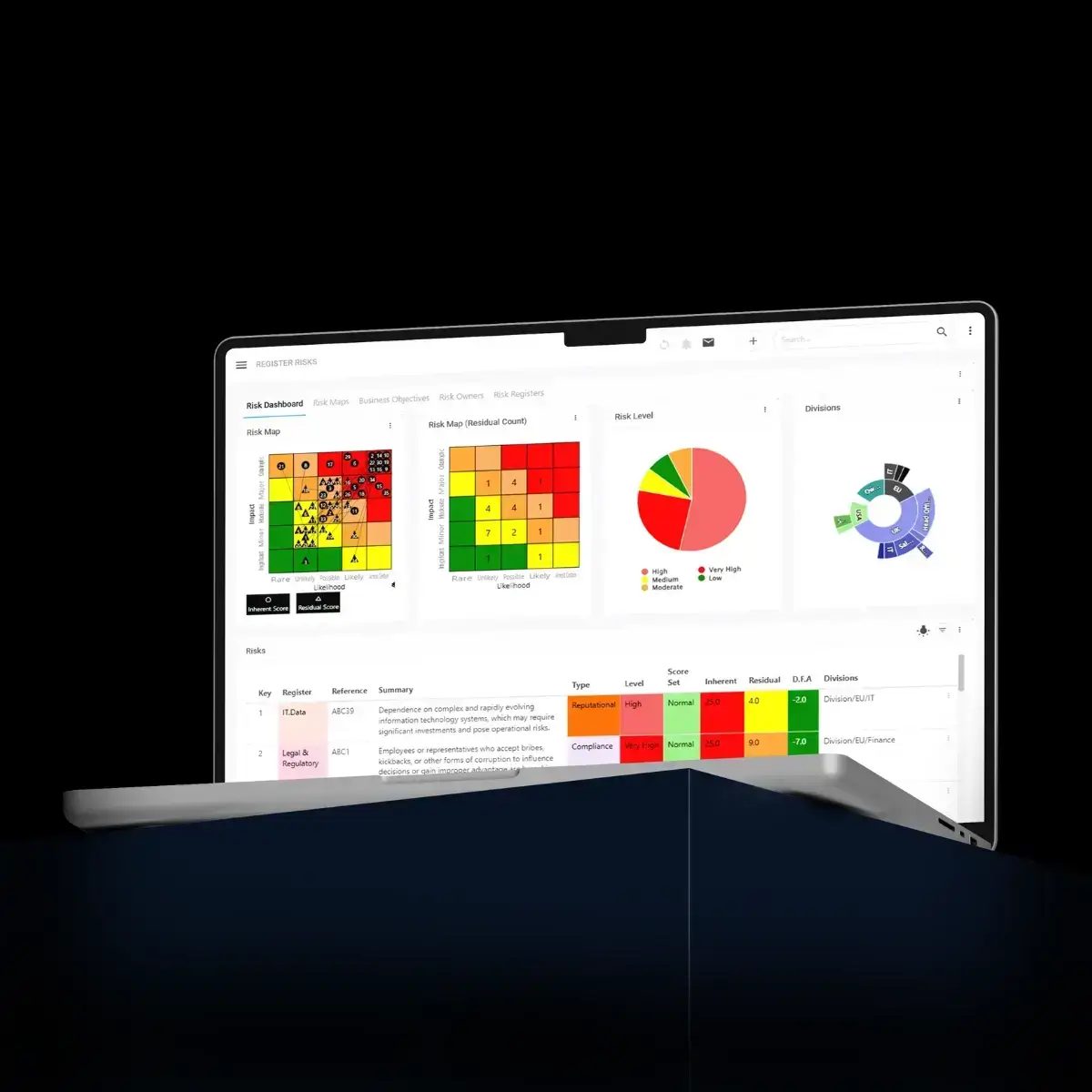
- Produce dashboards and reports for different stakeholders
Symbiant’s modular structure allows organisations to select the capabilities they need and expand the platform as their GRC programme develops.
Build a more connected control environment with Symbiant
Continuous control monitoring is not simply about conducting more frequent tests. It is about giving organisations an accurate, connected and actionable view of whether their controls continue to protect important objectives.
By connecting controls with risks, incidents, compliance obligations, indicators, audits and remedial actions, Symbiant helps organisations identify weaknesses earlier, strengthen accountability and maintain a clearer view of their overall control environment.
Discover how Symbiant GRC can help your organisation monitor controls, manage risk and maintain audit-ready evidence. Request a personalised demonstration today.

Pricing Disclaimer
* Modules are charged at a standard monthly fee, not on a per-user basis. All users can access each module at any required level. Please note that costs exclude VAT, AI features, and additional modules you may wish to use. User seats are required.