
Risk Controls Software
Control Testing and Controls Management: Building an Effective Framework for Risk, Compliance, and Resilience
Control testing is a critical part of effective risk management, ensuring that the controls organisations rely on to manage risk are operating as intended. While many organisations have documented controls, far fewer regularly test their effectiveness or maintain clear, auditable evidence that those controls are working.
This guide explains what control testing is, why it matters, and how a connected controls management approach helps organisations strengthen governance, improve compliance, and build greater operational resilience.
Take control of your compliance and risk processes
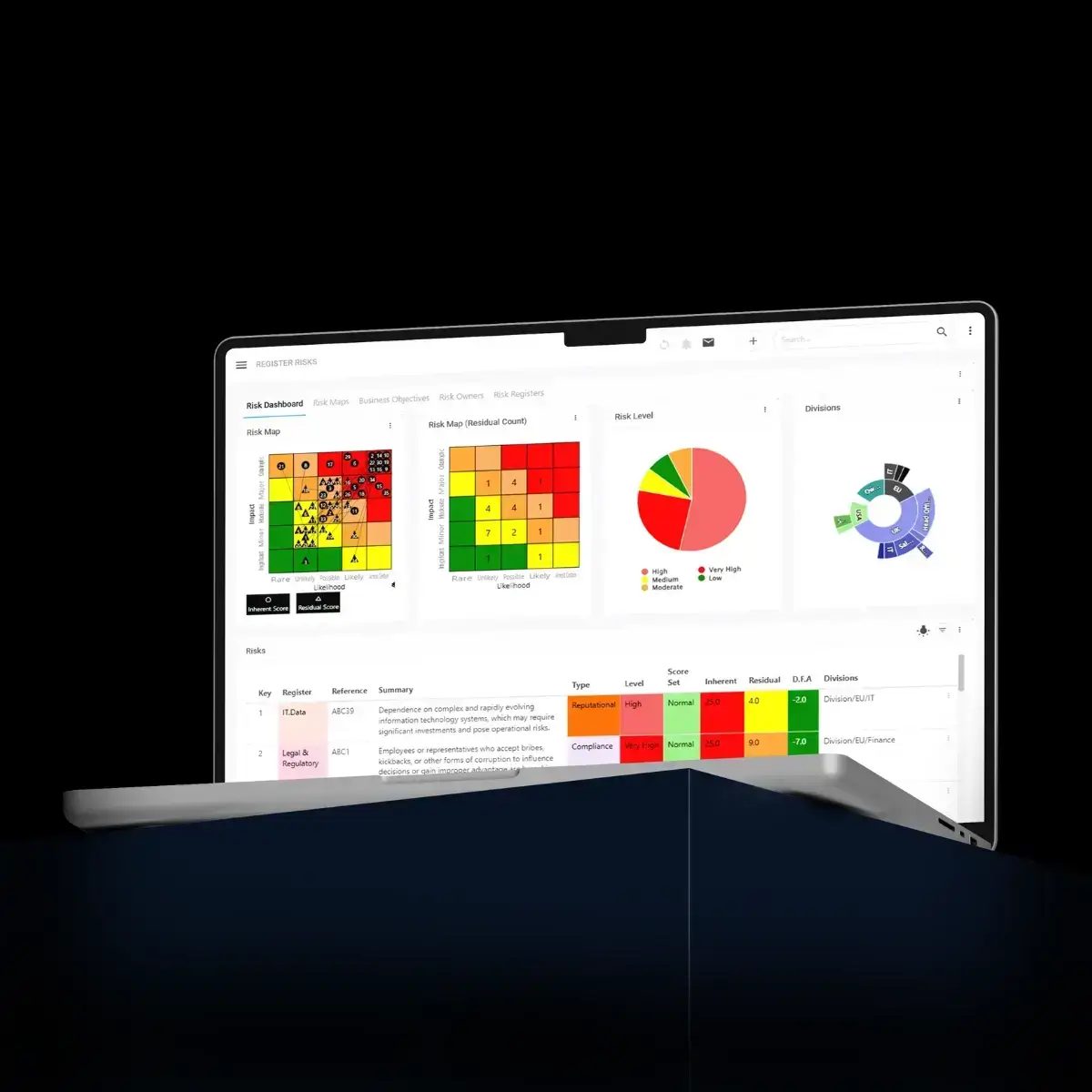
Move beyond spreadsheets and disconnected systems with a flexible platform that centralises your data, tracks actions, and gives you clear visibility across your organisation.
A robust control environment is a cornerstone of effective governance, risk, and compliance (GRC). It enables organisations to manage risk proactively, safeguard critical assets, and demonstrate compliance with frameworks such as ISO 27001.
However, while most organisations recognise the importance of controls, far fewer can confidently answer a fundamental question:
Are our controls actually working?
In practice, many control environments suffer from common challenges:
- Controls are documented but not systematically tested
- Controls are tested but lack consistent, auditable evidence
- Evidence exists but is not clearly linked to the risks being managed
The result is a fragmented and often manual control framework that provides limited assurance and reduced confidence at both operational and executive levels.
Control testing addresses this gap. It provides a structured and reliable mechanism to confirm that controls are not only defined, but are operating effectively, consistently, and in alignment with the organisation’s risk profile.
What is Control Testing?
The ISO 31000 standard defines a control as a “measure that modifies risk.” While technically accurate, this definition is broad and can lack practical meaning for those responsible for applying controls in day-to-day operations.
Control testing is the process of evaluating whether internal controls are:
- Appropriately designed to address specific risks
- Operating effectively in real-world conditions
In simple terms, it ensures that controls perform as intended, consistently, reliably, and in alignment with the organisation’s risk profile.
However, effective control testing goes beyond periodic or ad hoc reviews. It requires a structured, repeatable approach that is embedded within the organisation’s wider risk management framework, ensuring controls remain relevant, measurable, and responsive to change.
The Two Dimensions of Effectiveness
Symbiant enables organisations to clearly distinguish between:
Design Effectiveness
Is the control capable of managing the risk?
Controls are directly aligned to the risks they mitigate, ensuring clarity of purpose and structural integrity.
Operating Effectiveness
Is the control actually working?
Automated assessments and questionnaires capture real-world execution, providing evidence-based assurance rather than assumption.
Why Connected Controls Matter
Traditional control environments are often fragmented—relying on spreadsheets, email trails, and disconnected systems. This creates blind spots and delays in identifying control failures.
Symbiant enables a shift towards Continuous Control Assurance through:
- Risk-to-Control Mapping
Controls are explicitly linked to risks, providing immediate visibility of how control performance impacts overall exposure - Automated RCSA
Risk Control Self-Assessments can be scheduled and repeated consistently. If a control fails, residual risk scores are updated in real time - Embedded AI for besster insights
Symbiant AI for Controls, Risk, and Audit
Intelligent, Connected, and Context-Driven Risk Management
Symbiant’s embedded AI enhances how organisations manage controls, risks, and audit processes by transforming fragmented data into structured, actionable insight.
Rather than relying on manual input and disconnected systems, Symbiant AI works across your entire GRC framework—linking risks, controls, incidents, and audit findings to provide a consistent, real-time view of control effectiveness and risk exposure.
Intelligent Risk Identification and Structuring
Symbiant AI supports the full lifecycle of risk identification and documentation by:
- Suggesting new risks specific to your organisation based on real data
- Drafting and refining risk descriptions, impact statements, and mitigation considerations
- Identifying relevant business objectives, functions, processes, and risk categories
- Ensuring risks are clearly contextualised and consistently aligned across workflows
This removes ambiguity and creates a structured, standardised risk register.
Enhanced Risk Understanding and Prioritisation
Effective risk management requires understanding not just what could happen—but what happens if nothing is done.
Symbiant AI enables this by:
- Highlighting downstream consequences of inaction
- Modelling the potential outcomes of effective mitigation
- Supporting more informed prioritisation of risks based on impact and urgency
Data-Driven Risk Scoring and Residual Risk Calculation
Symbiant AI replaces subjective scoring with consistent, logic-based evaluation:
- Applies structured scoring models to reduce emotional bias
- Assesses control effectiveness in real time
- Automatically recalculates residual risk based on control performance
This ensures risk ratings remain accurate, dynamic, and aligned with reality.
Control Identification, Linking, and Effectiveness
Symbiant AI strengthens control management by:
- Suggesting relevant controls based on identified risks
- Linking risks to existing controls across the system
- Supporting the assessment of control effectiveness
- Providing indicative control weightings to understand relative impact
This creates a clear, traceable relationship between risks and controls, improving assurance and decision-making.
Root Cause Analysis and Consequence Mapping
Understanding why risks occur—and what happens when controls fail—is critical.
Symbiant AI provides:
- Automated root cause identification based on available data
- Visualisation of cascading impacts when controls fail
- Insight into how risks propagate across business functions
This enables organisations to move from reactive response to proactive risk mitigation.
Emerging Risk Detection
Symbiant AI continuously analyses data to identify:
- New and previously overlooked risks
- Risks emerging from audit findings
- Risks triggered by incidents or control failures
This ensures your organisation remains aware of changing risk exposure in real time.
Audit Intelligence and Automation
Symbiant AI transforms auditing from a manual process into a more intelligent and efficient function:
- Generates audit recommendations and remediation actions
- Drafts and refines audit documentation for clarity and consistency
- Aligns audit findings with risks, controls, and business objectives
This improves both audit quality and efficiency.
Incident Analysis and Control Improvement
Symbiant AI enhances incident management by:
- Linking incidents to affected risks, controls, and business functions
- Identifying root causes of incidents automatically
- Suggesting new or improved controls to prevent recurrence
- Generating structured action plans for remediation
This creates a continuous feedback loop between incidents, risks, and controls.
Intelligent Data Linking Across the Organisation
One of Symbiant AI’s most powerful capabilities is its ability to connect data across the GRC ecosystem.
It automatically links:
- Risks to controls
- Controls to incidents
- Incidents to audit findings
- Risks to business objectives and processes
This provides a single, unified view of risk and control performance, eliminating silos and improving collaboration.
Duplicate Data Detection and Data Quality
Maintaining clean and accurate data is essential.
Symbiant AI:
- Detects duplicate risks and data entries instantly
- Reduces duplication across systems and workflows
- Improves the integrity and usability of the risk register
This can significantly reduce administrative effort and improve reporting accuracy.
From Reactive Processes to Proactive Assurance
With Symbiant AI, organisations move from:
- Manual → automated
- Fragmented → connected
- Reactive → proactive
By embedding intelligence into controls, risk, and audit processes, Symbiant enables:
- Faster identification of weaknesses
- Stronger control assurance
- Better-informed decision-making
- Greater organisational resilience
Real-Time Visibility and Reporting
Effective reporting connects controls to outcomes.
Symbiant provides:
- Interactive dashboards for executive and board-level oversight
- One-click Control Effectiveness Reports
- Clear visibility of high-value controls and emerging weaknesses
This enables faster, more informed decision-making across the organisation.
Beyond Compliance: Building Resilience
Control testing is often treated as a compliance exercise.
In reality, it is the mechanism that determines whether your risk framework is truly effective.
By moving away from manual, spreadsheet-based approaches and adopting a connected GRC platform, organisations can:
- Identify weaknesses before they escalate into incidents
- Demonstrate compliance with confidence
- Strengthen accountability with clear ownership and audit trails
- Build a resilient, risk-aware operating environment
Frequently Asked Questions
The model clearly separates risk ownership from risk oversight.
- The first line owns and manages risk as part of day-to-day operations
- The second line provides oversight, frameworks, and monitoring
- The third line delivers independent assurance
This separation ensures that risk is actively managed by the business while being consistently monitored and validated by independent functions.
In banking and financial services, the Three Lines of Defence model is widely used:
- 1st Line: Front-office teams, operations, and business units managing risks such as credit, market, and operational risk
- 2nd Line: Risk management and compliance functions overseeing regulatory adherence and risk frameworks
- 3rd Line: Internal audit providing independent assurance to senior management and the board
This structure supports regulatory compliance and strengthens financial risk governance.
The key difference lies in responsibility:
- 1st Line: Owns and manages risk
- 2nd Line: Oversees and guides risk management practices
- 3rd Line: Independently assesses the effectiveness of controls and governance
Each line plays a distinct role, ensuring that risk is managed, monitored, and validated across the organisation.
The model provides several key benefits:
- Clear accountability across risk management functions
- Stronger governance and oversight
- Improved risk visibility and reporting
- Enhanced compliance with regulatory requirements
- More informed decision-making
When supported by connected systems, it also enables better collaboration and real-time risk insights.
Despite its strengths, the model can present challenges:
- Siloed working between teams
- Lack of real-time risk visibility
- Over-reliance on manual processes
- Difficulty balancing independence and collaboration
- Limited integration with business strategy
Without modern tools, organisations may struggle to fully realise the model’s benefits.
The model provides the structural foundation for effective Enterprise Risk Management (ERM).
It ensures that:
- risks are identified and managed at the operational level
- oversight functions maintain consistency and compliance
- internal audit validates effectiveness
This alignment enables organisations to manage risk holistically and link it directly to strategic objectives.
Build a Stronger Control Environment with Symbiant
Move beyond manual control testing and disconnected spreadsheets. Symbiant connects your risks, controls, incidents, audits, and actions within a single platform, giving you continuous visibility into control effectiveness and organisational risk.
Automate control assessments, identify weaknesses before they become incidents, and provide your board, auditors, and regulators with the evidence they need—all from one connected GRC platform.
Book a demo today and see how Symbiant helps you build a more resilient, compliant, and risk-aware organisation.

Pricing Disclaimer
* Modules are charged at a standard monthly fee, not on a per-user basis. All users can access each module at any required level. Please note that costs exclude VAT, AI features, and additional modules you may wish to use. User seats are required.