
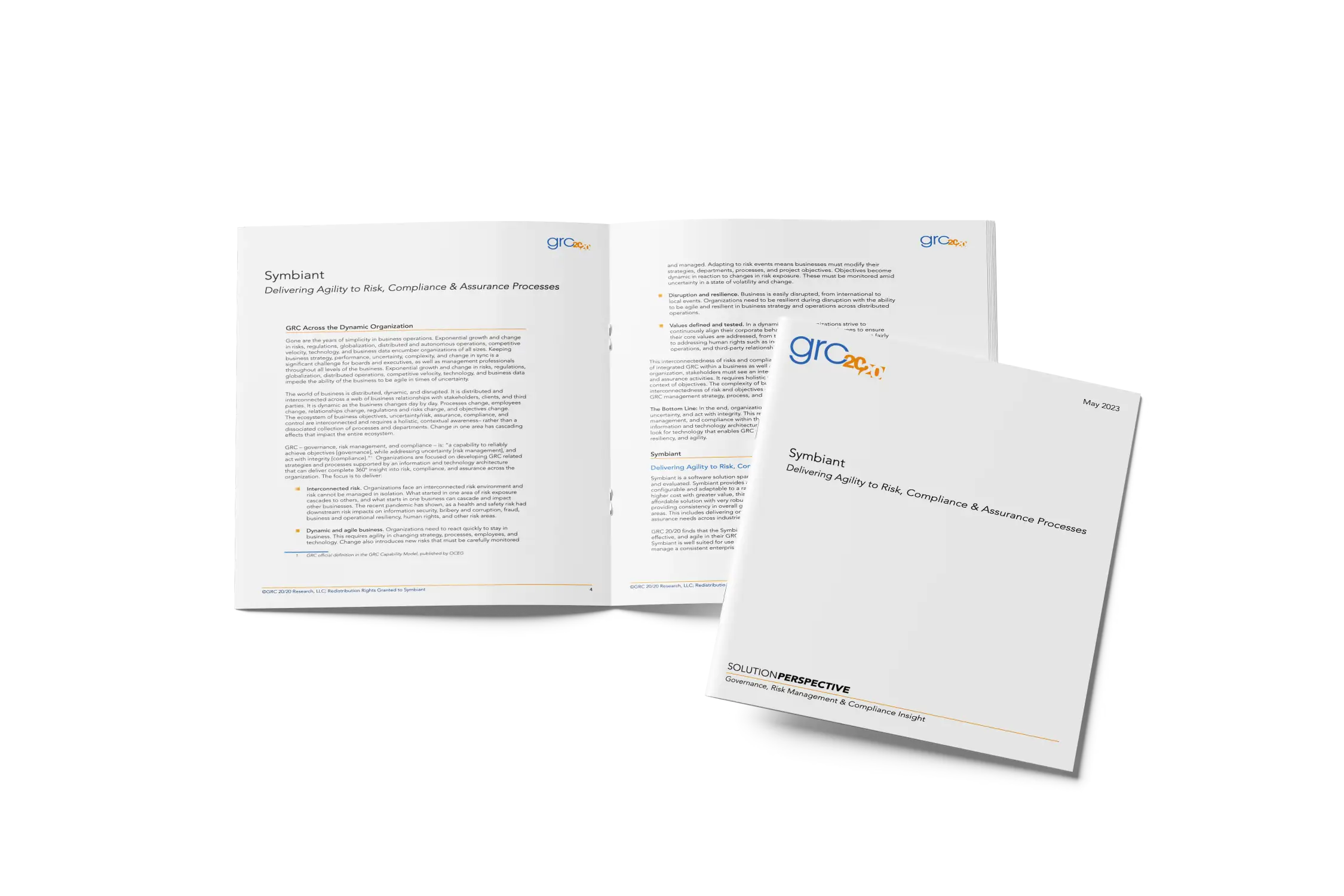
Audit Management Software
From Spreadsheets to Connected GRC: A Practical Guide to Modern Risk, Audit and Compliance Management
Take control of your compliance and risk processes
Move beyond spreadsheets and disconnected systems with a flexible platform that centralises your data, tracks actions, and gives you clear visibility across your organisation.
If your organisation is still managing risks, controls, incidents and compliance through spreadsheets and email, you are not alone. However, this approach becomes increasingly difficult to sustain as organisations grow, regulatory expectations evolve, and the need for timely, reliable information increases.
Manual processes often result in fragmented data, inconsistent reporting, and limited visibility across key areas of governance, risk and compliance (GRC). As data volumes increase and decision-making becomes more time-sensitive, these limitations can begin to affect both operational efficiency and organisational resilience.
Modern GRC platforms have emerged to address these challenges by providing a more structured, connected and scalable approach to managing risk and compliance activities.
Executive Summary
Why it’s time to move beyond spreadsheets
Spreadsheets offer flexibility, but they are not designed to support complex, interconnected GRC processes.
Common limitations include:
- Lack of audit trail and traceability
- Version control challenges
- Difficulty linking risks, controls, incidents and actions
- Time-consuming manual consolidation and reporting
As organisations are expected to demonstrate greater accountability and real-time oversight, these limitations can create exposure rather than control.
Preparing for change
Adopting a GRC platform represents a broader operational shift, not just a technology change.
Organisations typically need to:
- Understand existing processes and identify inefficiencies
- Engage stakeholders across risk, compliance, audit and operational teams
- Align on clear objectives and success criteria
- Establish a structured approach to implementation and adoption
Successful transitions are often those that focus equally on people, processes and technology.
Key considerations when selecting a GRC platform
Not all platforms are designed in the same way, and selecting the right solution requires a focus on practical usability and long-term fit.
Key considerations include:
- Usability: Can both specialists and non-specialists engage with the system effectively?
- Configurability: Can workflows, scoring models and data structures be adapted to organisational needs?
- Data connectivity: Are risks, controls, incidents and actions meaningfully linked?
- Reporting and visibility: Can stakeholders access timely, relevant insights?
- Scalability: Can the system evolve as organisational requirements change?
While emerging technologies such as AI can provide additional support, their value is typically realised once a strong data and process foundation is in place.
Approaching vendor selection
A structured evaluation process is essential.
Rather than focusing on feature lists alone, organisations benefit from:
- Defining clear use cases based on current challenges
- Testing how platforms support real workflows
- Involving stakeholders from different functions
- Assessing implementation approach, support and long-term flexibility
The most effective solutions are those that align closely with how the organisation operates in practice.
Defining success in the first year
Early success is usually characterised by improved structure and visibility rather than full transformation.
Typical outcomes include:
- Centralisation of risk and compliance data
- Reduction in manual reporting effort
- More consistent workflows and accountability
- Improved quality and timeliness of reporting
- Increased organisational visibility over risk and control environments
These early improvements create a foundation for more advanced capabilities over time.
Longer-term value
Beyond operational efficiency, structured GRC approaches enable a shift in how organisations manage risk.
This includes:
- Moving from reactive to more proactive risk management
- Strengthening governance and accountability
- Supporting more informed, data-driven decision-making
- Embedding risk and compliance more effectively into day-to-day operations
Over time, this can contribute to greater organisational resilience and a more mature risk culture.
Why it’s time to move on from spreadsheets
Lack of governance
Manual spreadsheet-based systems are not designed to support the level of governance required in modern organisations.
They typically lack:
- A clear audit trail
- Version control
- Visibility over who made changes, when, and why
This absence of traceability creates challenges when demonstrating compliance with established frameworks such as SOX, ISO 27001 and Basel III, all of which require well-documented, defensible records. Without structured oversight, it becomes difficult to evidence decisions or validate the integrity of data.
Knowledge concentration
A less visible but equally significant risk is the concentration of knowledge within individuals.
In many organisations, critical spreadsheets are understood by only one or two people — often those who built complex formulas, macros or data structures. This creates a dependency that is rarely documented.
If those individuals are unavailable or leave the organisation, processes can become difficult to maintain, adapt or even interpret. Over time, this can lead to operational disruption and reduced confidence in the data being used.
Inconsistency and limited visibility
Spreadsheets are inherently static and disconnected, which makes maintaining consistency across teams and departments challenging.
As a result:
- Data is often duplicated across multiple files
- Reporting becomes a manual consolidation exercise
- Outputs may vary depending on timing, format or interpretation
For senior stakeholders, this can lead to reports that are delayed, inconsistent, or lacking sufficient context. In turn, this reduces the reliability of information used for decision-making and increases exposure to compliance and reporting risks.
Research has also shown that spreadsheet error rates are high. A widely cited study by Ray Panko at the University of Hawaii found that a significant proportion of spreadsheets contain errors. When used in areas such as financial reporting, compliance tracking or risk management, these errors can have material consequences.
Common challenges across functions
The limitations of spreadsheets are experienced differently across teams, but the underlying issue is the same: fragmentation of data and processes.
- Risk teams often struggle to bring together risk indicators, incidents and actions into a single, coherent view. Time is spent reconciling data rather than analysing it.
- Compliance teams frequently operate without a centralised obligations register, relying on manual tracking and follow-ups. Linking controls to regulatory requirements can be inconsistent and time-consuming.
- IT and cybersecurity teams may duplicate effort when mapping controls to multiple frameworks such as ISO 27001, NIST CSF or PCI DSS, often without a unified structure.
- Executives and boards receive reports that are retrospective, difficult to interpret, and not always aligned with current organisational risk or performance.
The broader impact
While these challenges may appear operational, their impact is broader.
Fragmented systems:
- Reduce efficiency and increase manual workload
- Limit visibility across interconnected risks and controls
- Delay reporting and decision-making
- Increase the likelihood of missed or emerging risks
Ultimately, the issue is not simply the use of spreadsheets, but the lack of a connected, structured environment where governance, risk and compliance activities can be managed consistently and transparently.
Scalability and connected GRC
Modern governance, risk and compliance requires more than isolated registers or standalone processes. It depends on the ability to connect data across the organisation in a structured and scalable way.
A connected GRC environment enables organisations to link:
- Risks, incidents, controls and actions
- Key Risk Indicators (KRIs) and assessments
- Obligations, policies and compliance activities
This interconnected approach allows users to trace relationships between causes, impacts and responses, improving both visibility and decision-making.
Structured automation and workflow management
Routine activities such as attestations, control testing, escalations and reminders can be standardised and managed through structured workflows.
This reduces reliance on manual follow-ups and helps ensure that:
- Tasks are completed consistently
- Deadlines are visible and tracked
- Accountability is clearly defined
Over time, this supports more reliable and repeatable processes across risk, compliance and audit functions.
Flexibility without technical dependency
An effective GRC platform should allow risk and compliance teams to configure registers, workflows and data structures without requiring technical development.
This includes:
- Building and adapting registers to reflect organisational needs
- Adjusting scoring models and workflows
- Updating forms, fields and reporting structures
Reducing dependency on external configuration enables teams to respond more quickly to regulatory or operational change.
Real-time insight and reporting
Dynamic reporting capabilities allow stakeholders to access timely, relevant information rather than relying on static or manually compiled reports.
This supports:
- Improved visibility of emerging risks and issues
- More informed decision-making
- Greater alignment between operational activity and strategic oversight
For senior stakeholders, this means clearer insight into where attention is required and why.
Alignment with established frameworks
Pre-configured structures aligned to recognised standards such as ISO 27001 or NIST CSF can support faster implementation and greater consistency.
Rather than building frameworks from scratch, organisations can:
- Map controls and risks to established standards
- Maintain alignment as requirements evolve
- Reduce duplication of effort across teams
Designed to scale with the organisation
As organisations grow, their GRC requirements become more complex.
A scalable approach allows for:
- Expansion across departments and business units
- Adoption of additional frameworks and regulatory requirements
- Increased data volumes without loss of structure or clarity
The system should adapt to organisational needs, rather than requiring processes to be redesigned around system limitations.
A connected approach with Symbiant
Symbiant supports this model by enabling organisations to manage risks, controls, incidents, assessments and actions within a single, connected environment.
By linking data across modules and maintaining a Single Source of Truth, it allows organisations to:
- Maintain consistency across GRC activities
- Improve traceability and oversight
- Reduce duplication and manual reconciliation
This structured and connected approach provides a more sustainable foundation for managing governance, risk and compliance as organisational demands evolve.
Transform the Way Your Organisation Manages Risk
Modern governance requires more than spreadsheets. It requires connected data, structured workflows and complete visibility across your organisation.
Symbiant’s modular GRC platform helps organisations centralise risk, audit and compliance activities, automate manual processes and make better-informed decisions with confidence.
Discover how Symbiant can help you build a more connected, resilient organisation.

Pricing Disclaimer
* Modules are charged at a standard monthly fee, not on a per-user basis. All users can access each module at any required level. Please note that costs exclude VAT, AI features, and additional modules you may wish to use. User seats are required.