
ISO 27001
ISO 27001 Risk Assessment & Control Alignment: A practical guide to aligning risks, controls, and treatment plans for audit-ready compliance
An ISO 27001 risk assessment is the foundation of an effective Information Security Management System (ISMS), helping organisations identify, assess and treat information security risks in a structured, risk-based way. This guide explains the ISO 27001 risk assessment process step by step and shows how Symbiant’s award-winning GRC software helps centralise risks, controls and treatment plans within a single, audit-ready platform.
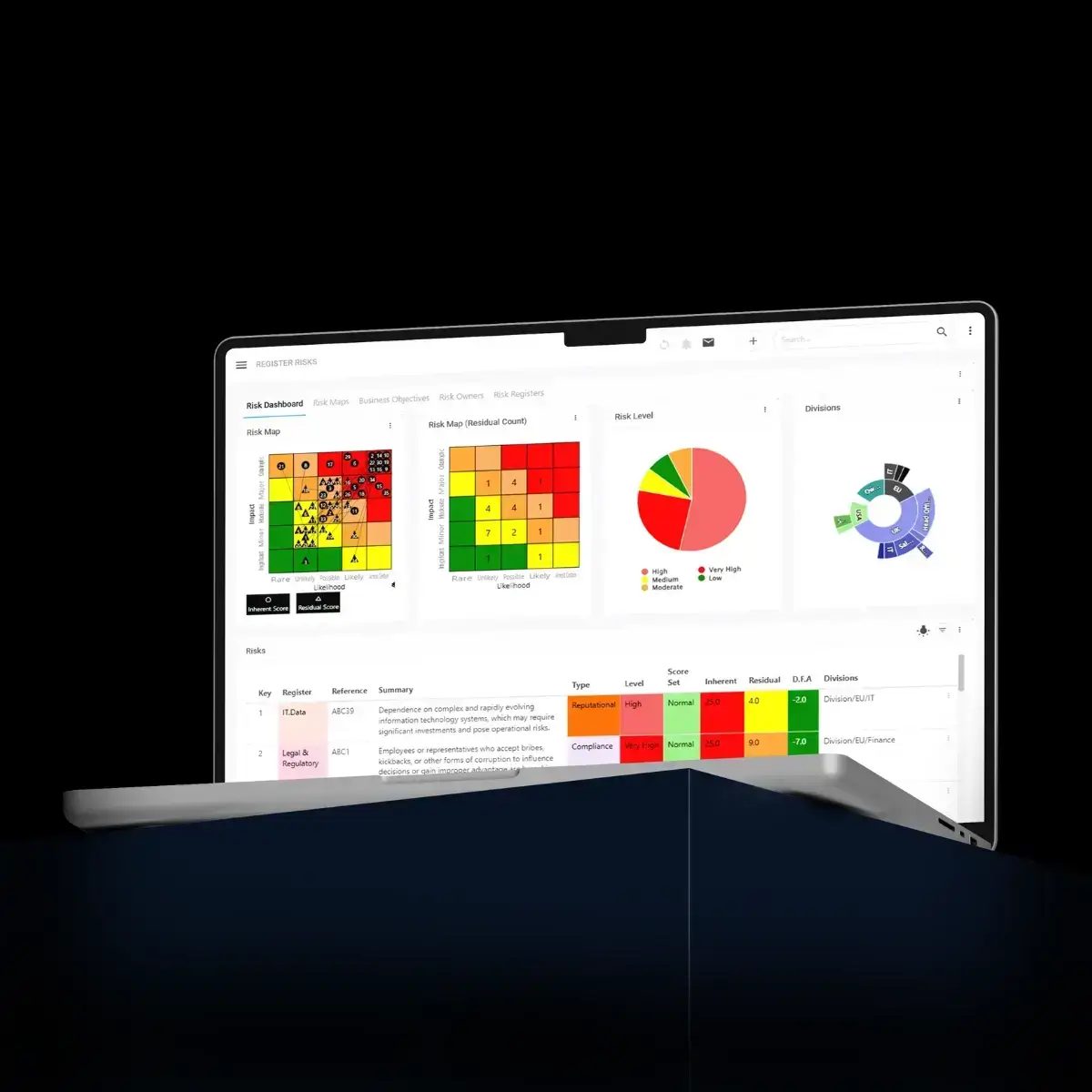
Take control of your compliance and risk processes
Move beyond spreadsheets and disconnected systems with a flexible platform that centralises your data, tracks actions, and gives you clear visibility across your organisation.
ISO 27001 takes a structured, risk-based approach to building and maintaining an Information Security Management System (ISMS). At its core, it requires organisations to clearly identify risks, evaluate their impact, and implement appropriate controls to protect information assets.
However, in practice, many organisations struggle, not with the framework itself, but with fragmented processes, disconnected data, and manual risk tracking.
This guide outlines how ISO 27001 risk assessment works and how to implement it effectively using a connected, system-driven approach with Symbiant award-winning GRC software.
What is ISO 27001 risk management?
Under ISO 27001 Clause 6, ISMS risk management consists of two key components:
- Risk assessment
- Risk treatment
Risk assessment (Clause 6.1.2) requires organisations to define a structured, repeatable methodology that:
- Establishes clear risk criteria
- Produces consistent and comparable results
- Identifies risks across internal, external, and third-party environments
- Evaluates and prioritises risks based on likelihood and impact
Risk treatment (Clause 6.1.3) then ensures that:
- Appropriate treatment options are selected
- Controls are clearly defined and implemented
- A Statement of Applicability (SoA) is maintained
- Justifications are documented for included or excluded controls
- A formal, approved risk treatment plan is in place
With Symbiant, this entire process is managed within a Single Source of Truth (SSOT), ensuring every risk, control, and decision is fully traceable and audit-ready.
When Should You Conduct an ISO 27001 Risk Assessment?
ISO 27001 risk assessment is not a one-time exercise—it is a continuous process embedded within your ISMS.
Typically, organisations conduct assessments:
- Before ISO 27001 implementation and certification
- During major business or technology changes
- After security incidents or control failures
- On a regular basis (at least annually)
A connected system like Symbiant ensures assessments are not static snapshots—but part of an ongoing, real-time risk management process.
How to Conduct an ISO 27001 Risk Assessment (6 Steps)
1. Define Your Risk Assessment Methodology
Start by establishing how risk will be identified, measured, and prioritised.
Your methodology should define:
- How risks and vulnerabilities are identified
- Risk ownership and accountability
- Likelihood and impact scoring models
- Risk prioritisation criteria
- Thresholds for treatment and escalation
Symbiant supports this through flexible scoring models, custom workflows, and configurable risk frameworks, allowing you to tailor the methodology to your organisation, not the other way around.
2. Identify and Document Information Security Risks
Next, identify risks across your ISMS by:
- Mapping information assets (systems, data, infrastructure)
- Identifying threats and vulnerabilities
- Recording everything within a structured Risk Register
Symbiant’s Risk Register acts as a central, dynamic repository, linking risks to controls, incidents, and assessments—removing duplication and ensuring consistency across your organisation.
3. Analyse and Prioritise Risks
Each risk must be evaluated based on:
- Likelihood (probability of occurrence)
- Impact (business consequence)
Using structured scoring models, risks can be prioritised and visualised clearly.
With Symbiant:
- Risk scoring is dynamic and automatically updated
- Residual risk adjusts based on control effectiveness
- Aggregated scoring provides a holistic risk view
This enables faster, more confident decision-making.
4. Implement Risk Treatment and Map Controls
Once risks are prioritised, define how they will be treated.
This includes:
- Selecting appropriate treatment strategies
- Mapping risks to relevant controls
- Documenting decisions for audit purposes
Symbiant’s Controls and Policies Module simplifies this process by:
- Linking controls directly to risks
- Supporting Risk Control Self-Assessments (RCSA)
- Dynamically adjusting risk scores based on control performance
- Enabling one-click Statement of Applicability generation
This ensures your controls are not just documented—but actively managing risk.
5. Produce Risk Reports and Maintain Audit Evidence
To demonstrate compliance, organisations must produce:
- Risk assessment reports
- Risk prioritisation summaries
- Risk treatment plans
- Statement of Applicability
Symbiant centralises all documentation and provides real-time, audit-ready reporting, eliminating the need for manual consolidation across spreadsheets and systems.
6. Continuously Monitor and Improve Your ISMS
ISO 27001 requires continuous improvement—not periodic reviews.
This means:
- Regular reassessment of risks
- Ongoing control monitoring
- Updating treatment plans as risks evolve
With Symbiant:
- Automated notifications highlight changes in risk exposure
- Linked data ensures updates cascade across the system
- Dashboards provide real-time visibility across risks, controls, and actions
The result is a living ISMS, not a static compliance exercise.
From Manual Risk Management to Connected Compliance
Traditional ISO 27001 approaches rely heavily on spreadsheets, disconnected tools, and manual processes. This often leads to:
- Inconsistent risk data
- Weak audit trails
- Delayed reporting
- Limited visibility across the organisation
Symbiant replaces this with a connected, modular GRC platform where:
- Risks, controls, incidents, and assessments are fully linked
- Data is entered once and used across the system
- Compliance becomes structured, repeatable, and scalable
Build an Audit-Ready ISO 27001 Framework with Confidence
ISO 27001 is not just about meeting requirements—it’s about building a resilient, well-controlled organisation.
By aligning your risk assessments, controls, and objectives within a single system, Symbiant helps you:
- Strengthen your security posture
- Simplify certification and audits
- Improve decision-making with real-time insights
- Maintain continuous compliance without manual overhead
Build an Audit-Ready ISO 27001 Risk Management Framework
Move beyond spreadsheets and disconnected processes with a connected GRC platform that centralises your ISO 27001 risk assessments, controls, treatment plans and audit evidence. Symbiant helps you strengthen information security, simplify compliance, and maintain a resilient, audit-ready Information Security Management System.Discover how Symbiant can support your ISO 27001 journey.

Pricing Disclaimer
* Modules are charged at a standard monthly fee, not on a per-user basis. All users can access each module at any required level. Please note that costs exclude VAT, AI features, and additional modules you may wish to use. User seats are required.