
UK Government
Orange Book Risk Management (UK Government) Strengthening Governance, Accountability and Risk Oversight in the Public Sector
The UK Government’s Orange Book provides the foundation for effective risk management across the public sector, helping organisations embed risk into governance, decision-making, and strategic delivery. Rather than treating risk as a standalone compliance exercise, it promotes a connected approach where objectives, controls, assurance, and accountability work together to improve organisational resilience.
This guide explains the key principles of Orange Book risk management, how public sector organisations apply the framework in practice, and how connected GRC software such as Symbiant can help centralise risk information, strengthen governance, and provide the visibility needed to support informed decision-making.
Take control of your compliance and risk processes
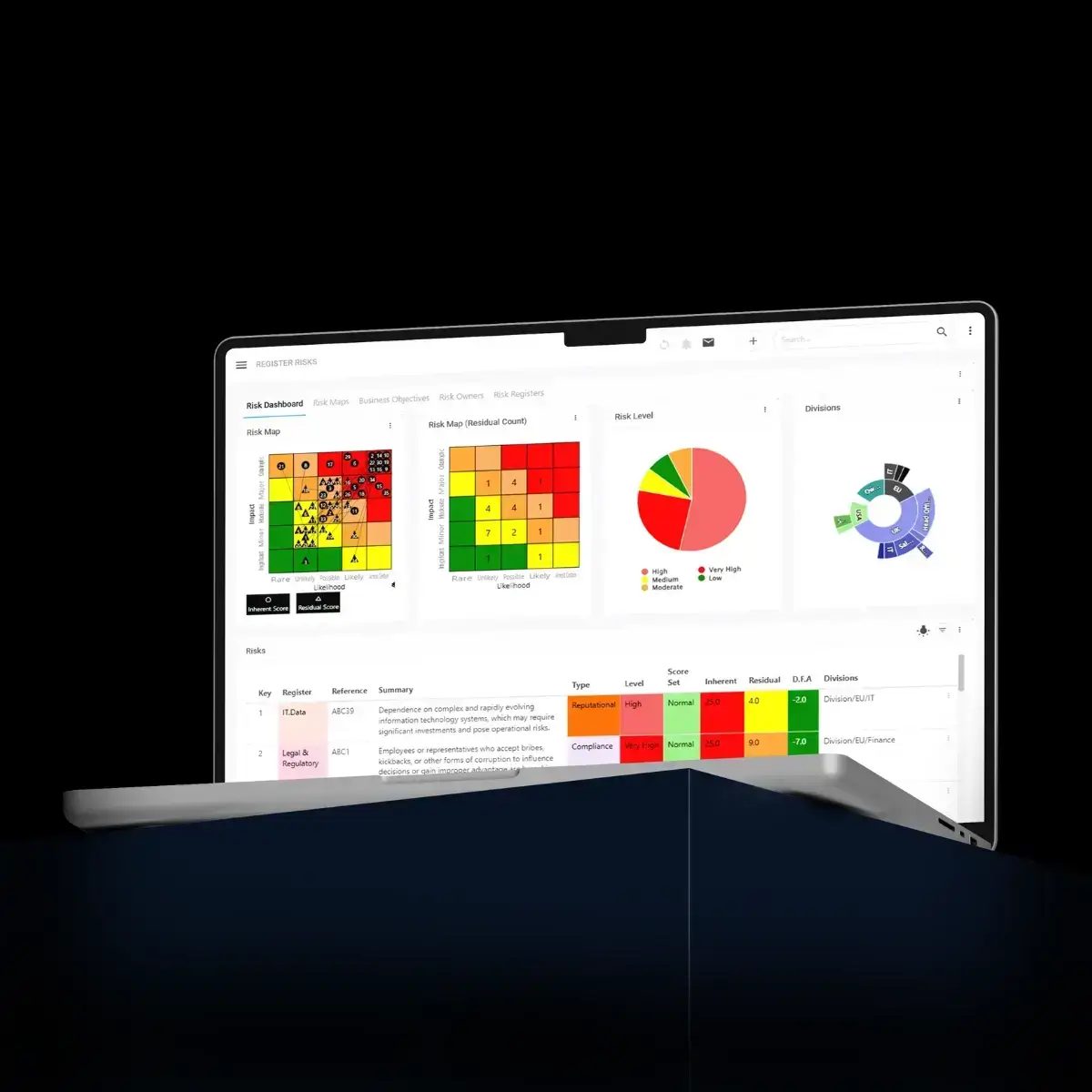
Move beyond spreadsheets and disconnected systems with a flexible platform that centralises your data, tracks actions, and gives you clear visibility across your organisation.
The UK Government’s Orange Book: Management of Risk – Principles and Concepts provides a comprehensive framework for how public sector organisations should approach risk management. It sets clear expectations for governance, accountability, and decision-making, ensuring that risk is not only managed, but actively used to support organisational objectives.
For departments, agencies, and arm’s-length bodies, the Orange Book is more than guidance. It forms the foundation for building resilient, transparent, and well-governed organisations.
What is the Orange Book in Risk Management?
The Orange Book is official guidance issued by HM Treasury, defining how risk should be identified, assessed, managed, and reported across UK public sector organisations.
It promotes a structured, principles-based approach to risk management, ensuring that:
- Risk is aligned with strategic and operational objectives
- Decision-making is informed, evidence-based, and accountable
- Governance structures support clear ownership and oversight
- Risk information flows effectively across the organisation
At its core, the Orange Book reinforces that risk management is embedded into governance, performance, and delivery, not treated as a standalone activity.
Core Principles of Orange Book Risk Management
The Orange Book outlines key principles that organisations are expected to embed into their operating model:
1. Risk Aligned to Objectives
Risk must be directly linked to organisational objectives—ensuring decision-makers understand how uncertainty impacts delivery and outcomes.
2. Defined Risk Appetite
Organisations should clearly define their risk appetite, enabling consistent and informed decision-making across teams.
3. Clear Roles and Responsibilities
Effective governance depends on clearly defined ownership—from operational teams through to senior leadership and audit committees.
4. Integrated Assurance
Risk, control, audit, and compliance activities should operate in a connected way—providing a joined-up view of assurance.
5. Continuous Monitoring and Reporting
Risk management must be ongoing, with regular monitoring, reporting, and escalation to support timely and informed decisions.
How UK Public Sector Organisations Apply the Orange Book
In practice, applying Orange Book principles means moving beyond static, spreadsheet-driven processes towards a connected and dynamic approach to risk management.
Organisations typically:
- Maintain centralised risk registers linked to objectives
- Use risk workshops to identify and assess emerging risks
- Define and monitor controls and mitigation actions
- Track incidents and near misses to identify patterns
- Establish Key Risk Indicators (KRIs) as early warning signals
- Deliver board-level reporting with clear visibility of risk exposure
This ensures risk information remains consistent, current, and actionable—supporting stronger governance and faster decision-making.
Supporting Orange Book Alignment with Connected GRC Software
Embedding Orange Book principles effectively requires more than defined processes—it requires systems that enable integration, visibility, and control.
A connected GRC platform supports this by:
- Creating a Single Source of Truth (SSOT) for risk, audit, and compliance data
- Linking risks to objectives, controls, incidents, and actions
- Supporting dynamic risk scoring and real-time updates
- Enabling cross-functional collaboration
- Providing automated workflows, reporting, and audit trails
This approach allows organisations to align with Orange Book expectations while remaining flexible and scalable.
Why the Orange Book Matters More Than Ever
In an environment defined by increasing regulatory scrutiny, operational complexity, and public accountability, the Orange Book plays a critical role in shaping how organisations manage uncertainty.
It ensures that:
- Governance frameworks are robust and transparent
- Risks are understood in context, not in isolation
- Decisions are supported by reliable, connected data
- Organisations can respond quickly to emerging risks and change
Ultimately, the Orange Book helps organisations move from reactive risk management to proactive, strategic oversight.
How to Conduct an ISO 27001 Risk Assessment (6 Steps)
1. Define Your Risk Assessment Methodology
Start by establishing how risk will be identified, measured, and prioritised.
Your methodology should define:
- How risks and vulnerabilities are identified
- Risk ownership and accountability
- Likelihood and impact scoring models
- Risk prioritisation criteria
- Thresholds for treatment and escalation
Symbiant supports this through flexible scoring models, custom workflows, and configurable risk frameworks, allowing you to tailor the methodology to your organisation, not the other way around.
2. Identify and Document Information Security Risks
Next, identify risks across your ISMS by:
- Mapping information assets (systems, data, infrastructure)
- Identifying threats and vulnerabilities
- Recording everything within a structured Risk Register
Symbiant’s Risk Register acts as a central, dynamic repository, linking risks to controls, incidents, and assessments—removing duplication and ensuring consistency across your organisation.
3. Analyse and Prioritise Risks
Each risk must be evaluated based on:
- Likelihood (probability of occurrence)
- Impact (business consequence)
Using structured scoring models, risks can be prioritised and visualised clearly.
With Symbiant:
- Risk scoring is dynamic and automatically updated
- Residual risk adjusts based on control effectiveness
- Aggregated scoring provides a holistic risk view
This enables faster, more confident decision-making.
4. Implement Risk Treatment and Map Controls
Once risks are prioritised, define how they will be treated.
This includes:
- Selecting appropriate treatment strategies
- Mapping risks to relevant controls
- Documenting decisions for audit purposes
Symbiant’s Controls and Policies Module simplifies this process by:
- Linking controls directly to risks
- Supporting Risk Control Self-Assessments (RCSA)
- Dynamically adjusting risk scores based on control performance
- Enabling one-click Statement of Applicability generation
This ensures your controls are not just documented—but actively managing risk.
5. Produce Risk Reports and Maintain Audit Evidence
To demonstrate compliance, organisations must produce:
- Risk assessment reports
- Risk prioritisation summaries
- Risk treatment plans
- Statement of Applicability
Symbiant centralises all documentation and provides real-time, audit-ready reporting, eliminating the need for manual consolidation across spreadsheets and systems.
6. Continuously Monitor and Improve Your ISMS
ISO 27001 requires continuous improvement—not periodic reviews.
This means:
- Regular reassessment of risks
- Ongoing control monitoring
- Updating treatment plans as risks evolve
With Symbiant:
- Automated notifications highlight changes in risk exposure
- Linked data ensures updates cascade across the system
- Dashboards provide real-time visibility across risks, controls, and actions
The result is a living ISMS, not a static compliance exercise.
Orange Book Aligned. Built for Better Governance.
Purpose-built with guidance from UKHSA, Symbiant helps UK public sector organisations embed the principles of the UK Government’s Orange Book by connecting governance, risk, controls, audit, and assurance within a single, configurable GRC platform. Replace disconnected spreadsheets with real-time visibility, stronger accountability, and better-informed decision-making.

Pricing Disclaimer
* Modules are charged at a standard monthly fee, not on a per-user basis. All users can access each module at any required level. Please note that costs exclude VAT, AI features, and additional modules you may wish to use. User seats are required.