

For years, organisations have approached risk management through a relatively simple process: identify risks, assess their impact, implement controls, and monitor the results.
While this approach remains important, today’s business environment has changed dramatically.
Organisations no longer operate within isolated systems. Risks are interconnected. Supply chains are interconnected. Regulations, technology, third-party providers, cyber threats, operational processes, and strategic objectives are all interconnected.
When disruption occurs, it rarely affects just one area of the business.
A supplier failure can trigger operational delays.
An operational issue can create compliance concerns.
A compliance breach can damage reputation.
A cyber incident can impact customers, regulators, finances, and business continuity simultaneously.
The challenge facing organisations today is not simply managing individual risks.
The challenge is maintaining performance when multiple risks occur at the same time.
This is where resilience becomes critical.
Risk Management Protects the Organisation. Resilience Enables It to Continue Operating.
Traditional risk management focuses on reducing the likelihood and impact of adverse events. Resilience focuses on ensuring the organisation can continue to function, adapt and recover when those events occur. Both disciplines are essential.
Risk management helps organisations understand uncertainty.
Resilience helps organisations navigate it.
The most effective organisations combine both capabilities into a single operating model, creating greater visibility, stronger decision-making, and improved confidence when disruption occurs.
Why Connected Risk Intelligence Matters
One of the biggest barriers to resilience is fragmented information. Risk data sits in one system. Incidents are recorded elsewhere. Controls are managed separately. Audit findings live in spreadsheets. Business continuity plans are stored in documents that are rarely reviewed.
The result is limited visibility.
Leaders struggle to understand how events, controls, actions, incidents, audits and objectives influence one another.
Without that context, decision-making slows precisely when speed matters most.
Organisations need more than individual records.
They need connected intelligence.
They need to understand:
- Which controls are failing
- Which risks are increasing
- Which incidents are becoming recurring issues
- Which audit findings remain unresolved
- Which business objectives are most exposed
- Which actions are overdue and increasing organisational vulnerability
Resilience depends on seeing the bigger picture.
Building Resilience Around Business Objectives
The strongest resilience programmes start with a simple question:
What are we trying to achieve?
Every organisation has objectives.
Delivering services.
Protecting customers.
Meeting regulatory obligations.
Growing revenue.
Maintaining operational stability.
Risk management becomes significantly more valuable when risks, controls, incidents, audits, assessments and actions are linked directly to those objectives.
This creates context.
It helps organisations understand not only what could go wrong, but what matters most when it does.
When resilience is aligned with business objectives, decision-makers can prioritise resources, respond faster, and focus attention where it delivers the greatest value.
From Siloed Activities to a Single Source of Truth
Modern resilience requires more than individual processes working independently.
Risk management, audit, compliance, governance, incident management, assessments, action tracking, and business continuity must work together.
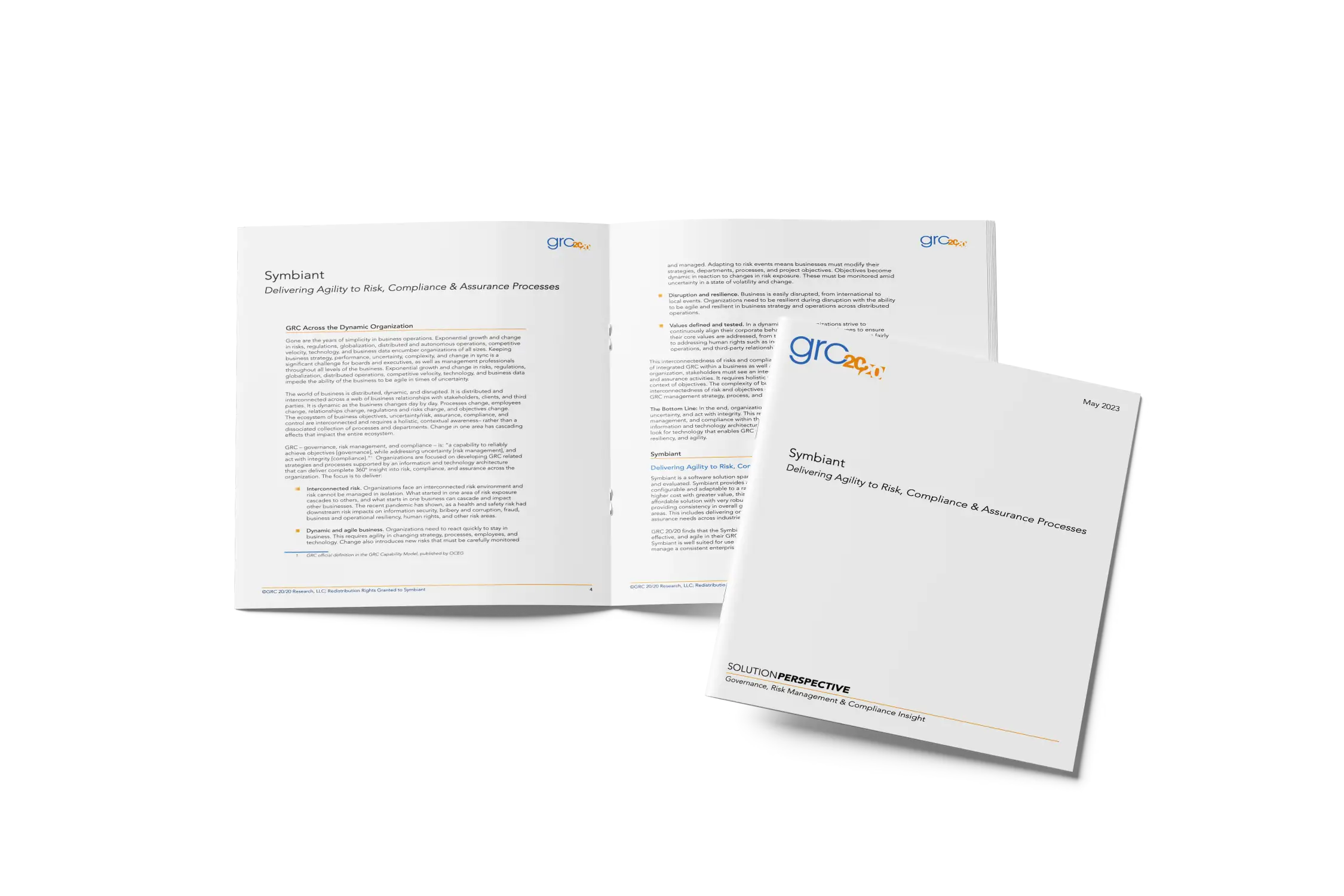
This is why many organisations are moving towards a Single Source of Truth model, where information is entered once, linked across functions, and made available to the people who need it most. Symbian’s award-winning, highly trusted GRC software is designed around this principle, creating a connected environment where risk, audit, compliance and governance information can be viewed together rather than in isolation. By connecting information across the organisation, teams gain greater visibility into emerging threats, dependencies, recurring issues, and opportunities for improvement.
The Goal Is Not to Eliminate Every Risk
No organisation can predict every disruption.
No framework can prevent every incident.
No control environment is perfect.
The goal is not perfection.
The goal is preparedness.
Resilient organisations understand their objectives, maintain visibility across their operations, identify weaknesses early, and respond effectively when conditions change.
In an increasingly uncertain world, that capability may become one of the most important competitive advantages an organisation can build.

Strengthen Resilience with Connected Risk Management
The organisations that thrive through disruption are not necessarily the ones with the fewest risks. They are the ones with the greatest visibility, the strongest alignment between objectives and risk, and the ability to make informed decisions when circumstances change.
Symbiant helps organisations bring risk, audit, compliance, governance, incidents, controls, assessments and actions together within a single, connected platform, providing the clarity needed to anticipate challenges, respond with confidence, and build long-term resilience.
Ready to move beyond siloed risk management?
Book a Demo today and discover how Symbiant can help your organisation protect objectives, strengthen resilience, and make better decisions.