

Your business continuity plan may be documented, approved and stored in exactly the right place.
It may contain detailed recovery procedures, contact information, roles, responsibilities and escalation routes. It may be reviewed annually and presented to senior management as evidence that the organisation is prepared.
But none of this necessarily proves that the business can continue when disruption occurs.
A plan may describe what people are expected to do. It cannot, by itself, prove that:
- The information remains current
- The people named in it are available
- The recovery actions are achievable
- The controls intended to prevent disruption are working
- Critical suppliers can meet the organisation’s recovery needs
- Teams understand their responsibilities
- Hidden dependencies have been identified
- The plan will work under real operational pressure
That distinction matters.
Because a documented response is not the same as a proven capability.
A business continuity plan describes what should happen. Operational resilience depends on whether it can actually happen.
A continuity plan is a document. Business continuity is a capability.
A business continuity plan records how an organisation intends to respond to and recover from disruption.
Business continuity management is the wider process used to identify critical activities, understand disruption impacts, establish recovery priorities, develop response strategies, test those strategies and improve them as the organisation changes.
The plan is therefore an essential component of business continuity, but it is not the complete system.
This distinction is reflected in ISO 22301, the international standard for Business Continuity Management Systems. It describes a continuing management process covering planning, implementation, operation, monitoring, review, maintenance and improvement.
The emphasis is not simply on possessing a plan.
It is on maintaining a functioning management system capable of protecting the organisation and supporting recovery from disruptive incidents.
Why having a plan can create false confidence
Business continuity plans are reassuring.
They create structure around uncertainty. They show that disruption has been considered and that responsibilities have been assigned. For senior leaders, auditors and customers, the existence of a plan can appear to demonstrate preparedness.
But there is a risk that the plan itself becomes the evidence.
The document was reviewed. The approval box was completed. The next review date was scheduled. The plan’s status remains green.
Meanwhile:
- A critical supplier has changed its recovery arrangements
- An employee named in the response team has left
- A new system has created an undocumented dependency
- A related control has failed its latest assessment
- A recovery action from the previous exercise remains overdue
- A business process has changed without the continuity plan being updated
- Several incidents have exposed the same weakness
- A manual workaround relies on technology affected by the original disruption
The plan may not be badly written, but It may simply be disconnected from the information needed to keep it reliable.
That is where dangerous false confidence begins: when the existence of a plan is mistaken for evidence of resilience.
Business continuity does not live in a document
It lives in the relationships between:
- Critical services and the people who deliver them
- Business processes and the technology supporting them
- Internal operations and third-party suppliers
- Resources and the risks that could affect them
- Risks and the controls intended to reduce them
- Disruption scenarios and their potential consequences
- Recovery strategies and the actions required to deliver them
- Exercises and the weaknesses they expose
- Incidents and the lessons they provide
- Consider a critical customer service that depends on a cloud application.
The continuity plan may state that employees will switch to a manual process if the application becomes unavailable.
But what if that workaround requires access to data held within the same unavailable system?
What if remote employees need an identity service affected by the disruption?
What if customer contact details are only available through the failed application?
What if the alternative supplier requires a longer activation period than the organisation’s acceptable recovery timeframe?
What if an exercise identified these problems six months ago, but the resulting actions were never completed?
The plan may still appear complete when viewed in isolation.
The weakness only becomes visible when the plan is connected with its resources, systems, suppliers, risks, controls, incidents and outstanding actions.
| Continuity question | Documented plan alone | Connected continuity management system |
|---|---|---|
| What must be protected? | Lists important activities and resources | Connects critical resources with services, departments and dependencies |
| What could cause disruption? | Describes selected scenarios | Links resources with relevant risks, incidents and failure points |
| What reduces the likelihood or impact? | References existing controls | Connects controls with ownership, assessments and supporting evidence |
| Who must respond? | Records names and responsibilities | Assigns accountable owners, tasks, deadlines and escalation rules |
| Is the information current? | Depends on periodic manual review | Uses reviews, alerts and connected changes to maintain attention |
| Will the response work? | Describes the intended procedure | Supports scenario testing, action tracking and continuous improvement |
| What was learned from an exercise? | Often captured in a separate report | Connects findings with remedial actions and accountable owners |
| What has changed since the last review? | Requires manual investigation | Brings related risks, incidents, controls and actions into view |
Start with what the organisation cannot afford to lose
Effective business continuity planning begins by identifying the products, services, processes and resources the organisation must be able to maintain or recover.
This requires more than compiling a list of departmental activities.
A structured business impact analysis should help the organisation understand:
- Which activities are critical
- What those activities depend upon
- How disruption would affect customers and other stakeholders
- How the impact would develop over time
- Which resources must be restored first
- Where shared dependencies create concentrations of risk
- Which recovery actions should be prioritised
Without this context, continuity planning can become scenario-led instead of impact-led.
Teams may produce plans for cyberattacks, power failures or severe weather without first establishing which operational capabilities must be protected and what is required to maintain them.
The result can be a collection of plausible plans that do not fully reflect how the organisation actually operates.
Dependencies are where continuity assumptions are tested
Most critical services depend on more than one department.
They may rely on people, premises, technology, data, suppliers, utilities, specialist equipment, communications and other internal processes.
These relationships are rarely simple.
One supplier may support several critical services. One system may create a single point of failure across multiple departments. A recovery strategy for one team may depend on another team restoring its operations first.
When dependencies are recorded in separate spreadsheets, documents and systems, it becomes difficult to see these connections.
This can leave organisations unable to answer questions such as:
- Which services would be affected if this supplier failed?
- Which processes rely on this application?
- Which teams require access to this location?
- Is the same specialist employee essential to several recovery plans?
- Does one control protect multiple critical resources?
- Could one failure create a cascade across the organisation?
A connected continuity system makes these relationships easier to identify before disruption exposes them.
Testing should challenge the assumptions behind the plan
A continuity plan cannot be validated by reading it.
Exercises and scenario tests are needed to determine whether its assumptions, decisions and recovery procedures remain workable.
However, simply completing an annual exercise is not enough.
A useful test should challenge questions such as:
- Did the right people receive the information they needed?
- Were responsibilities understood?
- Could recovery actions be completed in the expected order?
- Were critical resources actually available?
- Did teams rely on undocumented knowledge?
- Were supplier assumptions realistic?
- Did the scenario expose previously unidentified risks?
- Could customer harm or operational impact develop differently from what was expected?
- What must change before the next exercise?
The real value of testing lies in what happens after the exercise.
Findings must become owned actions. Actions need deadlines, reminders and escalation. Once completed, the organisation should determine whether they have genuinely improved its recovery capability.
Otherwise, testing becomes another form of documentation: evidence that an exercise happened, rather than evidence that readiness improved.
Incidents should improve the continuity plan
Exercises test what might happen.
Incidents reveal what actually happens.
Every disruption, near miss and operational failure provides information about the organisation’s real dependencies, controls and response capability.
An incident may reveal that:
- A recovery procedure is unclear
- A supplier cannot provide support within the expected timeframe
- An escalation route is too slow
- A control does not operate as intended
- A critical resource was never included in the impact analysis
- Teams have created unofficial workarounds
- Customer consequences were greater than anticipated
If incident information remains in a separate reporting system, these lessons may never reach the continuity plan.
A connected approach allows incidents to challenge existing assumptions, inform scenario testing, expose potential control gaps and prompt relevant plans to be reassessed.
Seven questions that test whether your plan represents real readiness
Choose one of your organisation’s most critical services or resources and ask:
- Can we see every process, system, supplier, person and location it depends upon?
- Can we explain how disruption would affect customers, operations and organisational objectives?
- Can we identify the risks and controls associated with each critical dependency?
- Are recovery actions assigned to current owners with clear deadlines and escalation routes?
- Has the plan been tested against a realistic disruption scenario?
- Were weaknesses identified during the test converted into completed and evidenced improvements?
- Would a relevant incident, control failure or organisational change prompt the plan to be reviewed?
If answering these questions requires several spreadsheets, separate departmental plans, email searches and manually assembled reports, the problem may not be the continuity plan itself.
The problem is the fragmented system around it.
What should a living business continuity system provide?
A current view of critical resources
Teams should be able to identify and assess the resources that support essential operations across departments.
This information should be structured consistently while remaining flexible enough to reflect how the organisation actually operates.
Connections between continuity, risk and controls
Critical resources should connect with the risks that could affect them and the controls intended to reduce the likelihood or impact of disruption.
This helps the organisation understand both its exposure and the measures on which its recovery assumptions depend.
Accountable recovery and mitigation actions
Recovery strategies must be translated into specific activities with named owners, deadlines, reminders and evidence of completion.
A plan is only actionable when responsibility extends beyond the document.
Meaningful scenario testing
Testing should explore credible disruption scenarios, reveal overlooked impacts and assess whether current strategies remain suitable.
The results should feed directly into corrective actions and future reviews.
An audit trail of decisions and improvements
The organisation should be able to demonstrate when plans were reviewed, what changed, which weaknesses were identified and how they were addressed.
This provides stronger evidence of continual improvement than a folder containing different versions of the same plan.
Move from scheduled maintenance to continuous readiness
Annual reviews still have a role, but they should not be the only mechanism keeping continuity information current.
A material change should also trigger attention.
This might include:
- A new or changed supplier
- A significant incident or near miss
- A control failure
- A new technology implementation
- A departmental restructure
- A change to a critical business process
- An overdue recovery action
- A testing result that challenges an existing assumption
The goal is not to update every plan every time something changes.
It is to ensure that relevant changes reach the people responsible for determining whether the continuity strategy remains reliable.
How Symbiant connects planning with operational reality
Symbiant’s Business Continuity Planning Software helps organisations manage critical resources, disruption impacts, continuity plans and recovery actions within a connected GRC environment.
Teams can:
- Identify and assess business-critical resources across departments
- Apply configurable impact levels and scoring models
- Connect resources with relevant risks and controls
- Identify potential resource failure points
- Create structured mitigation and recovery plans
- Assign actions to named owners with deadlines
- Automate notifications and reminders
- Link incidents with resource failures
- Maintain an audit trail of continuity activity
- Import existing information from spreadsheets
Because continuity information can connect with Symbiant’s Risk Register, Controls and Policies, Incident Management and action-tracking capabilities, organisations gain a clearer view of the relationships surrounding each critical resource.
The optional embedded AI Assistant can support this process by helping users explore probable event scenarios, affected business areas, potential root causes, customer journey impacts, related risks and appropriate mitigations or controls.
These are AI-assisted insights. Decisions about criticality, risk, response and recovery remain human-led.
Symbiant is fully configurable and modular, allowing organisations to begin with the capabilities they need and expand their connected system over time. The Business Continuity module starts from £100 per month with unlimited users, excluding VAT and optional additional capabilities.
A plan should be the beginning of preparedness—not the evidence of it
A business continuity plan remains essential.
It creates structure, defines responsibilities and gives teams a starting point when disruption occurs.
But its value depends on whether it remains connected to the organisation it is intended to protect.
Real readiness requires current impact information, visible dependencies, tested assumptions, accountable actions and a continuous feedback loop between risks, controls, incidents and recovery planning.
The important question is not simply:
“Do we have a business continuity plan?”
It is:
“Can we demonstrate that the people, information, resources and recovery actions described in that plan will work when we need them?”
That is what separates having a plan from having the capability to continue.
Discover Symbiant’s connected Business Continuity Planning Software or book a personalised demonstration to see how your organisation can turn static planning into connected operational resilience.
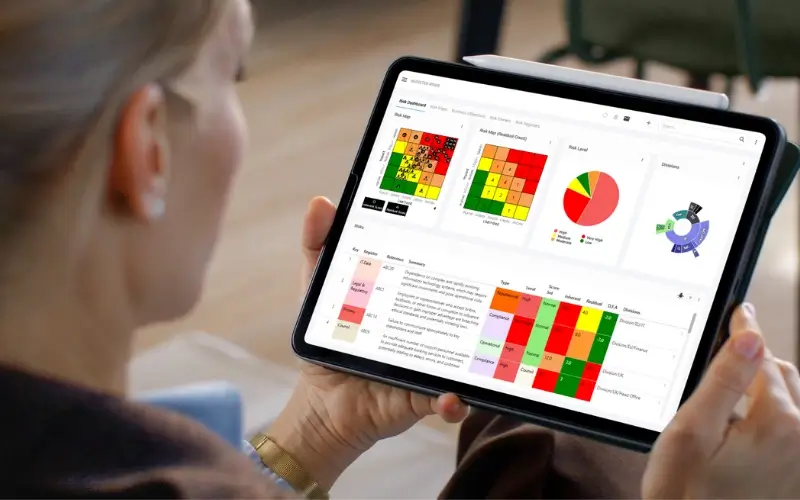
Discover a more connected approach to risk management
See how Symbiant can help your organisation centralise risk information, strengthen control oversight and demonstrate a clear, auditable approach to managing uncertainty.
Frequently asked questions
What is a business continuity plan?
A business continuity plan documents how an organisation will maintain or recover critical activities following disruption. It typically identifies response responsibilities, recovery procedures, required resources, communication arrangements and actions intended to reduce operational impact.
What is the difference between a business continuity plan and business continuity management?
What is a business impact analysis?
How often should a business continuity plan be tested?
Testing frequency should reflect the criticality of the service, the organisation’s risk profile and relevant regulatory requirements. Plans should also be reviewed when significant changes, incidents, control failures or new dependencies affect the assumptions on which they rely.
Does business continuity software ensure ISO 22301 compliance?
No software can guarantee certification or compliance by itself. Business continuity software can support an ISO 22301-aligned management system by helping organisations structure information, maintain plans, document responsibilities, track actions, perform reviews and demonstrate continual improvement.
What is the difference between business continuity and operational resilience?
Business continuity focuses on preparing for, responding to and recovering from disruption. Operational resilience is broader: it considers the organisation’s ability to anticipate, prevent, adapt to, respond to and recover from disruption while continuing to deliver its most important services.