

A business continuity plan can be complete, approved and aligned with a recognised standard, and still fail when disruption arrives.
The document may be current. The required fields may be populated. Responsibilities may even be assigned. But can the organisation show that its recovery assumptions are realistic, its dependencies are understood and its people can execute the plan under pressure?
That is the difference between documented continuity and evidenced resilience.
Business continuity standards such as ISO 22301 provide essential structure. They help organisations establish repeatable processes, define responsibilities, understand disruption and improve their ability to continue delivering products and services. However, the value of a standard depends on how its requirements and guidance are translated into day-to-day decisions, testing and improvement.
For boards, risk leaders and business continuity teams, the decisive question is therefore not simply:
Do we have a business continuity plan?
It is:
Can we demonstrate that our arrangements will protect our most important services and improve when weaknesses are found?
What are business continuity standards?
Business continuity standards provide recognised requirements, principles or guidance for preparing for, responding to and recovering from disruption.
They can help an organisation create a consistent approach to:
understanding its operating context and continuity risks;
identifying critical products, services, activities and resources;
completing business impact analyses;
selecting continuity and recovery strategies;
defining roles, plans and response procedures;
exercising and evaluating those arrangements; and
recording findings, corrective actions and continual improvement.
Not every document described as a “standard” performs the same job. Some contain formal management-system requirements against which an organisation can seek certification. Others provide supporting guidance, professional good practice or a framework for a related discipline such as risk or information security.
Understanding those differences helps organisations select the right combination without creating unnecessary complexity.
Turn Business Continuity Standards into Evidence of Readiness
ISO 22301 certification or alignment: which approach is right?
ISO 22301:2019 specifies requirements for a Business Continuity Management System (BCMS). An organisation can implement those requirements internally and use them as a benchmark, or it can seek independent certification through an accredited certification body.
Neither route should be reduced to a box-ticking exercise.
Certification may be appropriate when:
customers, procurement frameworks or contractual arrangements expect independent validation;
stakeholders need additional confidence in the organisation’s BCMS;
the organisation wants a formal external assessment; or
certification supports its market, sector or assurance objectives.
Alignment may be appropriate when:
the immediate aim is to build or mature practical capability;
a proportionate approach is needed for the organisation’s size and risk profile;
formal certification is not currently required; or
the organisation wants to establish sound processes before considering certification.
These are not opposing choices. An organisation may align first, improve its capability and later pursue certification where the added validation is valuable.
What matters is that the chosen approach produces more than compliant documentation. It should establish clear ownership, informed recovery priorities, tested arrangements and evidence that identified weaknesses are being addressed.
Which business continuity standards and frameworks matter?
The most relevant references depend on the organisation’s sector, geography, regulatory obligations, critical services and maturity. A focused combination is usually more useful than trying to adopt every available framework.
| Standard or guidance | Primary purpose | How it supports continuity and resilience |
|---|---|---|
| ISO 22301:2019, including Amendment 1:2024 | Requirements for a BCMS | Provides the core management-system requirements for establishing, operating, monitoring, reviewing, maintaining and continually improving business continuity arrangements. Certification is possible. |
| ISO 22313:2020 | Guidance on ISO 22301 | Helps organisations interpret and apply ISO 22301 requirements. It is supporting guidance rather than a separate certification standard. |
| ISO/TS 22317:2021 | Business impact analysis | Supports a structured BIA process for understanding disruption impacts and continuity priorities. |
| ISO/TS 22318:2021 | Supply-chain continuity | Provides guidance for managing continuity risks and dependencies across supply chains. |
| ISO 22398:2013 | Exercises and testing | Supports the planning, conduct and improvement of exercises used to validate arrangements. |
| ISO 22316:2017 and ISO 22336:2024 | Organisational resilience | Address resilience principles and attributes, and the development of resilience policy and strategy. ISO 22336 is broader than a business continuity response standard. |
| ISO 31000:2018 | Risk management guidance | Helps connect continuity decisions to objectives, uncertainty, risk appetite and treatment. ISO states that ISO 31000 is guidance and is not certifiable. |
| ISO/IEC 27001:2022 | Information security management | Supports the management of information-security risks that can cause or intensify operational disruption. Certification is possible. |
| NIST Cybersecurity Framework 2.0 | Cybersecurity risk outcomes | Helps organisations govern and reduce cybersecurity risk. It complements continuity planning but is not a replacement for a BCMS. |
| BCI Good Practice Guidelines 7.0 | Practitioner good practice | Organises business continuity into six professional practices covering establishment, organisational adoption, analysis, solution design, implementation and validation. |
For UK public bodies, the UK Government Organisational Resilience Guidance is also valuable. It describes resilience as an integrated capability involving risk management, business continuity, security, incident and crisis management, recovery and renewal, not as the responsibility of one isolated team.
See How Symbiant Connects the Complete Resilience Picture
How should you choose the right business continuity framework?
Begin with the outcomes your organisation must protect rather than the number of standards it can claim to follow.
Consider:
Your critical services and stakeholders
Which services, products or outcomes would cause serious harm if interrupted? Who depends on them, and what level of disruption could they tolerate?
Regulatory, contractual and sector expectations
Financial services, healthcare, government, education, utilities and other regulated or public-interest sectors may face specific resilience, security or continuity expectations. Customer contracts and procurement requirements may also influence whether formal certification is valuable.
The nature of your dependencies
Technology, data, premises, specialist staff, utilities and third parties can all become points of failure. Select guidance that reflects the dependencies most capable of interrupting your priority activities.
Organisational scale and maturity
A global group and a small charity may draw on the same principles while implementing them very differently. The approach should be rigorous enough for the risk, but usable enough to become part of normal operations.
The assurance you need
Decide who needs confidence and what evidence they require. That may include management review, internal audit, customer due diligence, regulatory scrutiny or independent certification.
The correct question is not “Which framework is most prestigious?” It is “Which combination helps us make better continuity decisions and demonstrate that those decisions are working?”
From a continuity plan to a resilience evidence chain
A plan is one record, but resilience depends on the relationships around it.
A credible continuity programme should be able to trace a connected path:
critical service → supporting resources and dependencies → disruption risks → preventive and recovery controls → continuity plan → exercise or incident → weakness → remedial action → assurance
Each link answers a different governance question:
What must continue?
Identify the products, services, activities and outcomes that matter most.What do they depend on?
Map the people, systems, information, premises, suppliers and infrastructure required for delivery.What could interrupt them?
Link disruption scenarios and operational risks to the affected resources and services.What reduces the likelihood or impact?
Record preventive, detective, response and recovery controls—and establish who owns them.What will happen during disruption?
Set out escalation routes, responsibilities, workarounds, communications, recovery actions and priorities.Has the plan been tested?
Exercise credible scenarios and record results rather than relying on the date of the last document review.What did the organisation learn?
Turn exercise findings and real incidents into assigned, time-bound actions.Can leaders see the current position?
Report readiness, exceptions, overdue activity and material weaknesses using live evidence.
When these records are held in disconnected spreadsheets, documents and inboxes, the evidence chain is easily broken. A plan may be updated without the corresponding risk assessment changing. An exercise may identify a weakness that never reaches the control owner. An action may be marked complete without evidence that it resolved the original problem.
Connecting the records makes those gaps visible.
Seven warning signs that a continuity programme may not work in practice
1. Plans are reviewed, but assumptions are not challenged
Changing the review date does not confirm that recovery time objectives, staffing assumptions, contact details, system dependencies or supplier arrangements remain realistic.
2. Critical activities are listed without their dependencies
A team may know what it must recover but not recognise that several priority services depend on the same person, platform, location or supplier.
3. Risks and continuity plans are managed separately
When the risk register changes but the related continuity arrangements do not, plans can remain based on an outdated view of exposure.
4. Exercises prove participation, not capability
Attendance and completion are weak measures of readiness. A useful exercise tests specific objectives, records decisions, exposes constraints and produces improvements.
5. Findings do not become owned actions
A lesson without an owner, deadline, evidence requirement and follow-up route is an observation—not an improvement.
6. Real incidents do not update the programme
Actual disruption provides valuable evidence about impacts, control performance, communication and recovery. If incident learning remains in a separate log, the continuity programme loses that evidence.
7. The board receives status without context
A green dashboard may show that plans exist or reviews are complete. It does not necessarily show whether material dependencies remain untested, recovery assumptions have failed or high-priority actions are overdue.
Questions boards and senior leaders should ask
Boards do not need to operate the BCMS, but they do need enough evidence to challenge whether it is effective. Useful questions include:
Which services or outcomes have the lowest tolerance for disruption?
Where do several critical services rely on the same resource or third party?
Which recovery assumptions have not yet been validated through an exercise or real event?
What material weaknesses were identified, who owns them and when will they be resolved?
Have completed actions been checked to confirm that they reduced the original exposure?
What has changed since the last review—within our organisation, suppliers, technology or risk environment?
Where is management accepting continuity risk outside agreed tolerance, and why?
These questions move reporting beyond “Do we have plans?” towards “What evidence supports our confidence?”
How Symbiant GRC Software helps make business continuity standards operational
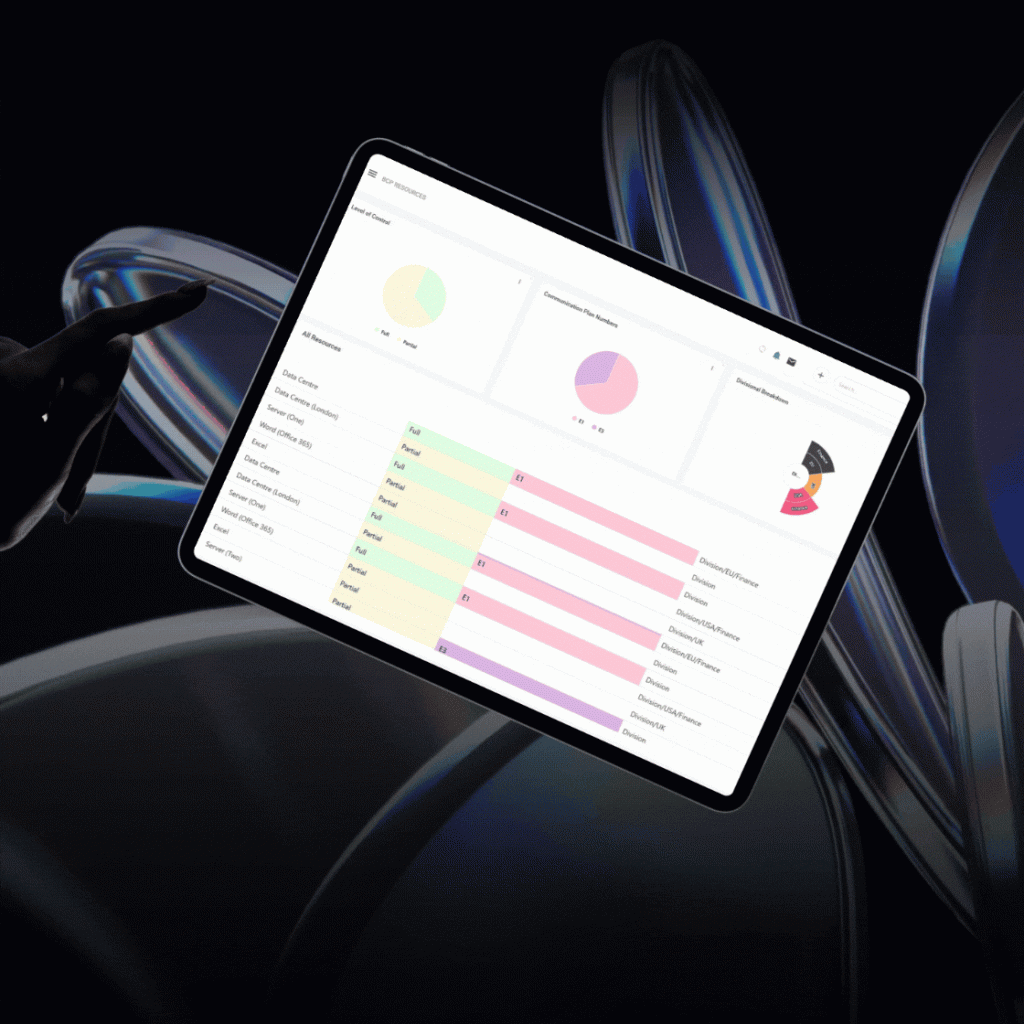
Symbiant’s Business Continuity and Resilience Planning Software gives organisations a central, configurable environment for managing continuity information and connecting it with the wider GRC picture.
Teams can use Symbiant to:
record critical business resources and evaluate impact across departments;
configure impact levels, scoring models and organisational structures around their own methodology;
build mitigation and recovery plans with clear tasks, owners and deadlines;
use alerts and reminders to keep reviews and actions moving;
link critical resources to the Risk Register, Controls and Policies and related actions;
capture operational events through the Incident Reporter and connect them to the affected risk context;
retain an audit trail of continuity and mitigation activity; and
present decision-makers with a more connected view of risks, dependencies, controls and improvement work.
Symbiant’s optional AI Assistant can also support scenario exploration by suggesting potential disruption events, affected business areas, root causes, related risks and possible mitigations. These suggestions support human judgement; they do not replace accountable decisions, testing or independent assurance.
Because Symbiant is modular and cost-effective, it enables organisations to begin with the capabilities they need and connect further risk, governance, compliance or audit modules as their approach develops. The platform is designed to adapt to the organisation’s existing framework rather than forcing every team into a rigid, pre-set method.
Can business continuity software make you ISO 22301 compliant?
No software can make an organisation compliant or certified by itself.
ISO 22301 applies to the organisation’s management system: its context, leadership, planning, support, operation, evaluation and improvement. Technology can make the associated work more consistent, visible and traceable, but effective implementation still depends on leadership, competent people, appropriate decisions and working practices.
The value of business continuity software is that it can help the organisation maintain the evidence behind its approach. Instead of treating plans, risks, controls, exercises, incidents and actions as separate files, teams can manage them as connected parts of the same resilience system.
That supports both practical readiness and clearer assurance, whether the organisation is aligning with ISO 22301, preparing for certification or improving an established BCMS.
Business continuity standards should be a starting point, not the final test
Standards answer an important question: what should a disciplined business continuity management system include?
They cannot answer the most important question on their own: will this organisation’s arrangements work against the disruption it actually faces?
That answer comes from current data, understood dependencies, credible exercises, incident learning, owned actions and transparent assurance.
The strongest continuity programmes do not choose between compliance and real-world readiness. They use the standard to create structure, and connected evidence to show whether that structure is delivering resilience.
Sources and Further Reading
International Organization for Standardization, ISO 22301:2019 — Business continuity management systems — Requirements
ISO Technical Committee 292, Security and resilience standards catalogue
International Organization for Standardization, ISO 31000:2018 — Risk management — Guidelines
International Organization for Standardization, ISO/IEC 27001:2022 — Information security management systems
The Business Continuity Institute, Good Practice Guidelines 7.0
Cabinet Office, UK Government Organisational Resilience Guidance
Cabinet Office, The UK Government Resilience Framework
National Institute of Standards and Technology, Cybersecurity Framework 2.0
Standards and guidance checked September 2026. Organisations should confirm the current edition and seek specialist advice where certification, legal or regulatory obligations apply.
See Your Continuity Evidence in One Connected View
Move beyond isolated plans and spreadsheets. With Symbiant, you can connect critical resources, disruption risks, controls, incidents, recovery actions and assurance in a flexible platform built around your organisation.

Frequently Asked Questions
What is the main international standard for business continuity?
What is the difference between ISO 22301 and ISO 22313?
Is ISO 31000 a business continuity standard?
What is the difference between business continuity and organisational resilience?
Does ISO 22301 certification guarantee that a plan will work?
How often should a business continuity plan be tested?
Testing should follow a planned, risk-based programme that reflects the importance of the service, the pace of change, previous findings and relevant obligations. Organisations should also reconsider plans after significant operational changes, supplier changes, incidents or exercises. The objective is not simply to repeat a test on a fixed date, but to build sufficient evidence that arrangements remain capable and current.