
ISQM Software: How Modern Firms Are Simplifying Quality Management and Compliance
Take control of your compliance and risk processes
Move beyond spreadsheets and disconnected systems with a flexible platform that centralises your data, tracks actions, and gives you clear visibility across your organisation.
Quality management has become a critical priority for organisations operating in highly regulated and assurance-driven environments. As expectations around governance, accountability, risk oversight, and operational consistency continue to increase, many firms are moving away from fragmented spreadsheets and disconnected processes toward more structured and connected systems.
The introduction of the International Standard on Quality Management (ISQM) reinforced the need for organisations to take a proactive and ongoing approach to identifying risks, implementing controls, monitoring incidents, and continuously improving quality processes.
However, managing ISQM requirements manually can quickly become difficult.
Risks, controls, incidents, reviews, action plans, and supporting evidence are often spread across emails, spreadsheets, shared folders, and disconnected systems. This creates silos, reduces visibility, and makes demonstrating compliance far more time-consuming than it should be.
Modern ISQM software helps organisations centralise these activities within one connected environment, creating stronger oversight, clearer accountability, and more efficient quality management processes.
What Is ISQM Software?
ISQM software is designed to help organisations manage and demonstrate compliance with the International Standard on Quality Management through structured workflows, centralised documentation, action tracking, and connected oversight.
Rather than relying on isolated processes, ISQM software allows organisations to:
- Identify and assess quality-related risks
- Implement and monitor controls
- Record and investigate incidents
- Track reviews and remedial actions
- Maintain audit-ready records
- Improve accountability across teams
- Demonstrate continuous monitoring and improvement
A connected ISQM framework helps organisations move beyond reactive compliance management toward a more proactive and sustainable quality management approach.
Why Spreadsheet-Based Quality Management Creates Problems
Many organisations still attempt to manage ISQM processes using spreadsheets, emails, and manually maintained documents.
While this may initially appear manageable, problems often emerge as processes grow.
Limited Visibility
When information exists across multiple files and systems, it becomes difficult to gain a complete overview of quality-related risks, incidents, controls, and outstanding actions.
Lack of Accountability
Without structured ownership and automated reminders, actions can easily become delayed, overlooked, or forgotten entirely.
Weak Audit Trails
Manual systems often struggle to provide clear evidence of who changed information, when updates occurred, and how decisions were made.
Disconnected Risk and Control Management
Quality risks, incidents, and controls are frequently managed separately, making it harder to understand relationships between issues and identify recurring weaknesses.
Time-Consuming Reporting
Preparing reports for management reviews, regulators, or external auditors often requires manual reconciliation across multiple data sources.
These challenges are one of the main reasons many firms are moving toward connected quality management software platforms.
How Modern ISQM Software Improves Quality Management
Modern ISQM software provides organisations with a more connected and structured approach to managing quality management requirements.
Centralised Quality Management
A connected platform creates a Single Source of Truth (SSOT) where risks, controls, incidents, reviews, and actions can all be managed together.
This improves visibility across the organisation while reducing duplication and information silos.
Connected Risk, Control and Incident Management
One of the biggest advantages of integrated ISQM software is the ability to connect related information together.
For example:
- Incidents can be linked directly to risks
- Risks can connect to controls and policies
- Failed controls can trigger reviews or remedial actions
- Action plans can be tracked through to completion
This creates a far more dynamic and transparent quality management process.
Automated Notifications and Action Tracking
Automation helps ensure quality management activities continue moving forward without relying entirely on manual follow-up.
Modern systems can automatically:
- Send reminders for overdue actions
- Notify owners when risk thresholds change
- Escalate unresolved issues
- Trigger reviews and assessments
- Track remediation progress
This improves accountability while reducing administrative overhead.
Improved Audit Readiness
ISQM software helps organisations maintain structured, tamperproof records that support internal reviews, external audits, and regulatory oversight.
Instead of manually gathering evidence from multiple locations, firms can generate reports and demonstrate governance activities more efficiently.
Key Features to Look for in ISQM Software
When evaluating ISQM software, organisations should look for solutions that support connected oversight rather than isolated workflows.
Important capabilities often include:
Risk and Control Management
The ability to identify, assess, and monitor risks while linking them directly to controls and mitigation activities.
Incident Reporting
Centralised incident management that supports investigation, escalation, trend analysis, and linkage to quality risks.
Action Tracking
Structured ownership, automated reminders, escalation workflows, and management oversight for remedial actions.
Audit Trails
Tamperproof tracking of changes, approvals, reviews, and updates for stronger accountability.
Flexible Assessments and Reviews
Dynamic questionnaires and assessments that adapt based on responses and support ongoing monitoring activities.
Reporting and Dashboards
Real-time reporting and management dashboards that improve oversight and support decision-making.
Integration Across Governance Activities
The ability to connect quality management activities with broader governance, risk, compliance, and audit processes.
How Symbiant Supports ISQM Management
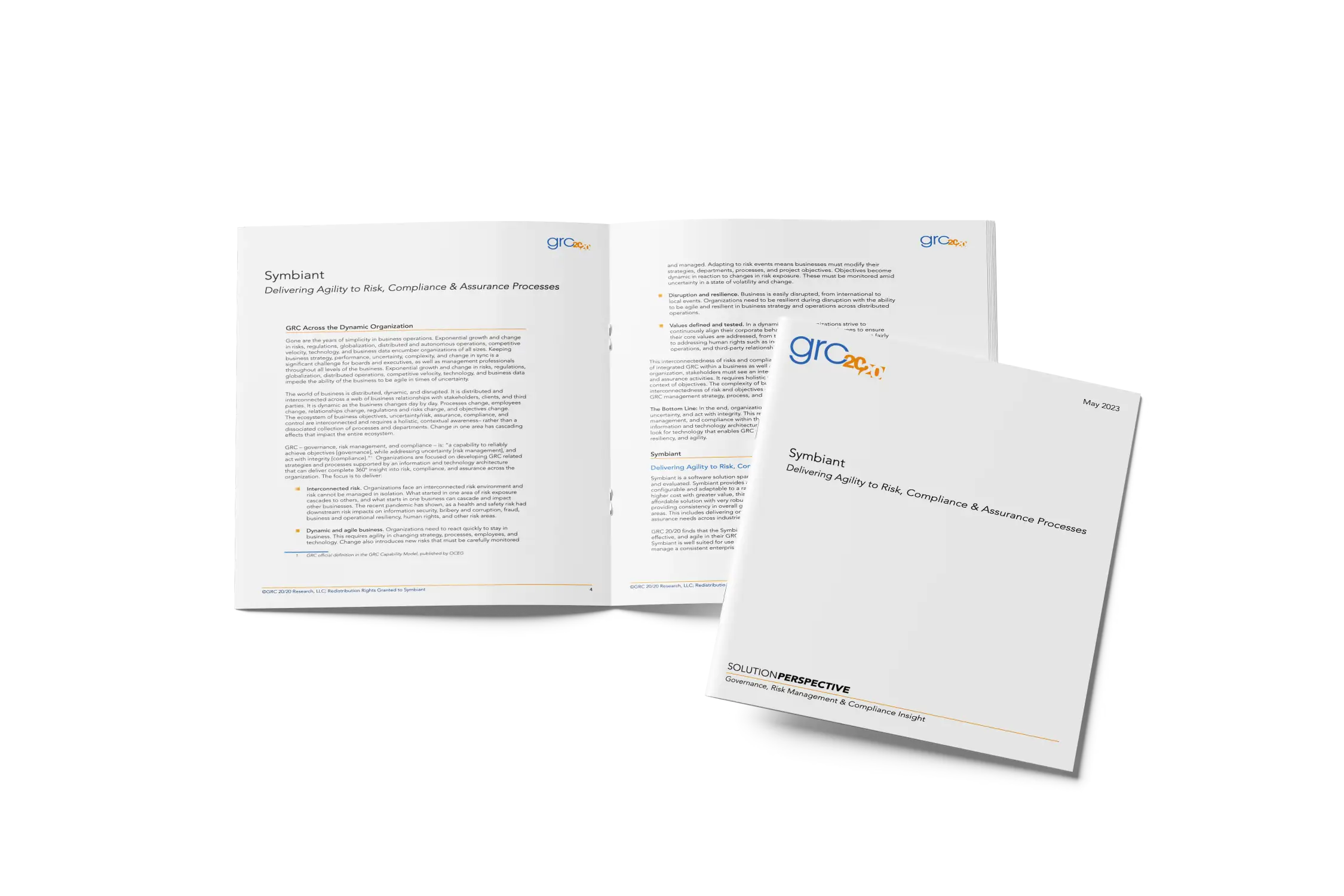
Symbiant’s ISQM Module is designed to assist organisations in managing International Standard on Quality Management requirements through a connected and easy-to-manage framework.
The module supports businesses in:
- Identifying risks
- Implementing controls
- Managing incidents
- Tracking reviews and remedial actions
within one connected platform.
Key Features of Symbiant’s ISQM Software
- Straightforward support for ISQM compliance
- Tamperproof design
- Spreadsheet data import
- Reviews and remedial action tracking
- Connected workflows across risk and control management
The module also integrates with:
- Risk Registers
- Controls and Policies
- Incident Reporter
- Wider Risk Modules
Because Symbiant is built around a Single Source of Truth philosophy, organisations can connect quality management activities across departments while improving collaboration, oversight, and reporting accuracy.
The Shift Toward Connected Quality Management
ISQM is no longer simply about maintaining documentation.
Organisations are increasingly expected to demonstrate ongoing oversight, accountability, continuous monitoring, and effective remediation processes.
Disconnected spreadsheets and manual processes make this significantly harder.
Modern ISQM software helps organisations move toward a more connected quality management framework where risks, controls, incidents, assessments, and actions work together within one ecosystem.
This not only supports compliance but also strengthens operational resilience, governance visibility, and organisational confidence.
Final Thoughts
As quality management expectations continue to evolve, organisations need more than static documentation and disconnected tracking processes.
They need visibility.
They need accountability.
And they need connected oversight across risks, controls, incidents, and remediation activities.
Modern ISQM software helps organisations simplify compliance while creating a stronger foundation for long-term quality management and operational improvement.
For firms looking to move beyond spreadsheets and fragmented workflows, connected ISQM management platforms provide a far more scalable and sustainable approach.
Take control of your compliance and risk processes
Move beyond spreadsheets and disconnected systems with a flexible platform that centralises your data, tracks actions, and gives you clear visibility across your organisation.