
From Audit Finding to Remediation: A Structured Approach to Audit Action Tracking
An internal audit finding does not create value simply because it has been identified, documented and reported.
The value is realised when the underlying issue is addressed.
For internal audit functions, this creates an important distinction between recording audit actions and demonstrating effective remediation. An organisation may have a comprehensive register of findings, recommendations, owners and target dates, yet still struggle to establish whether remedial actions have been implemented effectively, whether significant weaknesses remain unresolved, or whether management has accepted the risk associated with delayed action.
Effective audit action tracking therefore extends well beyond maintaining an administrative log.
It requires a structured process for assigning responsibility, monitoring progress, retaining evidence, reviewing implementation, managing overdue actions and providing appropriate assurance to management and the Audit Committee.
For organisations managing a growing volume of findings across multiple business areas, locations or audit engagements, audit action tracking software can provide the governance structure necessary to move from identifying an issue to demonstrating that it has been appropriately addressed.
Audit Action Tracking Is Part of the Assurance Process
The current Global Internal Audit Standards, issued by The Institute of Internal Auditors (IIA), place explicit emphasis on what happens after an audit engagement has concluded.
Domain V of the Standards covers the performance of internal audit services and includes the principle “Communicate Engagement Results and Monitor Action Plans.” The IIA explains that internal auditors are expected to work with management on recommendations or action plans and continue communicating with relevant stakeholders after the engagement itself closes.
This is particularly important under Standard 15.2: Confirming the Implementation of Recommendations or Action Plans.
The Standard requires internal auditors to maintain an established methodology for confirming implementation. This includes monitoring progress, conducting follow-up assessment using a risk-based approach and updating the status of action plans within a tracking system. Where agreed actions have not been implemented by the established completion date, internal audit is expected to obtain and document management’s explanation and consider whether the delay represents an acceptance of risk.
The implication is therefore significant.
An action should not be considered adequately managed simply because it appears on a tracker or has been marked as as complete by its owner.
Internal audit must retain sufficient visibility to determine whether the agreed response has actually been implemented and whether further follow-up is appropriate based on the significance of the original finding.
From Finding to Remediation: The Complete Audit Action Lifecycle
A robust audit action management process should maintain an identifiable relationship between:
Audit engagement → Finding → Recommendation → Management action → Owner → Target date → Evidence → Review → Verification → Closure
Each stage serves a distinct purpose.
1. Establish a Clearly Defined Audit Finding
Effective remediation begins with the quality of the original finding.
A finding should provide sufficient context to establish the nature of the deficiency and why it matters. Depending on the organisation’s methodology, this may include the condition identified, the expected criterion or control, underlying cause and potential effect or risk.
Without this context, subsequent action tracking can become detached from the purpose of the audit.
Six or twelve months after an engagement has concluded, an action owner or reviewer should still be able to establish:
what was identified;
why the issue was significant;
what recommendation was made;
what management agreed to do;
who accepted responsibility;
what evidence is required before closure; and
what risk remains if remediation is delayed.
This information becomes particularly important where actions are transferred between employees, target dates change, organisational structures evolve or findings remain open for an extended period.
2. Translate Recommendations Into Defined Management Actions
A recommendation and a management action are related, but they are not necessarily the same.
A recommendation may describe the improvement required.
The management action should define how the organisation intends to achieve it.
For example, a recommendation stating that access controls should be strengthened is difficult to track objectively. A corresponding management action could instead specify that quarterly privileged-access reviews will be introduced across defined systems, with exceptions documented and formally approved.
The second formulation establishes a much clearer basis for accountability and subsequent verification.
A well-structured audit action tracker should therefore retain the relationship between the recommendation and the specific actions agreed in response.
Where a single recommendation requires several activities, these should also be capable of being managed separately while remaining associated with the original finding.
3. Establish Clear Ownership and Accountability
Remediation can become difficult when responsibility is distributed without clear accountability.
An organisation may know which department is responsible for addressing a finding while still lacking clarity over the individual responsible for ensuring that the action progresses.
Effective audit action management should establish:
the responsible action owner;
relevant contributors or stakeholders;
the agreed target date;
the priority or significance of the finding;
the individual responsible for reviewing completion; and
any escalation requirements.
Technology is particularly useful at this stage because it can transfer routine administrative activity away from the internal audit team.
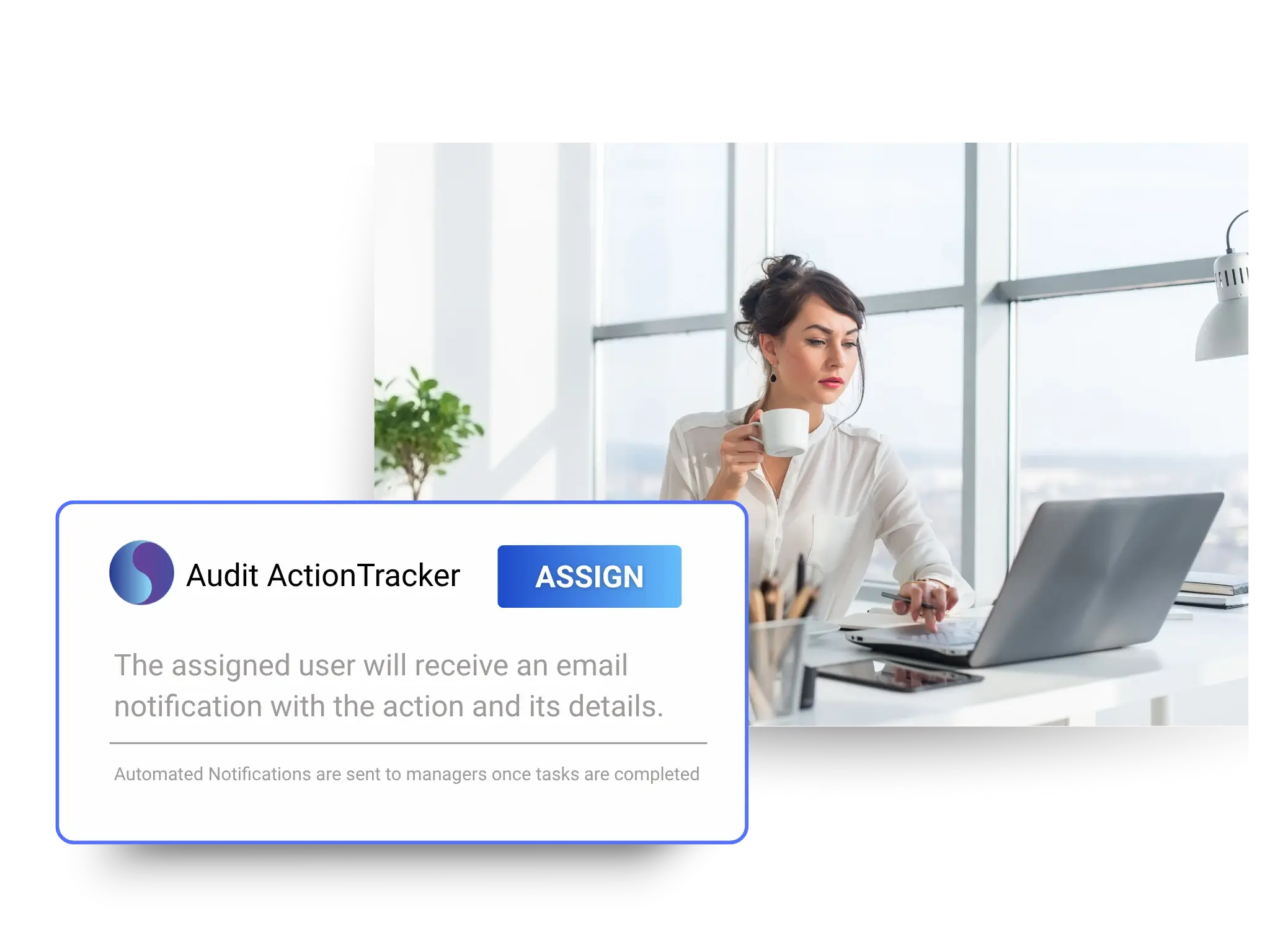
Rather than relying on auditors to send repeated emails requesting updates, the system can notify owners when actions are assigned and issue reminders as deadlines approach or become overdue.
This was an important benefit identified by Arrow Global after moving away from spreadsheet-based audit tracking.
The organisation described Symbiant’s workflow-based approach as:
“a massive leap away from spreadsheet-based action tracking”
and specifically highlighted its role in supporting action ownership and completion.
The significance of this is not simply administrative efficiency. Clear ownership creates a stronger line of accountability between the finding, management response and eventual outcome.
4. Monitor Progress Against the Original Commitment
Audit action tracking should provide visibility not only of current status, but also of the commitments originally made.
Target dates will sometimes need to change for legitimate operational reasons. However, repeatedly replacing original deadlines can obscure the history of an action and make it difficult to evaluate remediation performance.
A mature audit tracking process should therefore retain:
the original target date;
revised completion dates;
reasons for extensions;
status changes;
management commentary; and
a complete history of updates.
This creates a more meaningful audit trail.
It also enables internal audit and the Audit Committee to distinguish between isolated delays and systematic patterns.
For example, repeated extensions affecting high-priority actions within one business area may indicate a wider problem with resources, management attention, accountability or risk acceptance.
The information becomes useful not merely for administration but for governance.
5. Require Appropriate Evidence of Implementation
An action owner’s declaration that an activity has been completed may be appropriate as a progress update.
It is not necessarily sufficient evidence for closure.
The evidence required will depend on the nature and significance of the finding. Examples could include:
revised policies or procedures;
screenshots or system configuration records;
approval records;
control documentation;
training records;
meeting evidence;
completed assessments;
transaction samples;
management reports; or
evidence that a new control has operated successfully.
A structured audit remediation system allows supporting documentation to remain connected to the original action rather than becoming dispersed across inboxes, shared drives and individual working files.
That record is valuable both during the immediate follow-up process and later, when auditors, management or assurance functions need to establish why an action was considered complete.
6. Distinguish Between “Completed” and “Verified”
This is one of the most important distinctions within effective audit remediation.
Management may complete an action.
Internal audit may still need to verify its implementation.
The level of verification should be proportionate to the significance of the finding, consistent with the risk-based follow-up approach established under the IIA’s current Standards.
For a relatively low-risk procedural issue, documentary evidence may provide sufficient assurance.
For a significant control weakness, verification may require additional testing, observation of the revised control in operation or examination of a sample of transactions.
For this reason, audit tracking workflows should ideally allow different states to be recognised.
For example:
Open → In Progress → Submitted as Complete → Under Review → Implemented/Verified
This prevents a management update from automatically becoming an audit conclusion.
Symbiant’s Audit Action Tracker supports this distinction by allowing managers to review action updates and supporting attachments, provide responses and revoke a completed status where additional work is required. The system also retains a full record of user changes and original due dates.
This supports a more defensible closure process because the history of the remediation can be retained alongside the evidence used to support the decision.
7. Manage Overdue Audit Actions as a Governance Issue
An overdue audit action is not simply a late task.
In some circumstances, it represents continued exposure to a risk that management previously agreed required remediation.
That makes the reason for delay important.
Internal audit should be able to establish:
why the action is overdue;
whether the underlying risk has changed;
whether mitigating controls are operating in the interim;
whether the original action remains appropriate;
whether a revised date has been formally agreed; and
whether continued delay constitutes acceptance of the associated risk.
Standard 15.2 specifically addresses circumstances where management has not progressed agreed actions within established completion dates. Internal audit is expected to document the explanation and consider the matter in the context of risk acceptance.
Accordingly, overdue action reporting should provide more information than a total number of red or amber items.
Audit Committees and senior management need sufficient context to understand which significant exposures remain unresolved and why.
8. Report on Remediation, Not Simply Closure Rates
One of the limitations of audit action reporting is the temptation to focus almost exclusively on closure percentages.
For example:
92% of audit actions closed.
The figure may be correct, but it provides limited assurance on its own.
A relatively high closure rate may conceal a small number of long-running, high-priority findings. Equally, a lower overall closure rate may reflect a large number of lower-risk actions while the organisation’s most significant issues have already been addressed.
More informative reporting can include:
open findings by priority;
age of outstanding actions;
high-risk actions past their original due date;
number and frequency of deadline extensions;
actions awaiting evidence;
actions awaiting verification;
recurring findings;
actions by business area or accountable owner;
trends in remediation time;
significant accepted risks; and
repeat findings relating to the same control or root cause.
This provides senior management and Audit Committees with a clearer view of the remaining exposure, rather than simply the volume of administrative activity completed.
Audit Committee reporting in practice
This requirement for clear, timely reporting is reflected in the experience of Orbit Housing Group, which uses Symbiant for audit recommendation tracking.
Orbit stated:
“Reporting to management and the Audit Committee is much easier”
and also noted that the system provides current reports on the status of recommendations.
For an internal audit function, this illustrates an important benefit of structured audit action tracking: information entered as part of day-to-day remediation can also support governance reporting without requiring the audit team to reconstruct the position manually before each Committee meeting.
When Does Spreadsheet-Based Audit Action Tracking Become Difficult?
Spreadsheets can be perfectly appropriate for relatively small or straightforward audit action registers.
The issue is not that spreadsheets are inherently unsuitable.
The question is whether the complexity of the process has outgrown them.
Challenges typically become more apparent as organisations introduce:
larger numbers of findings and recommendations;
multiple audit teams;
decentralised action ownership;
several business units or geographic locations;
different levels of user access;
formal evidence requirements;
multiple approval stages;
frequent status changes;
extensive Audit Committee reporting; or
connections between audit findings, controls and organisational risks.
At this point, internal audit can become responsible for significant manual administration: circulating spreadsheets, consolidating versions, chasing owners, extracting evidence from emails, updating reports and reconciling conflicting status information.
The experience of Derbyshire Building Society provides a relevant example.
When replacing its Excel-based action tracking process, the organisation reviewed a number of providers. Its assessment of Symbiant was:
“the instant leader for features, ease of use, reporting and value for money.”
Importantly, the underlying objective was not simply to replace Excel with another database. Derbyshire Building Society was seeking stronger functionality, improved reporting, greater visibility and a more structured mechanism for managing audit actions.
Audit Action Tracking Across Complex and Distributed Organisations
The challenges become more pronounced when action owners operate across different locations or countries.
A central audit function may be responsible for monitoring findings involving business units across multiple jurisdictions, each with different management structures, operational priorities and time zones.
In these environments, relying on periodic email requests and locally maintained trackers can make it difficult to maintain a consistent view of remediation.
Concern Worldwide, an international humanitarian organisation operating across more than 20 countries, provides a useful example.
Its Head of Internal Audit & Investigations, Catherine Gleeson, explained that Symbiant was originally adopted to:
“facilitate follow-up of open audit findings.”
The organisation identified the web-based nature of the platform as particularly suited to its geographically dispersed operations. It has used Symbiant since approximately 2010 to support the follow-up and closure of findings across its international programme offices.
Concern has also highlighted the practical consequence of losing a centralised tracking system. Without an automated and globally accessible platform, its Internal Audit team anticipated significant additional time being required to follow up individual audit reports and consolidate updates across country teams.
The example demonstrates that audit action software is not simply about automation. For distributed organisations, it can form part of the operating infrastructure through which accountability is maintained across organisational boundaries.
The Importance of Accessibility for Action Owners
The success of an audit tracking process depends partly on individuals outside the internal audit function.
Most action owners are not auditors.
They may interact with the audit system only periodically, perhaps when receiving a recommendation, updating progress or submitting evidence.
The process therefore needs to be straightforward enough that users can respond without requiring specialist knowledge of the audit platform.
Brakes Ltd selected Symbiant specifically to reduce the administration associated with tracking issues and recommendations and to improve visibility across the organisation. Its feedback noted that users introduced to the emailed recommendation process found it positive to use and respond to.
This matters because the effectiveness of an audit action management system depends not only on the sophistication available to the internal audit team, but also on whether action owners actually engage with it.
A technically capable system that creates unnecessary friction for occasional users can simply introduce a different form of administrative burden.
What Should Audit Action Tracking Software Provide?
For organisations evaluating an audit action tracking system, functionality should reflect the governance requirements of the remediation process.
At a minimum, organisations may wish to consider whether the platform can support:
Centralised issue and recommendation management
Findings, recommendations and corresponding actions should remain connected rather than being managed as unrelated records.
Defined action ownership
Actions should be assigned to specific accountable individuals, with appropriate visibility for management and internal audit.
Automated notifications and reminders
The system should reduce dependence on manual chasing by issuing appropriate communications when actions are assigned, approaching their target date or becoming overdue.
Evidence management
Action owners should be able to provide supporting documentation and commentary directly against the relevant action.
Review and verification
The workflow should distinguish between an owner submitting an action as complete and an authorised reviewer confirming that the evidence is sufficient.
Complete audit history
Changes to status, deadlines, ownership and other relevant information should be retained to provide an auditable history of remediation.
Reporting and dashboards
Internal audit should be able to analyse outstanding actions by factors such as status, priority, age, responsible owner, business area and deadline.
Appropriate access controls
Users should only have access to the information appropriate to their responsibilities.
Configurability
Terminology, fields, workflows and reporting requirements vary considerably between organisations. Software should therefore support the organisation’s audit methodology rather than requiring the methodology to be redesigned around the software.
Integration with wider assurance information
Where possible, findings should be capable of being related to other relevant information such as risks, controls, working papers and audit engagements.
These are all capabilities provided within Symbiant’s Audit Action Tracker, including action assignment, automated reminders, evidence attachments, configurable workflows, granular permissions, status review, historic due-date retention and reporting for management and Audit Committees.
Moving Beyond an Isolated Audit Action Register
The wider opportunity lies in treating audit findings as part of the organisation’s overall assurance picture.
A significant finding may indicate:
that a control is not operating as intended;
that an existing risk assessment needs reconsideration;
that a regulatory obligation may be affected;
that similar weaknesses exist elsewhere;
that a previous incident has a wider root cause; or
that an issue identified by one assurance function is relevant to another.
When audit actions are maintained in isolation, these relationships can be difficult to identify.
For example, a recurring access-control finding may appear to be an audit remediation issue. When connected with incidents, control assessments and relevant risks, however, it may indicate a broader systemic weakness.
Similarly, several apparently independent audit recommendations may ultimately relate to the same ineffective control.
Connecting these records can therefore improve more than efficiency.
It can improve organisational understanding.
The IIA’s Global Internal Audit Standards position internal auditing within the wider context of governance, risk management and control. Domain V specifically recognises the need to develop findings and conclusions, work with management on actions and maintain communication following the engagement.
Audit remediation should therefore not be viewed solely as the final administrative stage of an audit.
It is part of the broader assurance cycle.
How Symbiant Supports the Journey From Finding to Remediation
Symbiant’s Audit Action Tracker Software is designed to provide a structured environment for managing audit findings, recommendations and subsequent actions.
Issues can be entered directly or imported from spreadsheets. Actions can then be assigned to responsible individuals, grouped against recommendations and supported by automated notifications and reminders. Action owners can provide updates, attach evidence and add explanatory commentary through a simplified interface.
The review process provides additional control.
Managers can review submitted evidence, provide responses and return actions for further work where appropriate rather than treating an owner’s declaration of completion as automatic closure. A full audit log records user changes, while original target dates remain available even where deadlines are subsequently revised.
Reporting then provides visibility over progress, overdue actions and wider remediation performance.
For organisations using additional Symbiant audit and GRC modules, actions can also form part of a broader connected environment incorporating Audit Working Papers, the Audit Universe, risks, controls and other governance information.
This creates a progression from:
finding an issue
to
assigning responsibility
to
evidencing remediation
to
understanding what the finding means for the wider organisation.
Proven Across Different Audit Environments
The relevance of this approach is reflected in the variety of organisations using Symbiant for audit management and action tracking.
Arrow Global has used the workflow-based system to move away from spreadsheet action tracking and strengthen action ownership.
Derbyshire Building Society replaced an Excel-based action tracking system after comparing a number of providers, highlighting Symbiant’s functionality, usability, reporting and value.
Orbit Housing Group uses the platform to maintain current reporting on audit recommendations and simplify information provided to management and its Audit Committee.
Brakes Ltd selected Symbiant to reduce the administration associated with managing audit issues and recommendations while improving organisational visibility.
And Concern Worldwide has used Symbiant for more than 15 years to support the follow-up of audit findings across an internationally distributed organisation. Its Internal Audit team has specifically highlighted accessibility, ease of use, custom reporting and the ability to maintain progress in closing findings.
These organisations operate in very different environments, but the underlying requirement is consistent: maintaining clear visibility and accountability between the point at which an audit identifies an issue and the point at which management can demonstrate that it has been addressed.
The Objective Is Not to Close an Action. It Is to Address the Finding.
A mature internal audit function should be able to answer more than:
How many audit actions are open?
It should be able to establish:
Which findings remain unresolved?
Which significant actions are overdue?
Who is accountable?
What evidence supports implementation?
Has remediation been independently reviewed where appropriate?
What risks remain exposed?
Are the same weaknesses recurring elsewhere?
Those questions move audit action tracking beyond administration and towards assurance.
The purpose of an audit action tracker is therefore not simply to replace a spreadsheet or produce a more attractive list of outstanding recommendations.
It is to establish a controlled, transparent and evidence-based process connecting the identification of a weakness with the organisation’s response to it.
Because an audit finding is not resolved when somebody changes its status.
It is resolved when there is sufficient evidence to demonstrate that the underlying issue has been appropriately addressed.
ensure audit actions are completed efficiently & on time
Explore Symbiant Audit Action Tracker Software
Symbiant’s Audit Action Tracker helps internal audit teams centralise findings and recommendations, establish clear ownership, automate follow-up, retain remediation evidence, monitor overdue actions and provide timely reporting to management and Audit Committees.
Combined with Symbiant’s wider Audit Management, Risk Management and GRC modules, audit findings can remain connected to the risks, controls and assurance activity they affect rather than becoming isolated records once an audit has concluded.