
Inherent Risk vs Residual Risk
Inherent Risk vs Residual Risk: Understanding the Difference and Measuring Control Effectiveness
Understanding the difference between inherent and residual risk is essential for evaluating whether your controls are genuinely reducing exposure. This guide explores both risk measures, why the gap between them matters, and how Symbiant helps organisations connect risks, controls and actions for more informed decision-making.
From only £100 per module/month for unlimited users*
Take control of your compliance and risk processes
Move beyond spreadsheets and disconnected systems with a flexible platform that centralises your data, tracks actions, and gives you clear visibility across your organisation.
Most organisations identify and score risks. The greater challenge is determining whether the controls introduced to manage those risks are actually working.
Inherent and residual risk assessments provide two important perspectives on an organisation’s exposure. Inherent risk represents the level of risk before controls or mitigation measures are considered, while residual risk reflects the exposure remaining after those measures have been applied.
However, these figures are most valuable when they are considered together. The difference between inherent and residual risk can reveal how effectively controls are reducing exposure, whether further treatment is required and where an organisation may be operating outside its agreed risk appetite.
In this guide, we explain:
- The difference between inherent and residual risk
- Why the gap between them matters
- How controls influence residual risk
- Common problems affecting risk assessments
- How connected GRC software can improve risk and control visibility
What is inherent risk?
Inherent risk is the level of exposure that exists before controls, safeguards or other mitigating actions are considered.
It represents the risk arising naturally from an activity, process, system, project or external environment. This provides organisations with a baseline against which the effectiveness of their controls can later be assessed.
Examples of inherent risks may include:
- The loss or unauthorised disclosure of sensitive information
- Disruption to an important service or business process
- Human error
- Fraud or misuse of access privileges
- Supply-chain disruption
- Regulatory or contractual non-compliance
- Health and safety incidents
- Failure of critical systems or infrastructure
Inherent risk is commonly assessed by considering the likelihood of an event occurring and the potential impact if it does. Organisations may express the result numerically, through a low-to-high rating scale or using a risk matrix.
The assessment should consider the organisation’s exposure as though the relevant controls were not operating. If existing controls influence the inherent score, it becomes difficult to establish an accurate baseline or demonstrate how much risk those controls are reducing.
Why is inherent risk important?
Inherent risk helps an organisation understand where its most significant underlying exposures exist.
It can support:
- The prioritisation of resources
- The design and selection of controls
- Risk-based audit planning
- Management and board reporting
- The allocation of risk ownership
- Decisions about risk treatment
- Comparison between different business areas or activities
Inherent risk should not be treated merely as a compliance field that must be completed. It establishes the starting point for evaluating the organisation’s control environment and remaining exposure.
What is residual risk?
Residual risk is the level of exposure that remains after controls and other mitigation measures have been considered.
Controls may reduce the likelihood of an event, its potential impact or both. However, they will rarely remove the risk completely. Residual risk therefore represents the exposure the organisation continues to carry and must monitor, manage, accept or treat further.
For example, an organisation may face an inherent risk of losing access to critical data. Backups, access restrictions, recovery procedures and system monitoring may significantly reduce that exposure, but some residual risk will remain because controls can fail or unexpected events can occur.
Other examples include:
- A data breach occurring despite access and security controls
- Service disruption despite business continuity arrangements
- Fraud continuing to present a risk after approval procedures are introduced
- Supplier failure despite due diligence and ongoing assessments
- Regulatory non-compliance despite policies, training and monitoring
Residual risk should be compared with the organisation’s risk appetite and tolerance thresholds. If the remaining exposure is too high, additional controls, actions or treatment decisions may be required.
What is the difference between inherent and residual risk?
The principal difference is whether controls have been considered.
| Risk measure | What it represents | What it helps establish |
|---|---|---|
| Inherent risk | Exposure before controls and mitigation | The organisation’s underlying level of risk |
| Residual risk | Exposure after controls and mitigation | The level of risk that remains |
| Risk reduction | The difference between the two assessments | The apparent effect of the control environment |
A simplified risk assessment may be expressed as:
Inherent risk – effect of controls = residual risk
In practice, the calculation may be more sophisticated. Organisations can use different scoring methodologies, weightings and criteria depending on their sector, objectives and risk framework.
The important point is that the relationship between risks, controls and residual exposure remains clear and defensible.
Why the gap between inherent and residual risk matters
The difference between inherent and residual risk provides an important indication of how effectively the organisation believes its controls are managing exposure.
A substantial reduction may indicate that strong, well-designed controls are operating effectively. A small reduction could suggest that controls are missing, inadequate, poorly implemented or unable to address the underlying causes of the risk.
However, the size of the gap should never be interpreted in isolation.
A large difference does not automatically prove that controls are effective. The result depends on the accuracy of the original risk assessment, the reliability of the control evaluation and the evidence supporting both scores.
Similarly, a narrowing gap does not always indicate deteriorating controls. The inherent risk itself may have changed because of new technology, altered processes, emerging regulation or developments in the external environment.
Organisations should therefore examine:
- Whether the inherent assessment remains accurate
- Which controls are linked to the risk
- Whether those controls address likelihood, impact or both
- How control effectiveness has been assessed
- Whether failed or ineffective controls have been identified
- Whether incidents indicate that the assessed exposure is unrealistic
- Whether residual risk remains within appetite
- Whether further actions are required
This is why connected risk and control information is more informative than isolated scores.
The importance of control effectiveness
Residual risk assessments depend heavily on the quality and effectiveness of the controls applied.
A control may exist in policy but fail to operate consistently in practice. Alternatively, it may be performed correctly but have little influence over the specific risk to which it has been linked.
An effective control assessment should consider factors such as:
- Whether the control is suitably designed
- Whether it addresses the relevant cause or consequence
- How frequently it operates
- Who owns and performs it
- What evidence demonstrates its operation
- Whether testing has identified weaknesses
- Whether incidents or control failures have occurred
- Whether associated actions remain outstanding
If a control has failed, become ineffective or is no longer operating, the residual risk assessment may need to be increased. Continuing to calculate residual exposure on the assumption that the control is effective could give management a misleading view of the organisation’s actual position.
Common challenges when assessing inherent and residual risk
Inconsistent scoring
Different risk owners may interpret likelihood, impact and control effectiveness differently. Without an agreed methodology and clear scoring criteria, similar risks can receive very different ratings.
Allowing controls to influence inherent risk
Inherent risk should represent exposure before controls are considered. If assessors subconsciously include the effect of current controls, the starting score can be understated and the resulting comparison becomes unreliable.
Overestimating control effectiveness
The existence of a control does not necessarily mean it is effective. Assessments should be supported by evidence, testing, monitoring, incidents and other relevant information.
Treating assessments as static
Risk exposure changes. New systems, suppliers, legislation, objectives and operating conditions can all affect inherent and residual risk. Assessments should be reviewed when the underlying context changes—not only when the next annual review becomes due.
Managing risks and controls separately
When risk registers and control records are maintained in different documents or systems, it becomes difficult to determine which controls protect which risks and whether changes have been reflected consistently.
Relying on spreadsheets
Spreadsheets may initially appear sufficient, but they can become difficult to govern as the number of risks, controls, owners and actions increases. Version control, inconsistent formulas, disconnected evidence and limited audit trails can undermine confidence in the resulting assessments.
Failing to connect incidents and actions
An incident may demonstrate that a control has failed or that the residual risk was underestimated. If incidents, controls, risks and remedial actions are managed separately, this information may not reach the people responsible for reassessing exposure.
How to manage inherent and residual risk more effectively
Establish a consistent methodology
Define how likelihood, impact, inherent risk, control effectiveness and residual risk should be assessed. Provide clear criteria so that ratings can be applied consistently across departments.
Connect risks with their controls
Every relevant control should be linked to the risks it is intended to manage. This allows users to understand the basis of the residual assessment and identify risks with insufficient control coverage.
Evaluate controls individually
Assess whether each control is appropriately designed and operating effectively. Avoid assuming that a list of controls automatically represents meaningful risk reduction.
Compare residual risk with risk appetite
Residual risk should be considered in relation to the organisation’s agreed appetite and tolerance levels. Where exposure exceeds those thresholds, it should trigger treatment, escalation or a formally approved acceptance decision.
Assign clear ownership
Risks, controls and treatment actions should have accountable owners. Defined responsibilities make it easier to monitor progress and escalate overdue or unresolved issues.
Reassess risk following material changes
Review risk scores when controls fail, incidents occur, business objectives change, new regulations arise or significant operational changes are introduced.
Preserve an audit trail
Maintain a reliable history of assessments, changes, approvals and actions. This enables management, auditors and regulators to understand how risk decisions were reached.
Managing inherent and residual risk with Symbiant
Symbiant brings risk, controls, incidents, actions, assessments and audit information together within one connected GRC environment.
Rather than maintaining risk scores in one spreadsheet and control information elsewhere, organisations can create direct relationships between their risks and the controls used to manage them. This provides greater context around residual risk and makes it easier to investigate whether an assessment remains justified.
With Symbiant, organisations can:
- Record and assess inherent and residual risk
- Apply configurable scoring criteria and risk matrices
- Link controls directly to relevant risks
- Assess control design and effectiveness
- Identify failed or ineffective controls
- Adjust residual exposure when control performance changes
- Assign risk, control and action owners
- Define and monitor risk treatment activities
- Connect incidents with existing risks or identify new ones
- Track actions and recommendations through to completion
- Maintain a clear history of changes and decisions
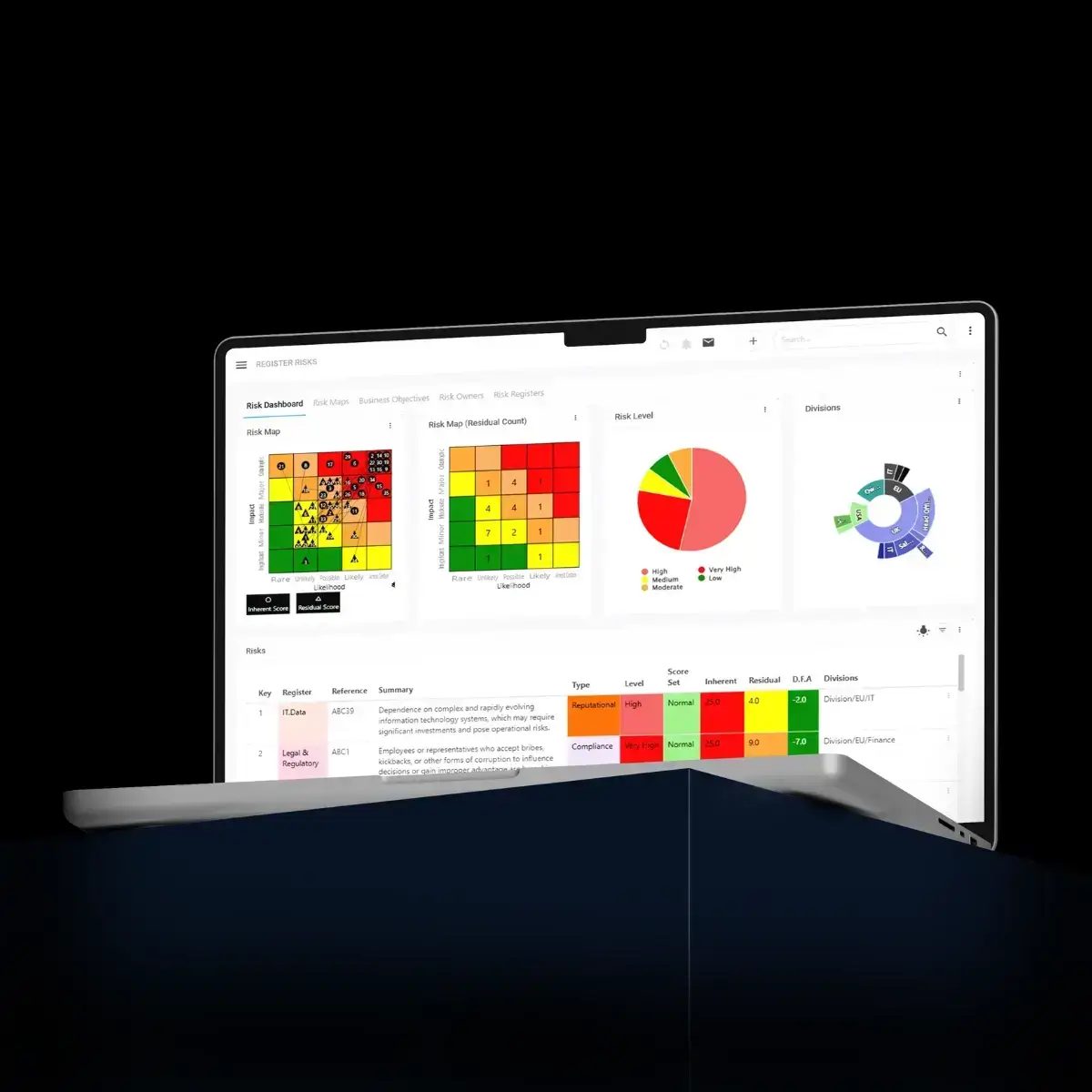
- Produce dashboards and reports for management oversight
Because Symbiant’s modules operate as part of a shared Single Source of Truth, a change recorded in one area can provide useful context elsewhere. An incident, failed control, overdue action or audit finding does not have to remain isolated from the risk assessment it may affect.
How Symbiant AI supports risk and control analysis
Symbiant AI assists users in examining the relationships between risks, controls and residual exposure while keeping human judgement at the centre of the process.
It can help organisations:
- Generate structured risk information from business objectives
- Identify potential causes and consequences
- Suggest relevant controls and mitigation measures
- Analyse whether controls adequately address a risk
- Highlight possible gaps or duplication
- Identify potentially ineffective controls
- Support inherent and residual risk assessments
- Recommend changes to residual risk where control performance warrants review
- Connect incidents, impacted resources, actions and related risks
This helps risk teams work with greater consistency while retaining oversight of the final assessment and treatment decision.
Turn risk scores into meaningful decisions
Inherent and residual risk should provide more than two ratings on a risk register. Together, they help organisations understand their original exposure, the contribution made by controls and the level of risk that remains.
The gap between them can be a valuable indicator—but only when it is supported by consistent scoring, credible control assessments and connected information.
Symbiant gives organisations the structure needed to manage these relationships in one configurable GRC platform, helping risk teams move beyond isolated assessments and build a clearer, evidence-based view of risk and control effectiveness.
Book a personalised demonstration to see how Symbiant can connect your risks, controls, incidents and actions within one integrated GRC environment.

Pricing Disclaimer
* Modules are charged at a standard monthly fee, not on a per-user basis. All users can access each module at any required level. Please note that costs exclude VAT, AI features, and additional modules you may wish to use. User seats are required.