
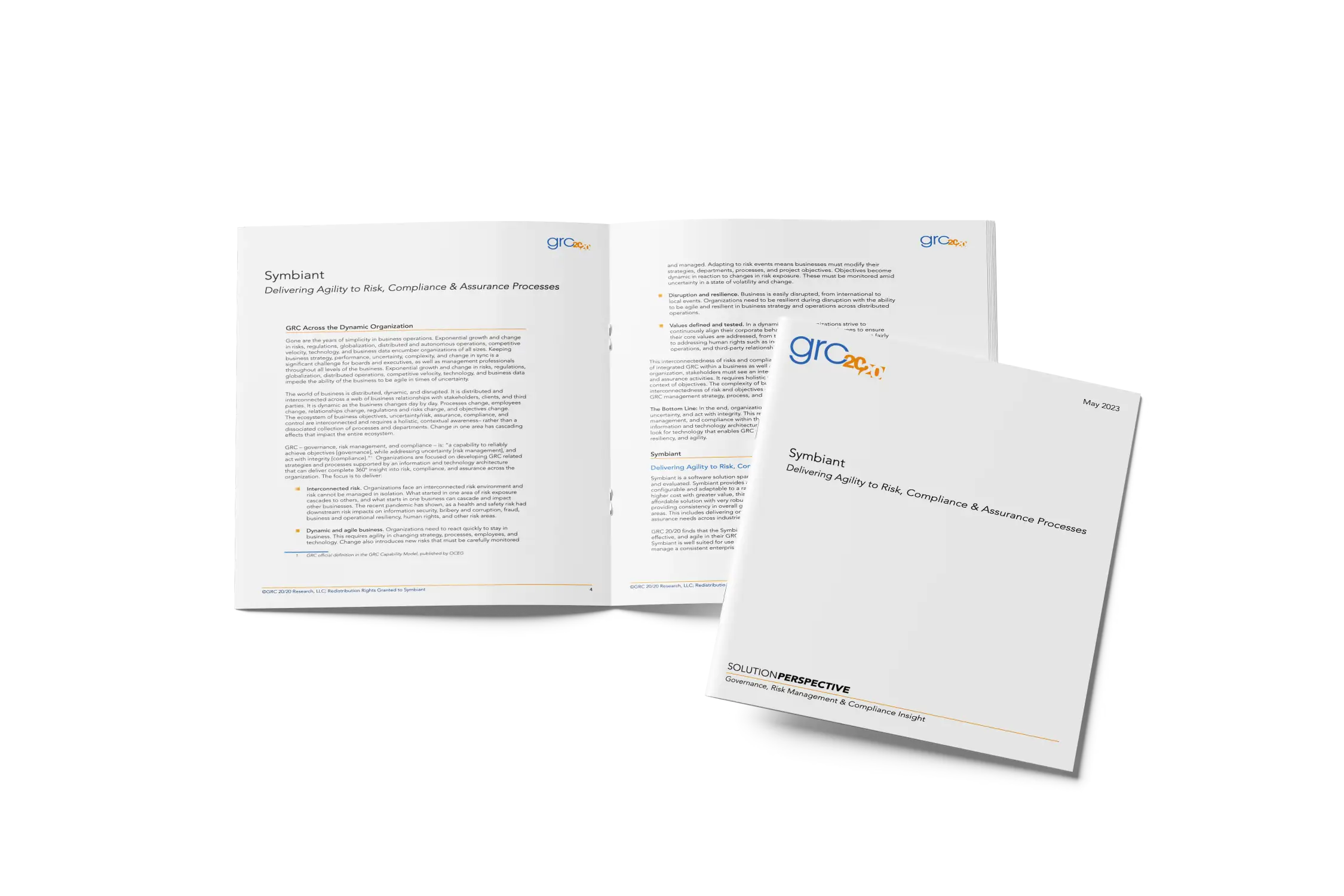
SYMBIANT COMPARISON SERIES
Symbiant vs Optro (formerly AuditBoard):
Which GRC Platform Is Right for Your Organisation?
Symbiant and Optro both provide connected GRC, risk, compliance and audit capabilities — but with different approaches.
Symbiant combines broad, configurable GRC functionality with transparent pricing, rapid implementation, included support and flexible 30-day terms. Optro offers a broad enterprise platform with specialist capabilities across areas such as SOX, cybersecurity and AI governance.
Compare functionality, implementation, reporting, AI, pricing and flexibility below.
Last reviewed: September 2026






Outstanding User Satisfaction with Symbiant's GRC, Risk Management and Audit Software
Independent results from a government-led survey demonstrate a level of trust and satisfaction that is exceptional in the GRC sector, reinforcing Symbiant’s position as a proven, reliable, and governance-ready solution for organisations with serious assurance responsibilities.
450
Survey Participants
95%
Users were satisfied or
better with the system as a whole
97%
Users were satisfied or
better with the support
Symbiant vs Optro
| Area |
 |
 |
|---|---|---|
| Starting Cost | From £3,600 / year (£300/month) | Not publicly disclosed* Custom quotation required |
| Licensing & Pricing Model | Modules determine functionality, while seats determine user access. Every active user can access all purchased modules at any permission level, with no additional cost per module. | Flexible quote-based plans with unlimited stakeholder licences |
| Platform Approach | Single integrated GRC and audit platform | Single connected enterprise GRC platform |
| Founded | Established in 1999 | Established in 2014 Formerly SOXHUB and AuditBoard |
| Typical Fit | Organisations of all sizes | Enterprise and complex GRC programmes |
| Deployment | SaaS | SaaS |
| Contract Terms | 30-day rolling contracts | Subscription terms — contact vendor |
| Support & Training | Included | Available Premium support and professional services also offered |
| Platform Configuration | Yes | Yes |
| Implementation Approach | Configurable ready-made modules | Implementation services and certified implementation partners |
| Published Implementation Timelines | Within a week** | No universal public implementation timeline Depends on products, scope and programme requirements |
| AI Capabilities | Yes — optional AI Assistant | Yes — AI and agentic capabilities |
| API Integration | Yes | Yes |
| Single Sign-On (SSO) | Yes | Yes |
| Reporting Suite | Included and free | Yes |
| Custom Reporting | Custom report builder included and free | Yes — configurable dashboards and reporting |
| Modular Approach | Yes — purchase only the modules required | Multiple GRC products with flexible plans |
*Optro does not currently publish a monetary starting price for its platform on its public pricing page. Optro states that it offers flexible plans aligned to business needs and unlimited stakeholder licences. Actual pricing may vary according to products, core-user requirements, implementation, professional services, integrations, optional capabilities and contractual terms. Buyers should obtain a current quotation directly from Optro.
**Standard Symbiant modules can be fully configured and provisioned within 5 business days, subject to client data readiness and scope requirements.
Take control of your compliance and risk processes
Move beyond spreadsheets and disconnected systems with a flexible platform that centralises your data, tracks actions, and gives you clear visibility across your organisation.
Two Connected GRC Platforms, Different Approaches
Both Symbiant GRC software and Optro recognise the same fundamental challenge: governance, risk, compliance and audit become harder to manage when information is fragmented across separate systems.
Both therefore provide environments where risk, control, compliance, audit and assurance information can be connected.
The difference is not simply whether either platform can support a complex organisation. It is also how each platform has evolved, how easily it can adapt and how much implementation and commercial complexity sits around the technology.
Two Different Paths to GRC
Optro began in 2014 as SOXHUB, a specialist platform designed around SOX compliance. As its capabilities expanded into internal audit and risk management, the company rebranded as AuditBoard in 2017.
Its development has continued considerably since then. AuditBoard was acquired by technology investor Hg in 2024 and, more recently, the company has expanded parts of its platform through strategic acquisitions, including FairNow for AI governance and Midship for AI-native SOX automation. In March 2026, AuditBoard became Optro, reflecting its evolution into a much broader enterprise GRC platform.
Symbiant has taken a different path.
Since 1999, Symbiant has grown organically as an independently developed GRC and audit platform. Every module is developed in-house, without building the product through acquisitions, external investment or acquisition debt.
That distinction has helped Symbiant retain direct control over how the platform is developed, how its modules work together and how new functionality is introduced.
Over more than 25 years, Symbiant has also had the privilege of working with organisations of very different sizes, sectors and levels of GRC maturity — from charities and focused risk teams to banks, government bodies and large regulated organisations.
That breadth of experience has directly shaped the platform.
Rather than developing around one type of organisation and expecting customers to adapt their processes to the software, Symbiant has continually evolved around the different ways organisations actually manage risk, controls, compliance, audit and governance.
The result is a platform that can be extensively configured around an organisation’s requirements while remaining practical to implement, administer and use.
Organisations can begin with the capabilities they need, configure the platform around the way they already work and add further connected governance processes as their requirements develop.
And because development remains in-house, those capabilities have been created as parts of the same underlying platform rather than as separate products that subsequently need to be brought together.
This also helps explain Symbiant’s commercial model.
Growing organically and developing the technology in-house allows Symbiant to focus investment on the platform and its customers while keeping pricing accessible.
The aim is not to offer a reduced version of enterprise GRC at a lower price. It is to provide the flexibility, connectivity and governance capability organisations actually need without adding unnecessary layers of software, implementation or cost.
For buyers, that creates an important distinction:
Enterprise capability does not have to mean enterprise complexity — or enterprise-level cost.
Symbiant GRC: Broad GRC Capability Without Unnecessary Complexity
Symbiant has been developed continuously since 1999 as a single integrated GRC, risk and audit platform.
Risks, controls, audits, incidents, compliance activities, actions, objectives and governance records can share:
- One security and permissions model
- Connected data structures
- Shared workflows and automation
- Integrated dashboards
- Cross-module reporting
- Configurable forms and methodologies
- Common users and organisational structures
Rather than maintaining isolated registers, organisations can connect information across their governance framework.
For example:
Objective → Risk → Control → Incident → Audit → Action → Assurance
A risk can be linked to the objectives it threatens, the controls used to manage it, incidents that indicate changing exposure, relevant KRIs, assurance activity, audit findings, evidence and remediation actions.
That creates a single source of truth (SSOT), a clearer governance picture without requiring teams to reconcile information manually across multiple systems.
And because Symbiant is highly configurable, the organisation does not need to redesign its methodology simply to fit the software.
Optro: Broad GRC Capability with Additional Specialist Focus
Optro is the company previously known as AuditBoard.
Originally founded as SOXHUB in 2014, the platform developed from a strong audit and SOX controls-management heritage before expanding into wider governance, risk and compliance.
Today, there is considerable overlap between the core GRC capabilities available from Optro and Symbiant.
Both can support areas such as:
- Internal and operational audit
- Enterprise risk management
- Controls management
- Regulatory compliance
- Business continuity
- Third-party and due-diligence processes
- Questionnaires and assessments
- Workflow and action management
- Reporting and dashboards
- AI-assisted GRC activities
These capabilities should therefore not automatically be treated as reasons to choose one platform over the other.
The more meaningful differences sit in how those capabilities are delivered, configured, implemented and priced, alongside several areas in which Optro has developed a particularly specialist focus.
Optro places significant emphasis on capabilities such as:
- Advanced SOX controls management
- Autonomous controls testing
- Dedicated AI-governance tooling
- Regulatory intelligence and horizon scanning
- Large-scale cybersecurity and information-security programmes
For organisations where these specialist capabilities sit at the centre of the requirement, they may be important considerations.
For organisations whose needs are centred on connected risk, controls, compliance, audit, incidents, actions, assurance and wider governance, however, Symbiant already provides substantial overlapping capability within a more straightforward modular platform.
The comparison should therefore not be based simply on which vendor has the longest feature list.
It should consider:
Which capabilities do we genuinely need, how easily can they be adapted to our organisation, how quickly can they be implemented and what will the platform cost to operate over time?
The Key Difference
The comparison is not simply:
Symbiant for smaller organisations vs Optro for enterprises.
Symbiant is already used across large, regulated, public-sector and complex organisational environments.
A more useful distinction is the type of infrastructure required to deliver the organisation’s GRC programme.
Optro provides an extensive enterprise ecosystem with specialist capabilities and a supporting professional-services structure.
Symbiant takes a more streamlined approach.
Organisations can implement the GRC capabilities they require, configure them around existing processes and connect additional areas over time without necessarily introducing the same level of implementation, administration or commercial complexity.
For many organisations, that means the question becomes:
Do we need more GRC software, or do we need the right GRC software to work better?
Breadth of Functionality
Symbiant provides a broad range of connected governance, risk, compliance, audit and operational modules within one platform.
Symbiant Modules:
- Risk Registers
- Risk Controls & Policy Management
- Business Objectives
- Risk Incident Reporter
- Risk Workshops
- Compliance Monitoring
- Action Tracker
- Records of Processing & Lawful Basis (ROPA)
- Data Protection Impact Assessment (DPIA)
- Questionnaires
- Complaints Manager
- Due Diligence
- Service Desk
- SHE (Security, Health, Safety & Environmental)
- Key Risk Indicators Software (KRI)
- Audit Universe
- Audit Working Papers
- Audit Action Tracker
- ISQM
- Document Management
- Business Continuity Planning
- AI Assistant
Because these modules operate within the same platform, information can be connected across functions without requiring separate systems for each governance process.
Audit Heritage vs Wider Operational Governance
Optro’s history remains relevant when comparing the platforms.
The company began as SOXHUB in 2014 before expanding from its original SOX focus into audit, risk and wider GRC.
Its audit and SOX heritage remains an important part of the platform.
Symbiant developed from a broader governance, risk and audit perspective and offers modules extending into operational governance areas alongside conventional GRC.
That distinction can influence the buying decision.
An organisation looking specifically for highly specialised SOX control assurance or autonomous controls testing may prioritise different capabilities from one seeking to connect:
Objectives → Risks → Controls → Incidents → Compliance → Audit → Actions → Assurance
across the organisation.
For the latter, Symbiant’s breadth and connected architecture can provide a strong alternative without requiring organisations to buy into a much larger enterprise programme.
Ease of Adoption
GRC software only creates value when people actually use it.
This is particularly important when responsibility extends beyond a central risk, compliance or internal audit team.
Symbiant GRC
Symbiant can present different users with the information and activities relevant to their responsibilities.
Someone outside the central GRC function may only need to:
- Update an action
- Complete an assessment
- Report an incident
- Review a control
- Provide audit evidence
- Update a risk
- Record a complaint
They do not need to understand the entire GRC system to complete those tasks.
Granular permissions determine what each user can see and what they are permitted to change.
This makes it easier to distribute ownership across first, second and third-line teams while maintaining governance and control.
Ready-made modules can then be configured around the organisation’s existing terminology, processes and methodologies.
Standard configuration, support and training are included.
Why This Matters
A technically powerful platform can still struggle if users find it difficult to navigate or require extensive training before contributing.
Symbiant’s model is designed to reduce that friction.
The objective is not to turn everyone into a GRC-system expert.
It is to make it easier for people throughout the organisation to complete the governance activities for which they are responsible.
Optro
Optro also places considerable emphasis on usability, no-code configuration and customer enablement.
Its implementation model includes dedicated implementation services, customer-success services, professional services, technical account management and implementation partners.
That infrastructure can be valuable for organisations undertaking complex enterprise deployments.
It does, however, represent a different operating model from configuring proven modules and beginning to use them relatively quickly.
A Symbiant Customer Perspective
“Have a system which was simple/easy to use & well controlled, so that we could roll this out to our 1OD teams. Cost effective, had capability to monitor & report on risk mitigation plans, ability to connect different parts of the risk framework – risks, controls, incidents and action tracking. One tool that could be used by multiple 2LOD risk & compliance teams”
— Camilla Owen, Head of Non-Financial Risk (1st Line of Defence), ALD Automotive
Implementation: How Much Project Do You Need?
Implementation can be one of the most important differences between GRC platforms.
The question is not only:
What can the software do?
It is also:
How much time, consultancy, internal resource and platform administration will be required before people can actually use it?
Symbiant GRC Software
Symbiant is designed for rapid, relatively low-complexity implementation.
Customers can start with ready-made modules, configure them around existing processes and expand into additional areas of GRC over time.
Configuration, support and training for standard deployments are included.
Because the modules already operate within one integrated environment, an organisation does not necessarily need to design an entire GRC architecture before implementing its first use case.
Start with risk.
Add controls.
Connect incidents.
Introduce audit.
Extend into compliance, business continuity, objectives or other governance processes when the organisation is ready.
Standard Symbiant modules can be configured and provisioned within five business days, subject to scope and client data readiness.
For organisations seeking to improve GRC quickly, that can significantly reduce the gap between selecting a platform and beginning to generate value from it.
Optro
Optro supports a more structured enterprise implementation model through implementation specialists, professional services and certified implementation partners.
These services can support configuration, integrations, training and wider platform architecture.
For particularly large or complex transformation programmes, this infrastructure may be useful.
The trade-off is that implementation can become a more substantial programme requiring additional planning, services and internal resources.
For context, an Optro customer case study published in September 2026 describes UK bank Shawbrook following a phased implementation, with its first module going live approximately three months after contract signing.
That represents one customer implementation rather than a universal Optro timeline.
It does, however, illustrate the difference in approach.
Symbiant is designed to get organisations using GRC software quickly. Optro can support a more extensive enterprise implementation programme.
A Symbiant Customer Perspective
”As a first-time user of Symbiant, I’ve been really impressed with how intuitive and easy the system is to navigate. The structure of the modules and overall user experience felt very clear and accessible, even without prior hands-on use, which is a strong advantage from an onboarding perspective. Based on my previous experience with other market-leading platforms, I would say Symbiant compares very favourably. It offers the functionality you would expect from established solutions, but in a way that feels more streamlined and user-friendly. The balance between capability and ease of use is particularly notable. From what I’ve seen so far, the platform appears to offer strong value for money, especially when compared with more complex and higher-cost solutions. It demonstrates that a well-designed, intuitive system can deliver both effectiveness and efficiency without unnecessary complexity. I’m genuinely excited to see how the platform continues to develop. It’s clear how the intuitive design and accessible structure would support me in my role by simplifying oversight, enhancing usability, and improving efficiency in managing risk and compliance.”
— Lisa Rankin, Compliance Manager, The Stafford Building Society
Reporting and Dashboards
Reporting should not simply reproduce individual registers.
The greater value comes from understanding how information connects.
Symbiant Includes
Standard Reporting Suite
Built-in reporting is available across risk, compliance, audit and governance processes.
Custom Report Builder
Organisations can create and maintain their own reports without requiring software development.
Cross-Module Reporting
Because information can be connected across the platform, reporting can follow relationships such as:
Risk → Control → Incident → Audit Finding → Action
rather than reporting on each process independently.
This provides a clearer view of exposure, assurance and remediation.
Integrated Dashboards
Users, managers and boards can be presented with information relevant to their roles and responsibilities.
Dashboards can help turn operational GRC data into a more useful management view across risks, controls, actions, incidents and assurance.
Reporting Without Additional Complexity
Standard reporting and unlimited report generation are included within the platform.
This means reporting capability does not need to become a separate development or professional-services project simply because an organisation wants more visibility from its GRC data.
Optro
Optro also provides configurable enterprise reporting, dashboards and analytics across its platform.
For organisations running particularly extensive audit, SOX, regulatory or cybersecurity programmes, these enterprise analytics capabilities may form an important part of the evaluation.
The practical comparison is therefore not whether both platforms provide reporting.
They do.
The better procurement question is:
What reporting and assurance visibility does the organisation actually require, and what level of platform and implementation complexity is necessary to deliver it?
Configuration and Flexibility
Your GRC methodology should not have to change simply because you bought GRC software.
Symbiant Can Be Configured Around
- Forms
- Fields
- Terminology
- Risk-scoring methodologies
- Organisational structures
- Roles
- Permissions
- Workflows
- Approval processes
- Notifications
- Reminders
- Escalations
- Questionnaires
- Assessments
- Dashboards
- Reports
Symbiant also supports API connectivity, SSO and configurable data imports.
This provides organisations with significant scope to adapt the platform around established governance frameworks and ways of working.
And because the modules share the same environment, many relationships between risks, controls, audits, incidents, actions and compliance activities can be created without integrating separate applications.
The result is flexibility without necessarily creating additional system architecture.
Optro
Optro similarly promotes no-code configuration and enterprise integrations, enabling organisations to adapt workflows and reporting around their programmes.
For sophisticated enterprise deployments, professional services and implementation partners can also support wider platform architecture and configuration.
The distinction therefore is not simply:
Can it be configured?
Both platforms offer flexibility.
A more useful question is:
How much configuration, consultancy and ongoing platform administration will be required to achieve what our organisation needs?
A Symbiant Customer Perspective
”We have had nothing but good experiences and we have a very strong relationship with the team at Symbiant. We continue to use Symbiant for a few reasons. 1. Cost – I don’t know of a GRC solution as broad as ours for a similar price. 2. Customisation – we are able to make changes to have the system look, feel, and run to our requirements with ease. 3. Support – the team at Symbiant Support are friendly, knowledgeable, understanding, and quick to respond.”
— Ben Moulds, Head of Health & Safety, Assurance and Compliance, Whistl
Workflows and Approvals
Complex governance processes often require more than a simple notification or task assignment.
Symbiant supports configurable multi-stage workflows that can reflect an organisation’s existing approval structures.
Stages can be assigned to authorised users or roles and can include:
- Review
- Approval
- Rejection
- Challenge
- Rework
- Resubmission
- Notifications
- Reminders
- Escalations
The platform retains an audit trail of activity and decisions throughout the process.
Combined with granular permissions, this allows organisations to create controlled processes without giving every participant unrestricted access to the underlying data.
This is particularly important in large organisations where risk, compliance and assurance activity often involves multiple lines of defence, management levels and approval stages.
Support and Training
Software capability is only one part of the cost and effort involved in operating a GRC platform.
Implementation support, configuration, training and ongoing assistance also matter.
Symbiant GRC
Standard support and training are included.
Customers have access to the team responsible for developing and supporting the platform, providing continuity from implementation through ongoing use.
The commercial model is deliberately straightforward:
Software + configuration + training + support
rather than automatically treating each of those components as a separate professional-services decision.
For organisations without a large internal GRC technology function, this can reduce both administration and uncertainty around the ongoing cost of operating the system.
Optro
Optro offers a substantial Success and Services ecosystem, including:
- Implementation
- Customer success
- Professional services
- Training and support
- Technical account management
- Partner services
For organisations running significant enterprise transformation programmes, access to this wider services infrastructure may be valuable.
Other organisations should consider how much of that infrastructure they genuinely require to achieve their intended GRC outcomes.
Enterprise Capability Doesn’t Have to Mean Enterprise Complexity
Large organisations have complex governance requirements.
That does not automatically mean the software used to manage those requirements has to be difficult to implement or administer.
Most organisations ultimately need to:
- Understand their risks
- Connect risks with strategic objectives
- Define and assess controls
- Collect evidence
- Monitor compliance
- Manage incidents
- Perform audits
- Track remediation
- Escalate exceptions
- Maintain accountability
- Provide reliable management and board reporting
Those requirements can exist in an organisation with hundreds or tens of thousands of employees.
The important question is whether the GRC platform makes those processes easier to govern or simply adds another layer of complexity around them.
Symbiant is designed to support sophisticated governance requirements while keeping the underlying platform configurable and accessible.
That combination — capability without unnecessary complexity — is one of the most important distinctions between the two approaches.
Which Organisations Should Consider Symbiant?
Symbiant can support organisations of different sizes and levels of GRC maturity.
It may be particularly attractive to:
- Enterprise organisations wanting a more proportionate GRC platform
- Large organisations seeking to reduce GRC-system complexity
- Regulated organisations
- UK public-sector bodies
- Local authorities
- Financial-services organisations
- Healthcare organisations
- Housing associations
- Charities and NGOs
- Universities and education providers
- Internal audit functions
- Risk and compliance teams
- Organisations combining multiple governance functions
- Organisations replacing spreadsheets or disconnected systems
- Teams seeking faster implementation
- Organisations wanting flexible contracts
- Organisations wanting greater pricing transparency
- Teams without large internal GRC-system administration functions
Importantly, the distinction is not organisation size.
The more relevant factors are the capabilities required, the complexity of the implementation the organisation is prepared to support and the commercial model it prefers.
When Might Optro Be Considered?
Optro may be particularly relevant where the procurement requirement centres on a smaller number of specialist capabilities, including:
- Mature and extensive SOX programmes
- Autonomous controls testing
- Dedicated enterprise AI-governance tooling
- Regulatory intelligence and horizon scanning
- Complex cybersecurity and information-security programmes
- Extensive enterprise integration programmes
- Large professional-services-supported GRC transformations
That is a more meaningful distinction than describing Optro’s general risk, audit, controls or compliance functionality as inherently more enterprise.
Symbiant also supports these core GRC disciplines.
The decision therefore comes down to the precise functionality required and the implementation, administration and commercial model the organisation wants around it.
Why Organisations May Consider Moving from Optro or AuditBoard to Symbiant GRC
An organisation reviewing an existing AuditBoard or Optro deployment may not necessarily be looking for less capable software.
It may simply want a different operating model.
Reasons to consider Symbiant may include:
- Lower and more predictable GRC software costs capable of supporting your organisations specific requirements
- Transparent pricing
- Shorter contractual commitments – Flexible 30-day contracts
- A lighter administration model
- Faster implementation
- Configuration included
- Support and training included
- Flexible workflows and approval processes
- Custom reporting without software development
- Connected risk, audit, compliance, incidents and actions
- Wider operational-governance capabilities
- Fewer dependencies on professional services
- The ability to introduce modules incrementally
- Direct access to the team supporting the software
- Optional AI Assistant
For organisations that do not require highly specialist capabilities such as autonomous controls testing, Symbiant can provide extensive overlapping GRC capability without requiring the same enterprise platform model.
Disclaimer
This comparison is based on publicly available information published by Symbiant, Optro and identified independent sources available in September 2026.
Optro was formerly known as AuditBoard. Historical references to AuditBoard relate to the same company and platform lineage.
Product capabilities, licensing, pricing and implementation arrangements may change. Optro does not currently publish standard monetary pricing on its public pricing page; organisations should obtain a current quotation directly from Optro.
Third-party trademarks and brand names are used solely for identification and comparison. Symbiant is not affiliated with or endorsed by Optro.
See How Symbiant GRC Software Fits Your Organisation
Every organisation has different risks, governance structures, assurance requirements and reporting needs.
A meaningful GRC comparison should therefore start with what your teams actually need to achieve.
See how Symbiant can connect:
Objectives → Risks → Controls → Evidence → Incidents → Audit → Actions → Assurance
within one configurable platform.
We’ll show you how Symbiant can work around your existing methodology, explain implementation and provide clear pricing based on the modules you genuinely require.
Enterprise-level GRC capability, without unnecessary cost, complexity or lengthy contractual commitments.

Symbiant vs Optro (Auditboard) : Frequently Asked Questions
Is Symbiant GRC an alternative to Optro or AuditBoard?
What is the main difference between Symbiant and Optro?
Both provide connected GRC capabilities, but their commercial and implementation approaches differ.
Optro increasingly targets sophisticated enterprise GRC programmes and offers specialist capabilities including autonomous controls testing, AI governance and regulatory intelligence.
Symbiant GRC focuses on providing highly configurable, connected GRC and audit modules through a comparatively straightforward modular model.
It also extends into operational governance areas including complaints, DPIAs, ROPA, health and safety, service desk, document management, business objectives and other processes.
Which platform is easier to implement?
Implementation requirements depend on scope.
Symbiant’s standard modules can be configured and provisioned within five business days where scope and data are ready, and standard configuration, support and training are included.
Optro supports enterprise implementations through its implementation teams, professional services and certified partners. Larger multi-product deployments may therefore involve a more substantial implementation programme.
Is Symbiant suitable for large organisations?
Yes.
Symbiant GRC supports organisations ranging from smaller teams to large, complex, regulated and public-sector environments, including organisations such as the UK Health Security Agency (UKHSA).
The distinction between Symbiant and Optro is therefore not organisation size or enterprise capability.
Both platforms can support large organisations.
The difference is in the approach.
Symbiant gives large organisations extensive connected GRC, audit, risk, compliance and governance capabilities within a highly configurable modular platform, without requiring the commercial complexity, lengthy contracts or services-heavy implementation model often associated with enterprise GRC software.
Large organisations can deploy the modules they need, configure them around their own structures and methodologies, support complex reporting requirements and expand the platform over time.
Optro may be particularly attractive where an organisation specifically requires capabilities such as highly specialised SOX management, autonomous controls testing or dedicated enterprise AI-governance tooling.
Symbiant, however, should not be positioned as the option for organisations with simpler requirements.
It is an enterprise-capable GRC platform with a simpler way to buy, implement and expand it.
Can Symbiant Handle Complex Approval Workflows?
Yes.
Symbiant supports configurable multi-stage workflows with authorised users and roles at different stages.
Processes can include approval, rejection, challenge, rework and resubmission, together with automated notifications, reminders and escalations.
Activity can be retained within the audit trail, while granular permissions govern what individual users can access.
Compare Symbiant with Other GRC Platforms
Explore more side-by-side comparisons to find the right GRC platform for your organisation.

Symbiant vs MetricStream
Explore how Symbiant compares with MetricStream for organisations seeking powerful, connected GRC with greater flexibility and a simpler route to adoption.

Symbiant vs LogicGate
Discover how Symbiant compares with LogicGate and why its ready-made, connected GRC modules may offer a more straightforward alternative.

Symbiant vs Protecht
Explore how Symbiant compares with Protecht across connected functionality, implementation, flexibility and commercial terms.

Symbiant vs Archer
Discover why Symbiant may be a better-fit Archer alternative for organisations seeking enterprise-level GRC capability without enterprise complexity.

Symbiant vs Ideagen
Explore how Symbiant’s single integrated platform compares with Ideagen’s broader portfolio of risk, audit and compliance solutions.
Symbiant vs ServiceNow
Discover how Symbiant compares with ServiceNow and why its purpose-built, connected GRC platform may offer a simpler and more cost-effective alternative.